On 16 September 2025, the Paris auction house Morand & Morand will hold a sale dedicated to Modern Slavic Art. Taking place at 2 p.m., with registration and bidding available via Drouot.com, the auction presents a significant group of works preserved by the descendants of Grégoire Halevy, known as Grégoire Raïssoff (d. Paris, 1973), an opera tenor whose career and personal ties linked him closely to the Russian repertoire.
Founded in 1956 and based in the 15th arrondissement, Morand & Morand has long been active in both voluntary and judicial sales, with notable auctions including the Auguste Rodin collection from the Dupin estate, the Germaine Richier estate, and the collections of Louis Blériot and Jacqueline and Marcel Pagnol. This September sale of Modern Slavic Art highlights the role of private collections in preserving overlooked chapters of cultural history.
Much of the auction is indeed devoted to the rediscovered late scenographic work of Konstantin Korovine, one of Russia’s foremost stage designers. Mussorgsky’s Boris Godunov, first staged in 1874 and later mounted at the Bolshoi in 1908 with Korovine’s sets and costumes, held a central place in the Russian operatic repertoire. At that performance, the great bass Fyodor Chaliapin appeared in the title role, with Raïssoff singing Prince Shuisky. In 1934, Raïssoff undertook a Paris revival of Boris Godunov and commissioned Korovine, then living in France, to produce new designs. The artist created more than 1,500 square metres of painted stage sets and over two hundred costumes, enriched with hand-painted motifs, silks, velvets, and brocades, often highlighted with gold and silver powder.
That same year, Raïssoff also staged Rimsky-Korsakov’s Golden Cockerel, first produced in Moscow in 1909. Korovine adapted his earlier designs for this revival, creating richly ornamented scenography inspired by Russian traditions. While some costumes were auctioned in a 1978 Paris sale, the surviving stage designs and works remain in the Raïssoff family and reveal a late, little-known phase of Korovine’s career.
Alongside Korovine’s designs, the auction features works by Russian and Ukrainian artists active in Paris during the same period: Emmanuel Mané Katz, Piotr Nilouss, and Oscar Miestchaninoff. Together, the lots reflect the breadth of émigré creativity in Paris during the early twentieth century.
Here are six highlights of the sale:
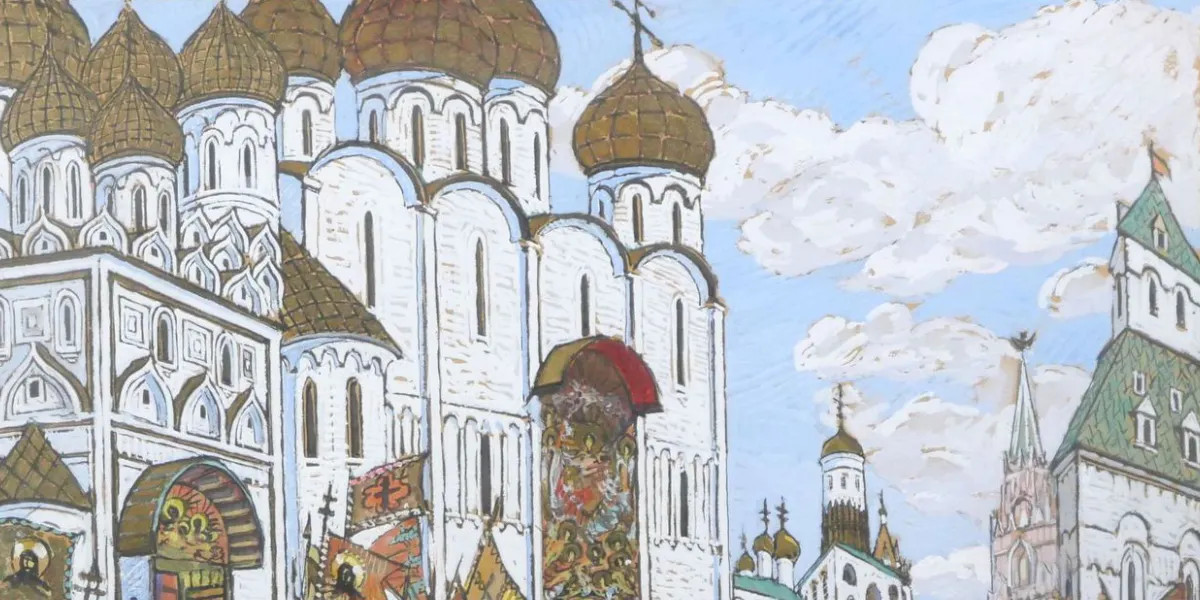
Konstantin Korovine, Stage Design for the Prologue of Boris Godunov (1934)
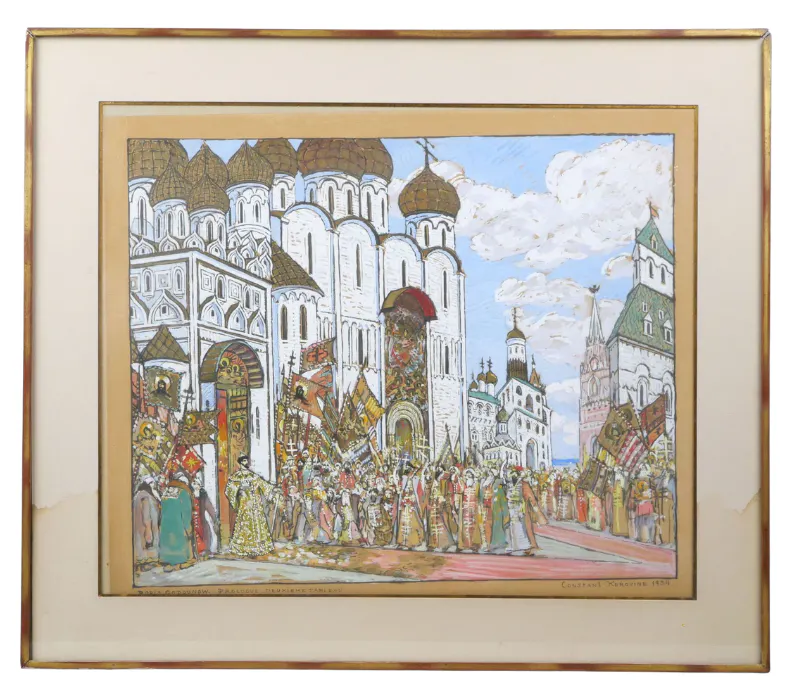
This gouache, watercolor, and ink drawing represents the second tableau of the prologue, titled “The Coronation.” Signed and dated 1934, it was part of Korovine’s scenographic work for the Paris production in which Raïssoff performed. Preserved by Raïssoff’s descendants, it offers a rare view of Korovine’s late stage designs executed during his years in France. The sheet measures 42 by 51 cm, or 55 by 64 cm framed.
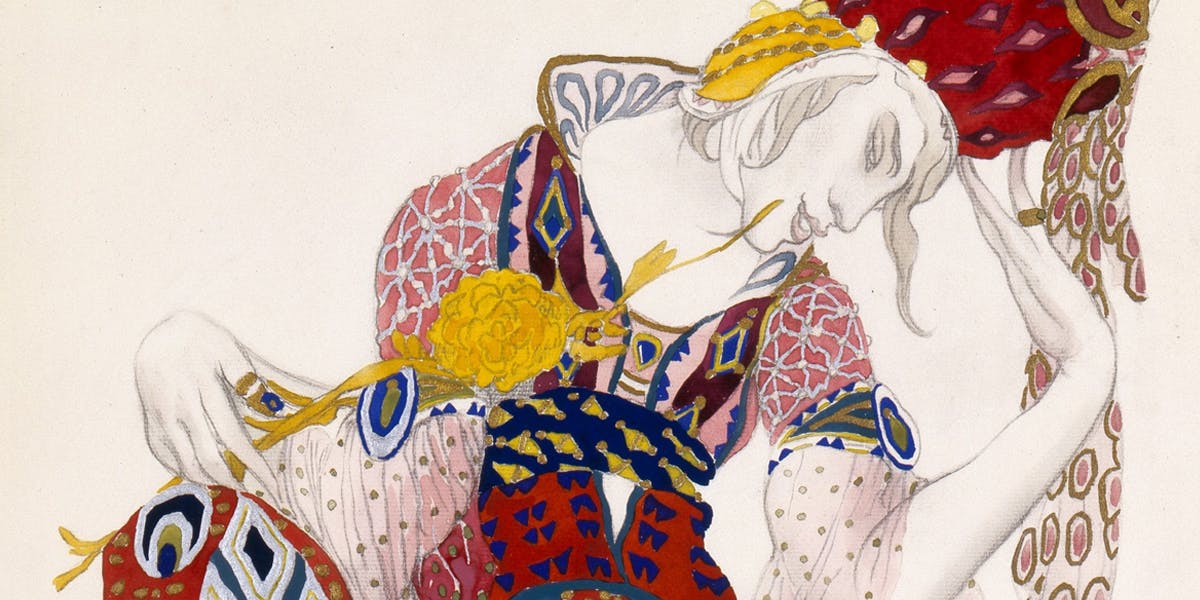
Konstantin Korovine, Costume Design for Boris Godunov (1934)
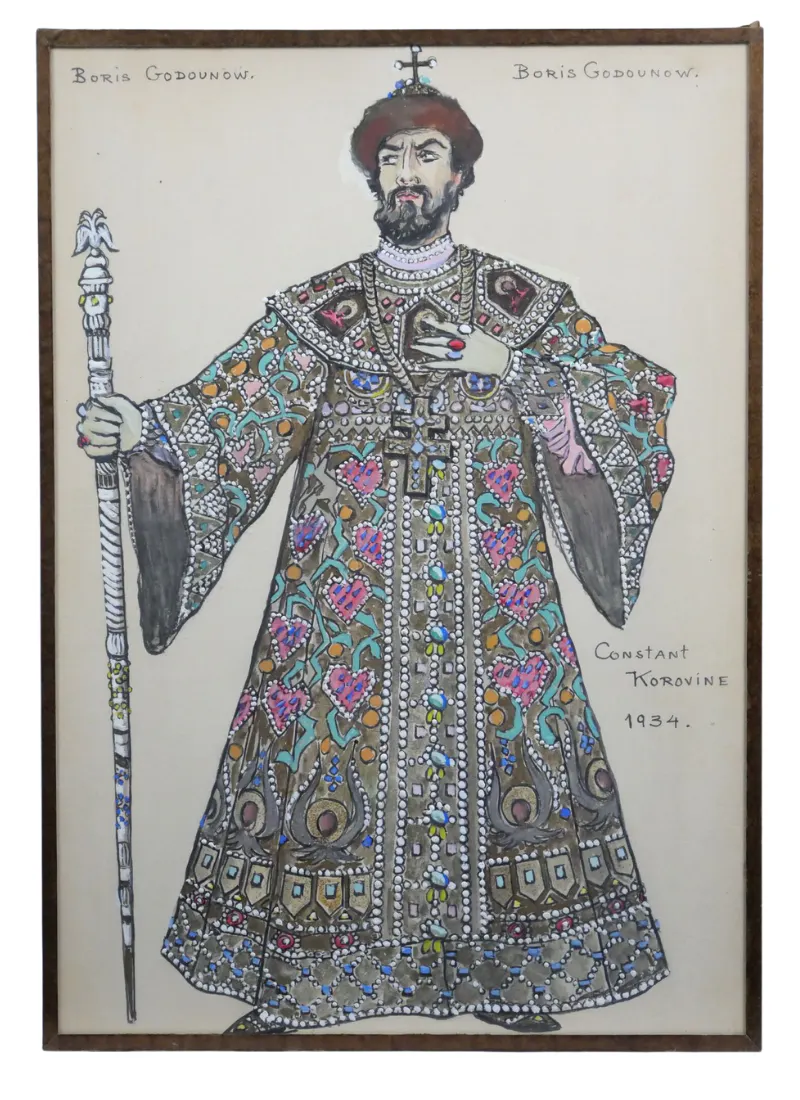
In this watercolor and gouache, Korovine depicts Boris Godunov in the likeness of Fyodor Chaliapin, recalling earlier representations by Alexandre Golovine. The design, titled “Boris Godounow / Boris Godounow,” measures 40 by 28 cm and is signed and dated by Korovine. It is preserved in the Raïssoff family and forms part of the 1934 revival ensemble, showing Korovine’s attention to theatrical grandeur and historical detail.
Konstantin Korovine, Preparatory Design for the Programme of The Golden Cockerel
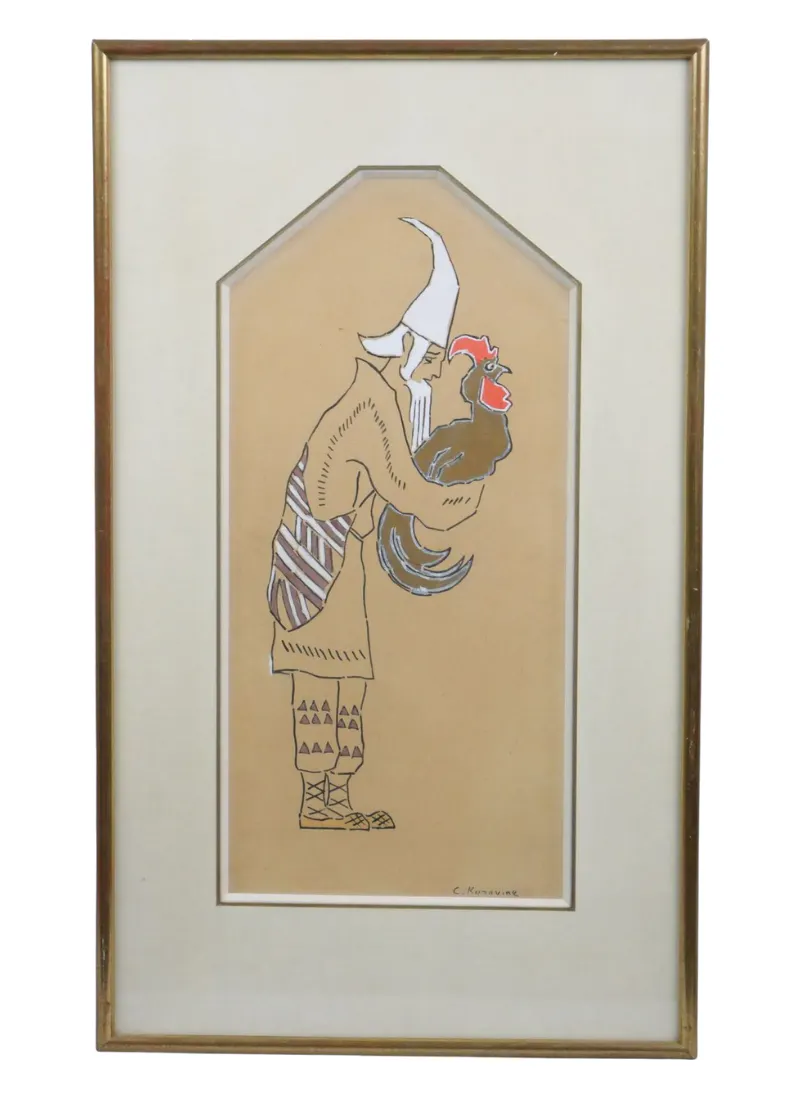
This ink and gouache sheet relates to Rimsky-Korsakov’s opera The Golden Cockerel, adapted from Pushkin. Accompanied by a coloured engraving, the programme cover, and a contemporary review from L’Éventail, the design demonstrates Korovine’s adaptation of his 1909 Moscow work for the 1934 Paris revival. It highlights his commitment to opera and ballet late in his career.
Oscar Miestchaninoff, Head of a Woman
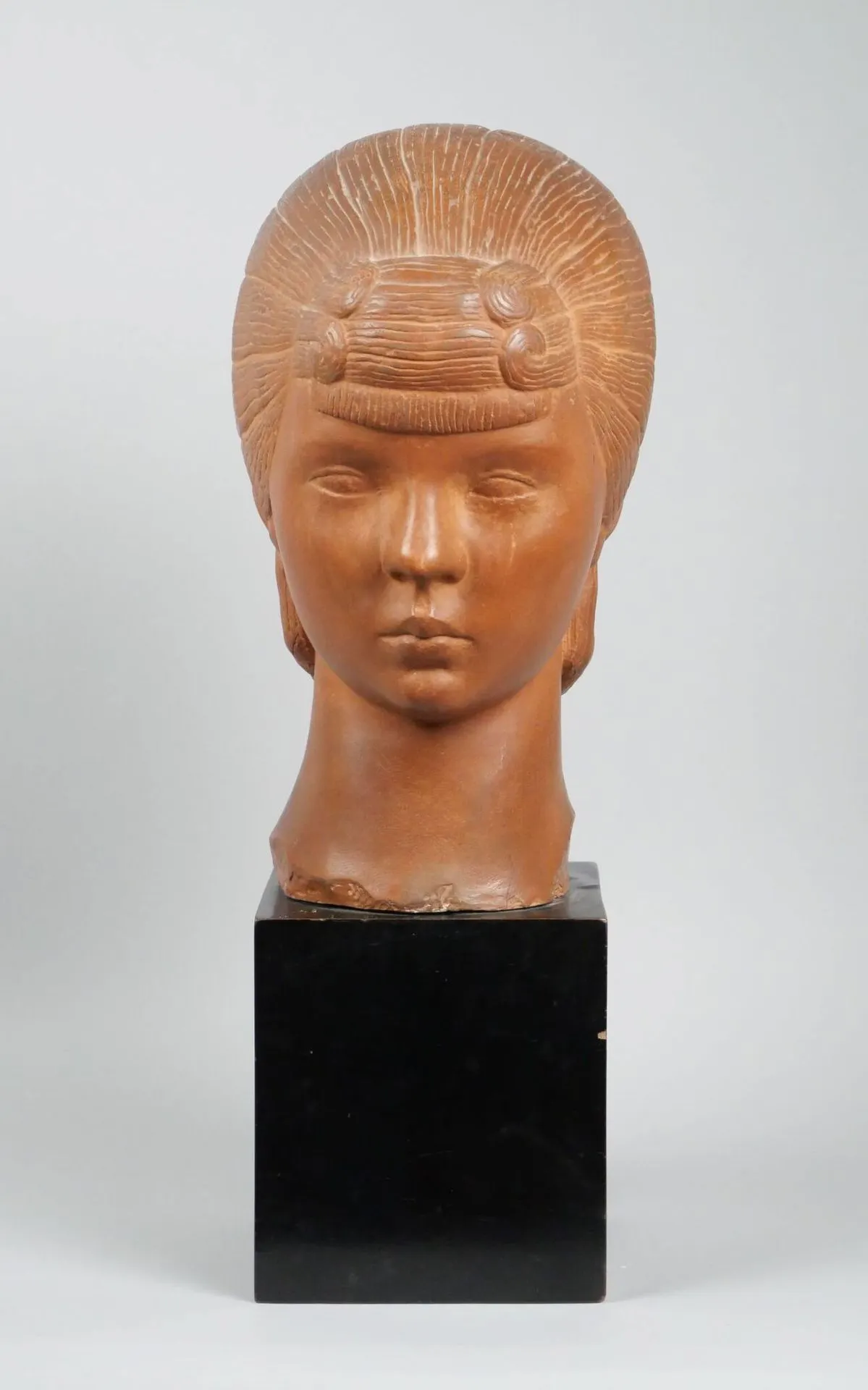
This terracotta sculpture, signed on the reverse, stands 49 cm high with its base. Preserved in the Raïssoff family, it shows the artist’s use of simplified forms and direct modelling. Miestchaninoff, active in Paris and associated with the avant-garde, worked closely with Matisse. Examples of his work are rarely offered on the market.
Emmanuel Mané Katz, Ship in a Storm (1936)
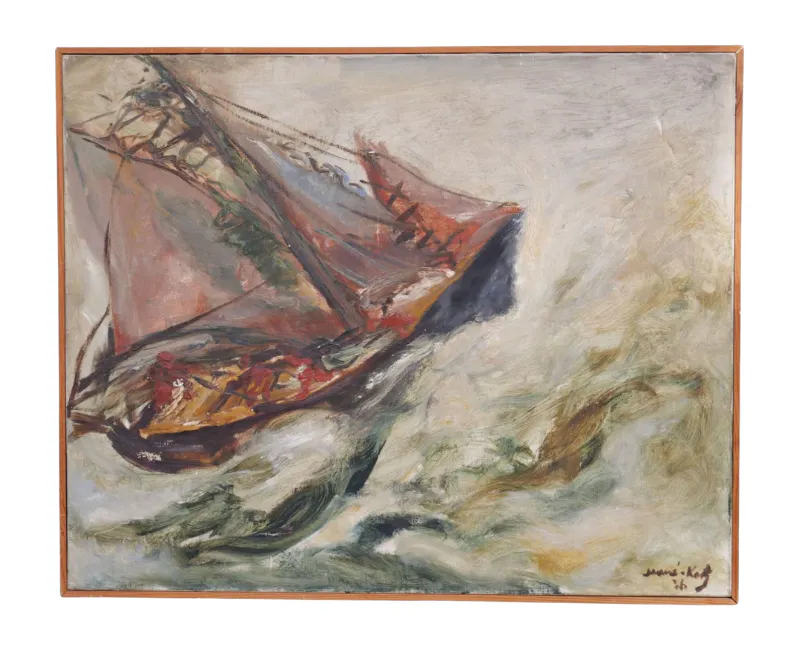
Oil on canvas, signed and dated lower right, this painting measures 80 by 100 cm (82 by 102 cm framed). Preserved in the Raïssoff collection, it depicts a vessel in a turbulent sea. While Mané Katz often painted Jewish themes, this work focuses on a dramatic maritime scene executed with vigorous brushwork.
Piotr Nilouss, The Lunch (1930)
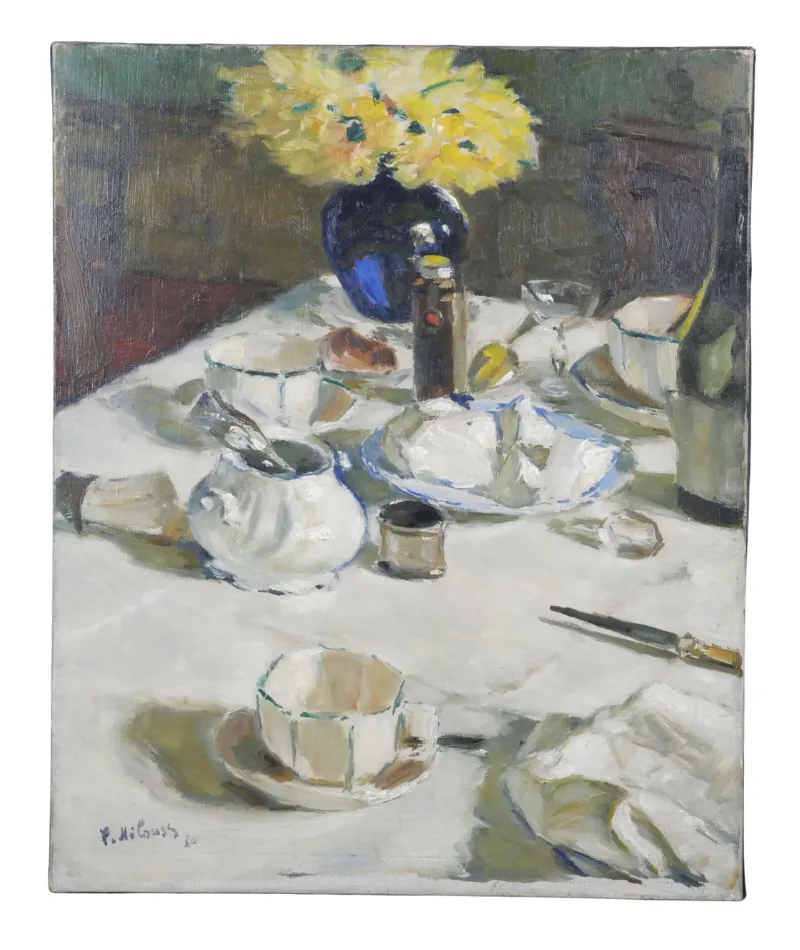
This oil on canvas still life, signed and dated 1930, reflects the refinement of Piotr Nilouss, a Russian painter trained at the Academy of Fine Arts in Saint Petersburg who later settled in Paris.
The sale of Modern Slavic Art will take place on Tuesday, 16 September 2025, at 2 p.m. Registration and bidding are available via Drouot.com, with viewing by appointment.