We look at four combinations of paintings and poems that share themes, moods, and visual resonance.
The Vampire by Charles Baudelaire and The Vampire by Edvard Munch

Edvard Munch’s painting, with its dark tones, pairs strikingly with Baudelaire’s unsettling poem. The figure of the vampire — her long red hair coiling around a passive, lifeless man — seems to represent the draining power of desire or obsession.
Toi qui, comme un coup de couteau, / Dans mon cœur plaintif es entrée. (You who, like a knife thrust, have entered my sorrowful heart.)
These lines from Baudelaire’s The Vampire are often cited for their emotional and visual impact. The pain they describe isn’t physical but deeply emotional. Both the painting and the poem evoke a world of seduction and destruction, where attraction and danger blur, and love becomes something consuming, even fatal.
See also: Edvard Munch: The Colors of the Soul
The Lady of Shalott by Alfred Lord Tennyson and The Lady of Shalott by John William Waterhouse

The Lady of Shalott by Alfred Lord Tennyson is one of the most iconic poems in English literature, inspired by a tragic tale from the Arthurian legends. The protagonist is a young woman who lives alone in a tower on the island of Shalott, along the river that leads to Camelot. Because of a curse, she can only observe the world through a mirror that reflects what happens outside. She spends her days weaving a tapestry that captures these scenes.
One day, she sees Lancelot, one of the knights of the Round Table, through the mirror. Captivated, she turns to look at him directly through the window, breaking the rules of the curse. This decision seals her fate. She climbs into a boat, writes her name on it, and lets the river carry her to Camelot. Lancelot later finds her lifeless body.
In 1888, John William Waterhouse painted a scene from this story, capturing the most dramatic moment: the Lady of Shalott setting out in her boat. Dressed in white, her expression is solemn. Her lips are slightly parted, perhaps as if praying or singing to steady herself. The composition and mood reflect the tension between longing for freedom and the constraints placed upon her.
Waterhouse’s painting feels almost like a visual poem — quiet, lyrical, and full of atmosphere. His brushstrokes evoke the same bittersweet tone as Tennyson’s verses, portraying the cost of stepping beyond one’s bounds in search of something more.
Want articles like this straight to your inbox? Subscribe our free newsletter!
The Raven by Edgar Allan Poe and The Nightmare by Henry Fuseli

Fuseli's The Nightmare (1781) draws us into a world dominated by fear and the surreal. A woman lies sprawled across a bed while a strange creature perches on her chest, and the ghostly head of a horse emerges from the shadows behind her. The painting is famous for its unsettling imagery, suggesting both supernatural presence and psychological disturbance.
This sense of eerie tension is echoed in Poe’s The Raven. In the poem, a man mourning the loss of his beloved is visited by a mysterious raven who speaks only one word: “Nevermore.” The bird’s repeated response becomes a torment, a symbol of grief that won’t subside.
Both the poem and the painting evoke a mood of dread and emotional paralysis. Fuseli’s creature and Poe’s raven are different forms of the same thing: an unwelcome, oppressive presence that settles in and refuses to leave. Together, they explore fear, not as spectacle, but as something deeply personal and haunting.
See also: The 10 Scariest Paintings in Art History
To Autumn by John Keats and Avenue of the Poplars in Autumn by Vincent van Gogh
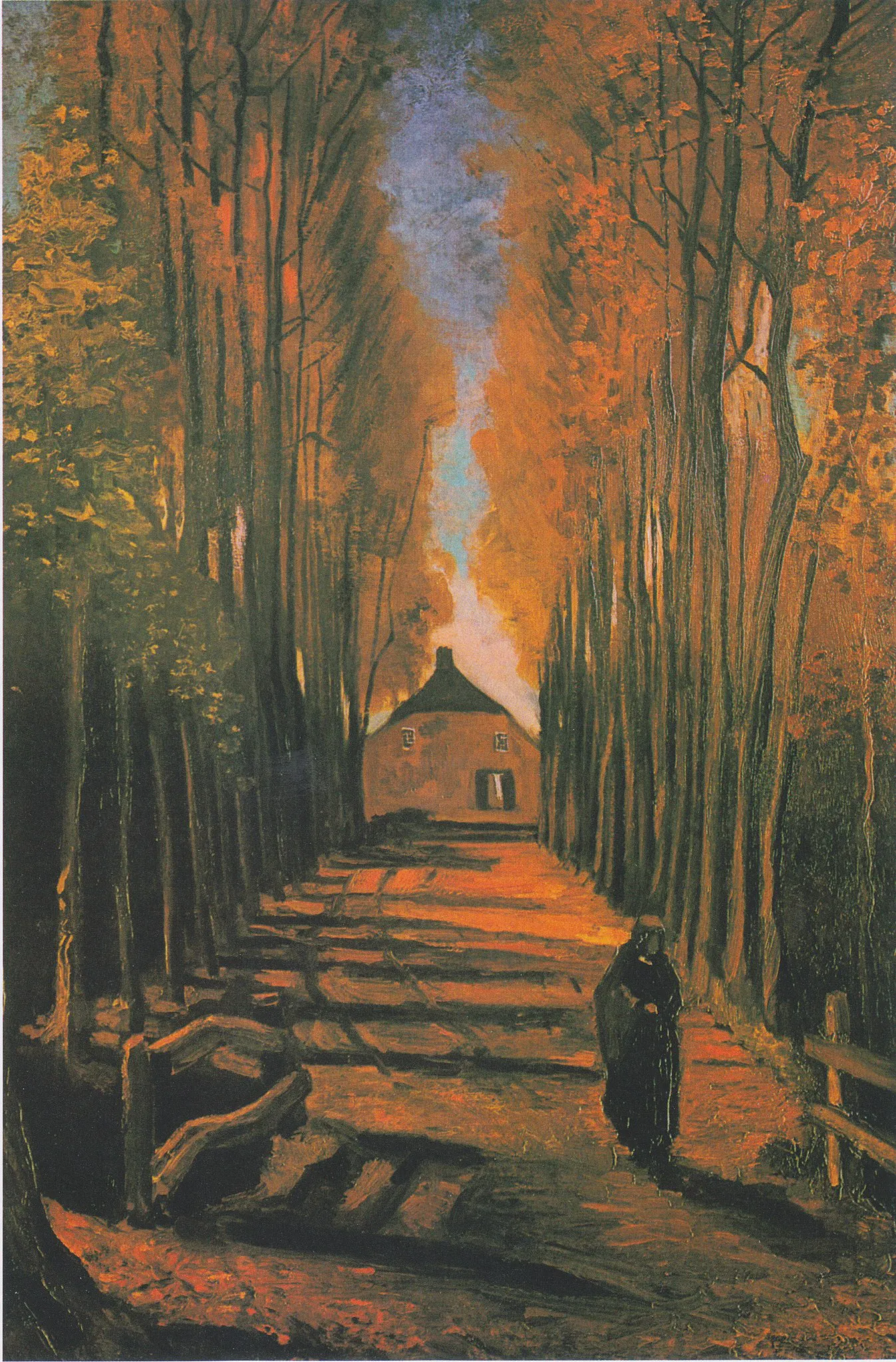
In John Keats’s To Autumn and Vincent van Gogh’s Avenue of the Poplars in Autumn, we find a quiet celebration of the season’s beauty and a reflection on the passage of time. Both works express a calm appreciation for change and impermanence.
Van Gogh had a deep affection for autumn. A quote often attributed to him reads: “As long as there is autumn, I will never have enough hands, canvases, and colours to paint the beauty I see…” His painting shows a straight path lined with tall golden poplars, under a soft blue sky. A lone figure stands in the distance, creating a sense of stillness and introspection.
See also: Van Gogh and Gauguin: An Artistic Correspondence
Keats writes: "Barred clouds bloom the soft-dying day, / And touch the stubble-plains with rosy hue." His verses are full of warm light and gentle movement, capturing the moment between summer and winter, life and decline. The mood is peaceful, not melancholic.
Both Van Gogh and Keats portray autumn as a time of quiet reflection — neither overly dramatic nor mournful. They focus instead on the richness of the moment, offering a gentle reminder of life’s cycles.