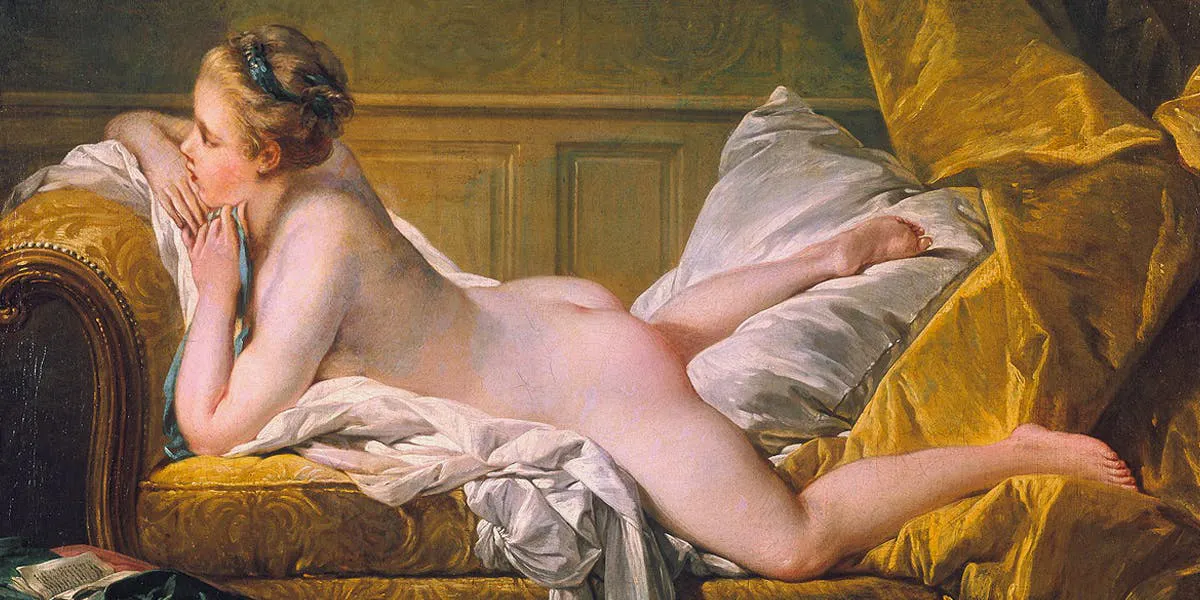
In the 18th century, the French artist François Boucher didn't represent women as Venuses of classical beauty, but as muses with provocative, erotic and unambiguous poses. Painter to the court of Louis XV and a favorite of the Marquise de Pompadour, François Boucher was both criticized and admired. Today, his muses still fascinate and wreak havoc at auctions.
Lying on her stomach, her legs playfully spread, the woman in Boucher's famous painting, believed to be Marie-Louise O'Murphy, wears nothing but a delicate blue ribbon in her blonde hair. She isn't fazed by her nudity, instead lying confidently across the chaise longue strewn with beautiful sheets. Deep in thought as she plays with the ribbon, the painting has a sense of voyeurism as the subject looks away from the viewer and to something outside the canvas.
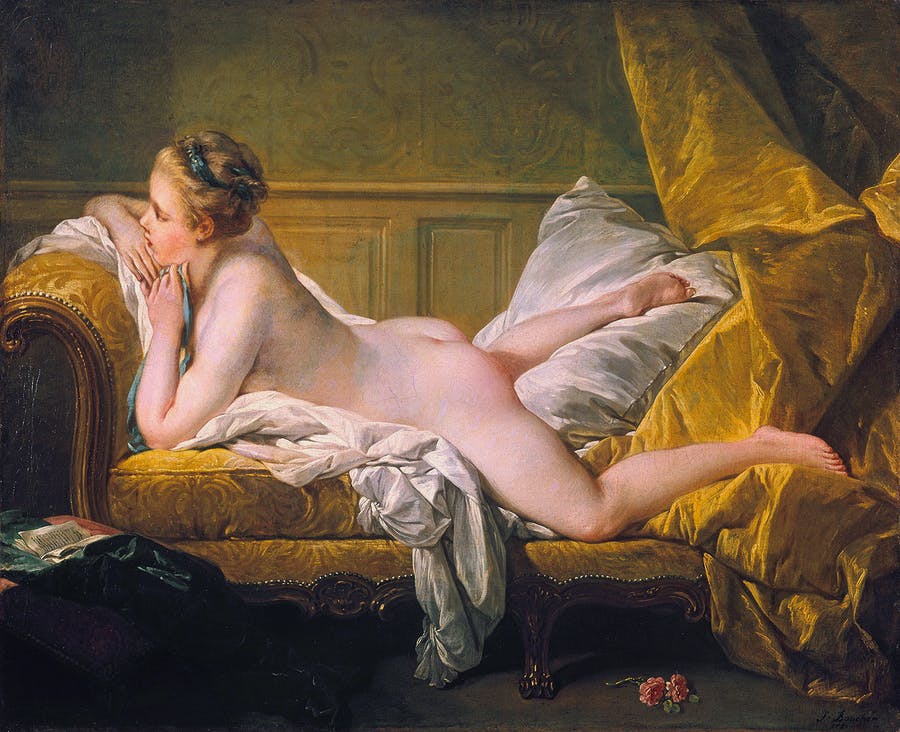
Marie-Louise O'Murphy was the daughter of Irish immigrants born in 1737, and worked as a seamstress in Paris. After meeting Boucher in 1751, Marie-Louise was employed by the artist to become his model. She later became Louis XV's mistress.
Marie-Louise sat, or rather lay, for Boucher at the age of 14. Boucher called her Casanova, referring to the memoirs of the Venetian theologian Giacomo Casanova, a specialist in the role played by women in religious history.
Related: Antoine Watteau: Frivolity and Melancholy
Boucher created two versions of this scene. The first is in the Alte Pinakothek collection in Munich, while the other is said to have been bought from Boucher himself by the brother of the Marquise de Pompadour, official mistress of Louis XV. Here, again, a certain eroticism emerges from the paintings, with characters who reveal themselves to the spectators in lascivious and natural poses.
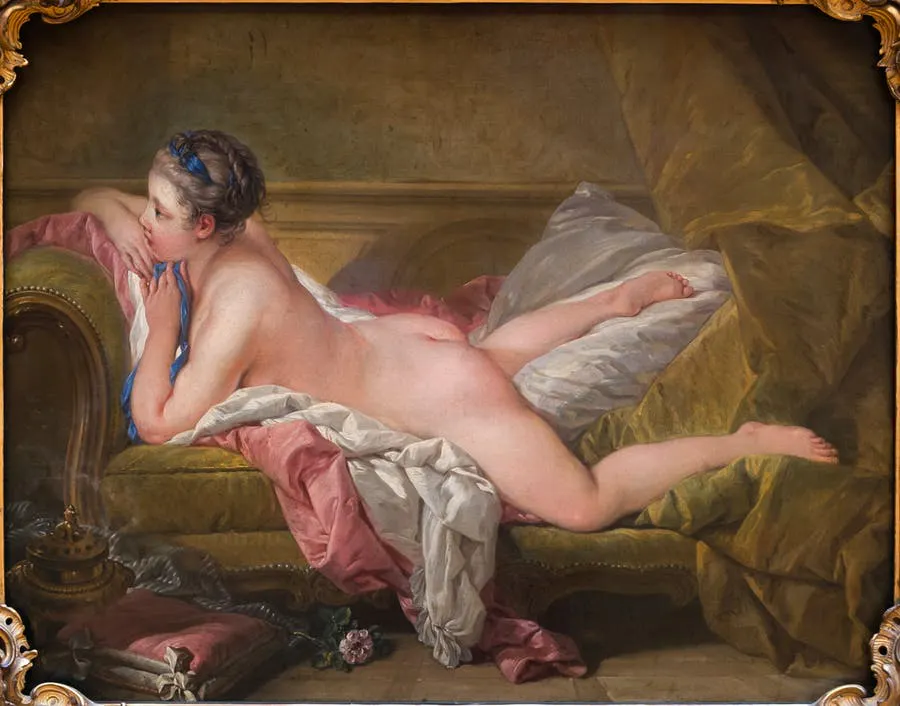
In 1752, Boucher painted Marie-Louise again, copying his own work with some changes. He chose a darker palette and added an oriental incense burner in the lower left corner, in place of the open book.
Elegant vulgarity is Boucher's signature.
The painting titled The Brunette Odalisque, painted a few years before Boucher and Marie-Louise O'Murphy's meeting, is considered to be the origin of this series. Historians believe that the woman illustrated in this version is none other than Boucher's own wife, Jeanne Buseau.
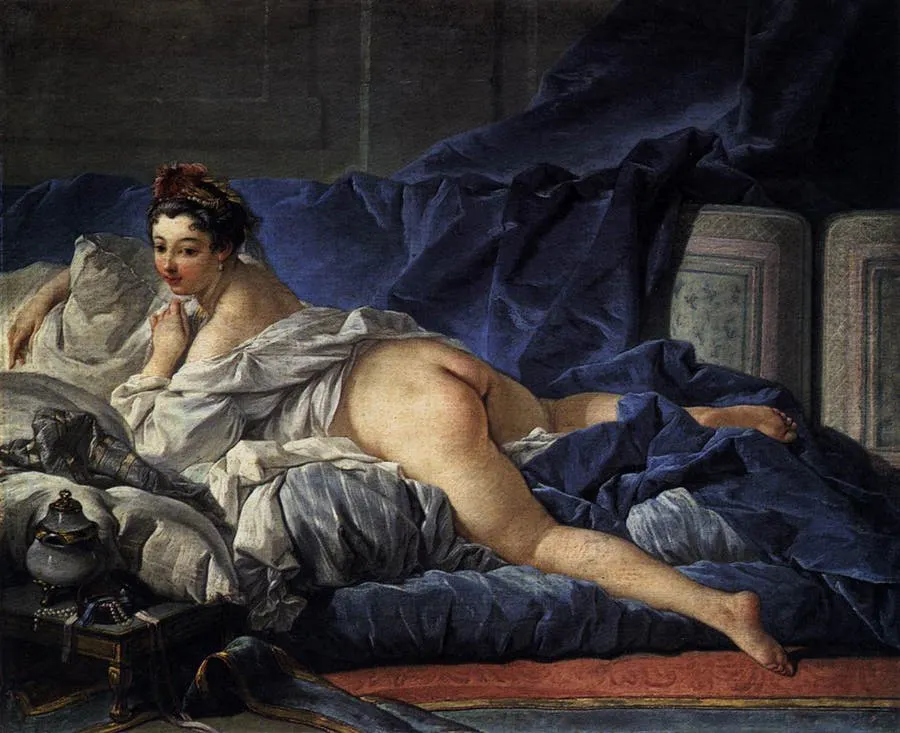
Boucher didn't seek to reproduce reality, but rather wanted to share his own reality. He was a sensual and precise painter who used brilliant colors, anything but straight lines, and a profusion of picturesque accessories.
His predilection for female nudes earned him, during his lifetime, the nickname of peintre des Grâces or "the painter of the Graces".
Related: Jacques-Louis David: The Neoclassical Revolutionary
Son of a designer passionate about furniture and decorative arts, Boucher was born in 1703 in Paris. His artistic education was entrusted to the painter François Lemoyne whose most remarkable works include murals at the Palace of Versailles. In 1723, Boucher received the Grand Prix de Rome from the Royal Academy of Painting and Sculpture. He spent four years studying in Italy, where he was inspired by paintings by late Renaissance Italian masters Titian, Tintoretto and Veronese.
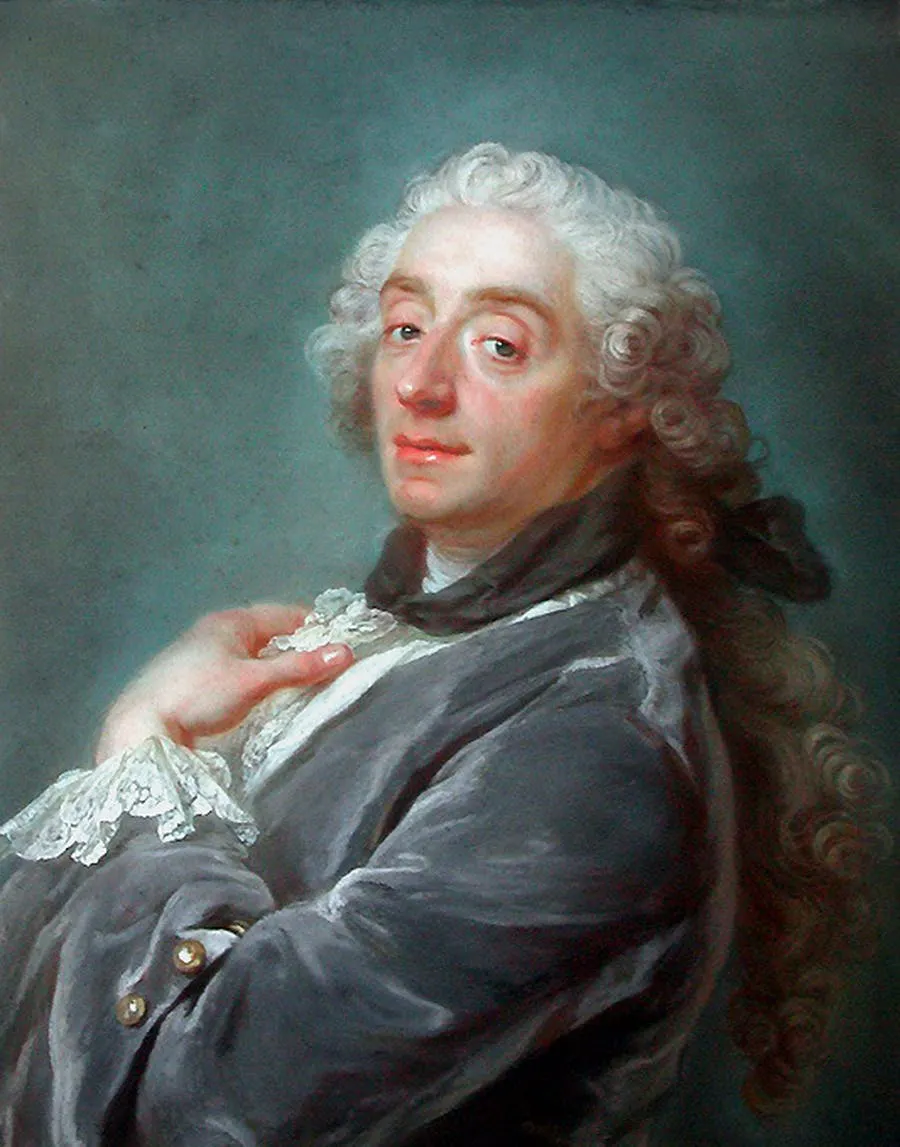
On his return to France, Boucher tackled all genres. He designed works for the Manufacture des Gobelins in Beauvais and the Manufacture de Porcelaine in Sèvres, he was a decorator at the Opera and, later, Director of the Royal Academy.
Related: The Art of Fashion: Fashion in Art
Boucher's mastery undoubtedly lies in his ability to paint human flesh and precious fabrics such as silk. In 1742, Boucher was appointed First Painter to the King. He received special support from the Marquise de Pompadour, who posed for him on several occasions.
He became the most sought-after painter of the mid-18th century. His works were making waves in the art world not only in France, but across Europe.
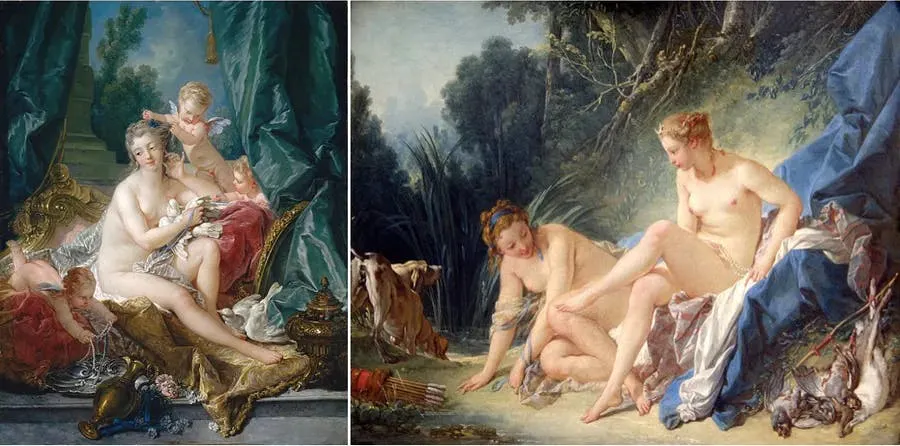
Boucher isn't the first in art history to elevate the nude female form to works of art, so why are his works so important?
The answer lies in his ideas and aspirations. Boucher painted his models for their aesthetic beauty: he wanted to show them to the world in all their glory, almost on a silver platter, as if he were saying to the world “Look how beautiful these women are”.
Related: William Bouguereau: The Last Neoclassical Artist
Boucher's canvases are characterized by both their honesty and their spontaneous character. The artist represented his vision of the world, as he liked to imagine it and without worrying about the repercussions.
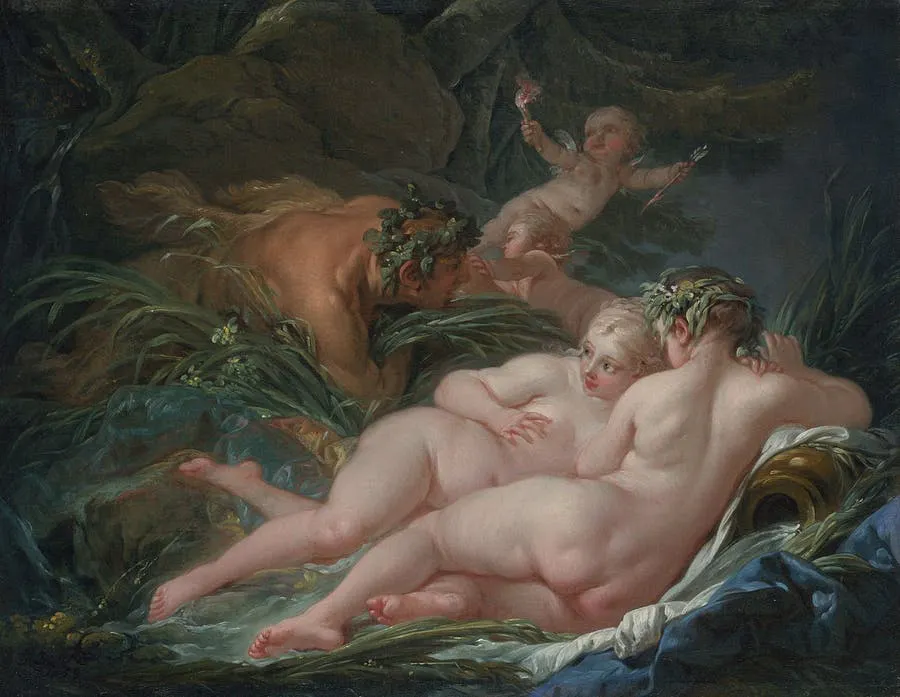
The paintings of François Boucher didn't go unnoticed. In 1761, Denis Diderot commented on the paintings of the artist in a mixture of admiration and disapproval: “What colors! What a variety! What a wealth of objects and ideas! This man has everything except the truth.”
Later, the Goncourt brothers summarized Boucher's profile in the following terms: “Elegant vulgarity is Boucher's signature... To be honest and to dare a term of the slang of the workshops which paints a little harshly his talent: he is scoundrel.”
Related: Eugène Delacroix: 5 Facts to Know
Unsurprisingly, his success was also accompanied by strong criticism, including that of Jean-François Millet, who discovered his paintings in Parisian museums: “I even had a very pronounced repulsion for Boucher. I could see his knowledge, his talent, but I could not understand his provocative subjects and see his sad women, without thinking how poor it all was. Boucher did not make naked women, but undressed little creatures: it was not the busty exhibition of the women of Titian, proud of their beauty to the point of showing off, to the point of showing themselves naked as they were so sure of their appearance. Powerful."
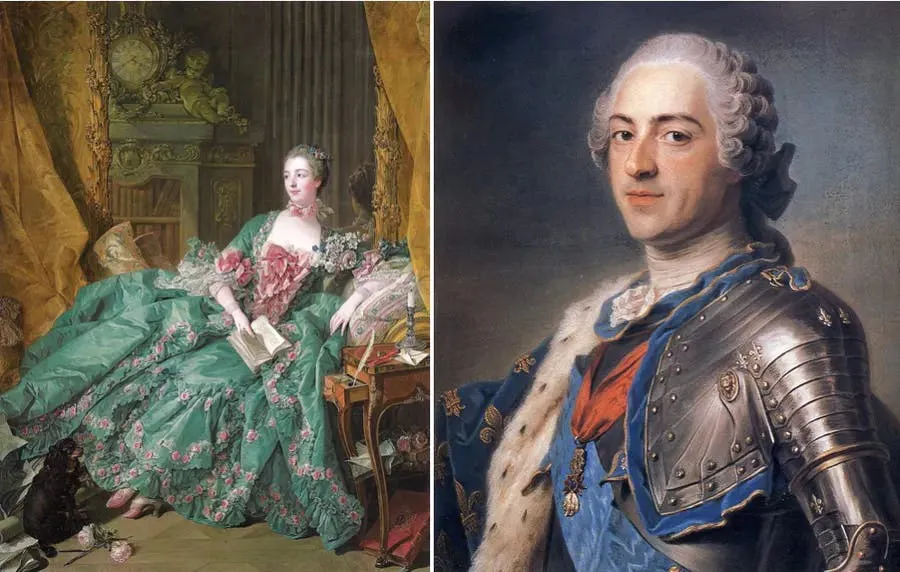
But Boucher's canvases went so far as to attract the attention of the greatest names of the Court. When King Louis XV discovered the painting of Marie-Louise, he wanted to meet her. His official mistress, Madame de Pompadour, then encouraged the king to have affairs, even introducing him to the women he wished to meet. For two years, Marie-Louise becomes the mistress of Louis XV, and even bore him a daughter.
Related: 5 Facts About Royal Mistress Madame du Barry
Boucher was one of the most prolific artists of his time and a great representative of the Rococo style. From porcelain to tapestry, his talents knew no end, which explains why he is today greatly associated with this movement. In addition to his enchanting nudes, he reinvented the pastoral scene in art, with shepherdesses draped in silk in erotic poses.
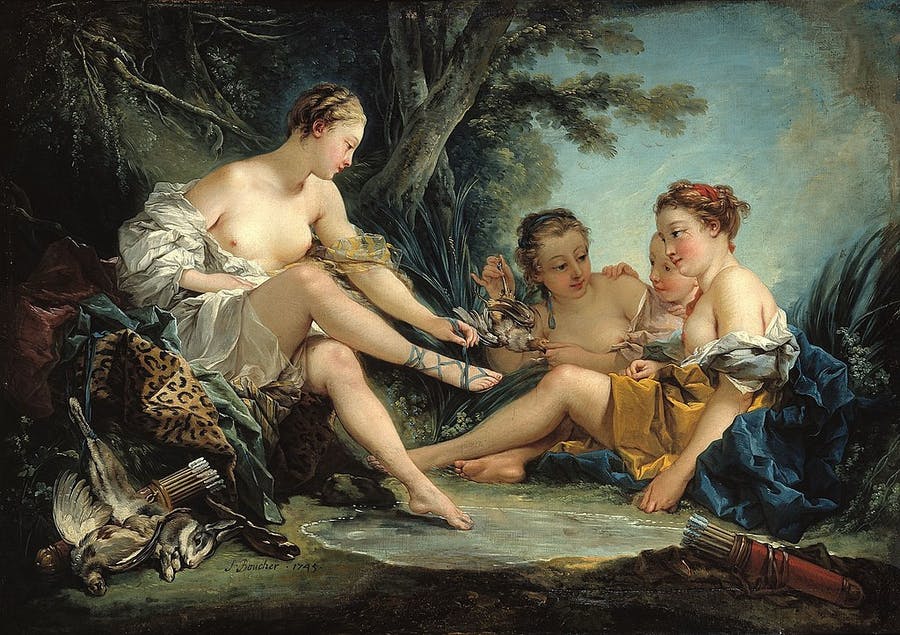
During his lifetime, as 'the king's first painter, Boucher was already extremely popular and sold a lot. He received orders from the greatest figures of the time, such as the Marquise de Pompadour or the Duchess of Orleans, who strongly recommended him within the Court.
Related: Five Centuries of the Nude in Painting
Boucher was a particularly prolific painter. It is estimated that his oeuvre contains at least 10,000 works, including many drawings, paintings and engravings.
But despite this dense and constant production, the works of the master Rococo are rare today, the most popular being those with erotic themes. Boucher's women are of particular interest, convincing witnesses of this 'libertine century'.
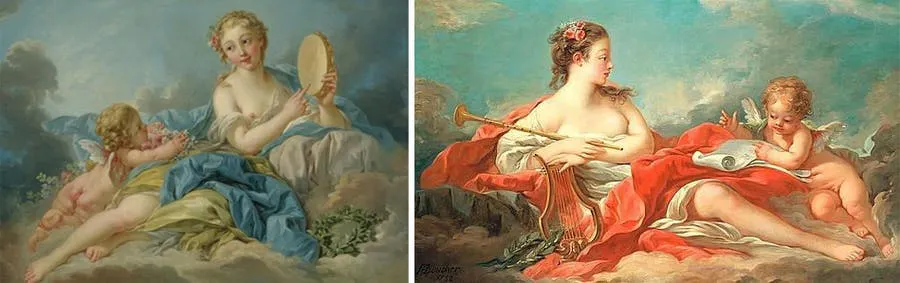
In 2005, the canvases Clio, The Muse of History and Song, and Erato, The Muse of Love and Poetry sold for £1.18 million at Christie's in London.
The following year, for $2.4 million, Christies in New York sold the almost seven-foot-wide work titled The Sleep of Venus, setting the record for the artist to date. This same painting was first offered at auction in 1779 at the Hotel d'Aligre in Paris. The canvas had then found a buyer for the equivalent of $3,000 today.
Related: On Rocky Paths: Female Artists from the Renaissance and Enlightenment
Unsurprisingly, Boucher's canvases achieve the best results, with drawings and engravings subject to large price variations depending on size, subject and technique.
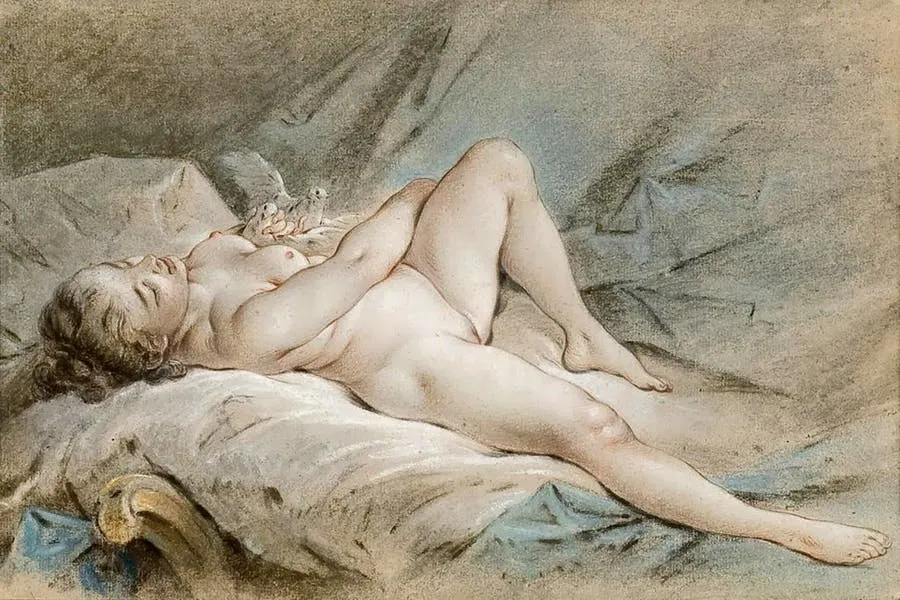
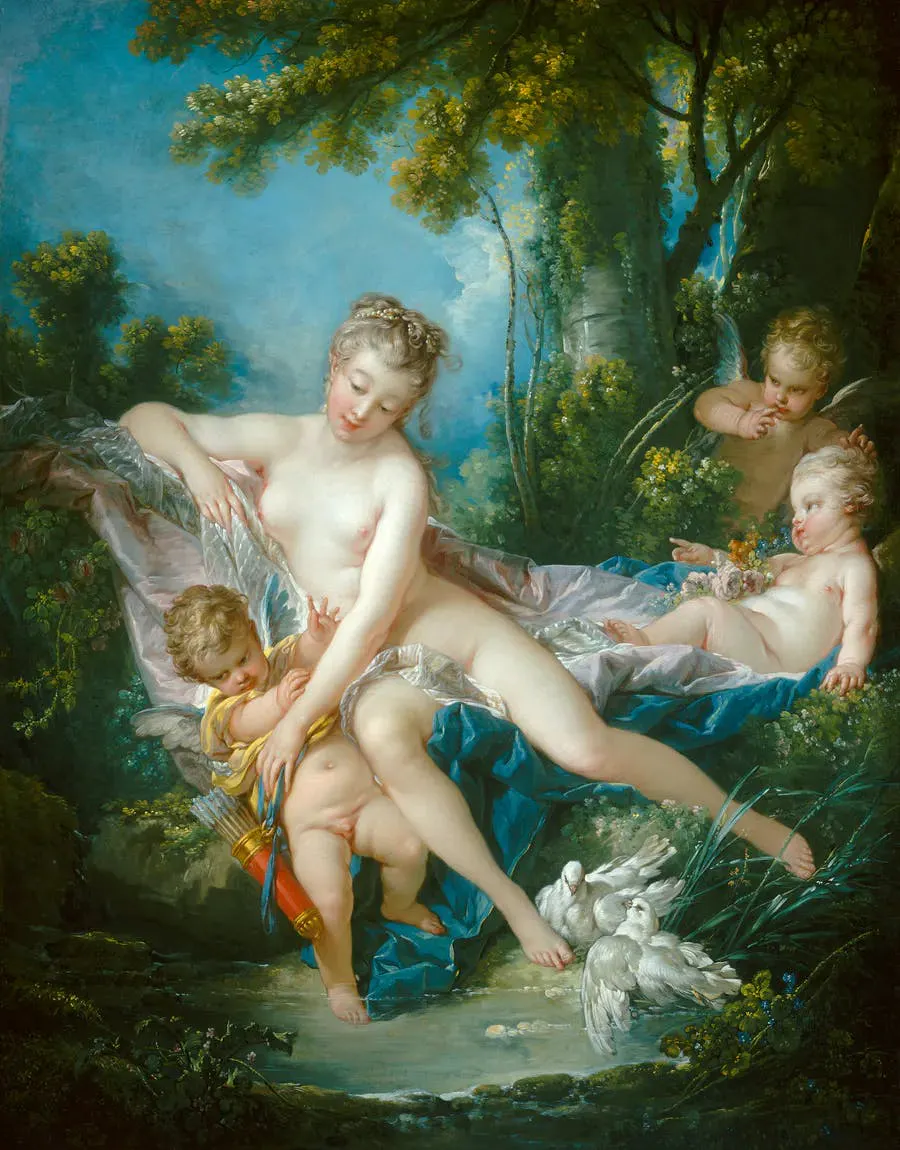
However, here again the theme of the muse remains very popular with collectors. In 2010, the drawing Venus Jouant Avec Deux Colombes was sold at Christie's in Paris for €601,000, while in 2008, Femme nue assis went to New York for $361,000.
Landscapes and genre scenes are much less sought after. For example, on December 8, 2004 at Christie's London, it was necessary to pay 'only' €125,000 to afford a painting by the master, a work titled The Water Mill, Landscape with a Shepherd and his Family Near a Mill.
Related: Weaponized Femininity: A History of Women Beheading Men in Art
Throughout the second half of the 20th century, the results of Boucher's works at auction remained relatively stable. It was not until the 2000s that we saw his prices explode.
The highest auction prices have been in London and New York. Paris, a stronghold of the ancient art market, nevertheless concentrates a third of François Boucher's works. However, the paintings which pass under the hammer of the French houses still rarely exceed $100,000.
Boucher knows the same fate as many of his contemporary artists. The old art market is divided into three very distinct segments: exceptional works whose prices are exploding, so-called 'accessible' works which allow young amateurs to afford a pretty piece and finally, what can be referred to as 'mid-range works', which remain the unloved children of auctions.
Find more articles on the history of art on Barnebys Magazine