'Hyakunin Isshu zukō kokura no nishiki' 百人一首図考 小倉のにしき...
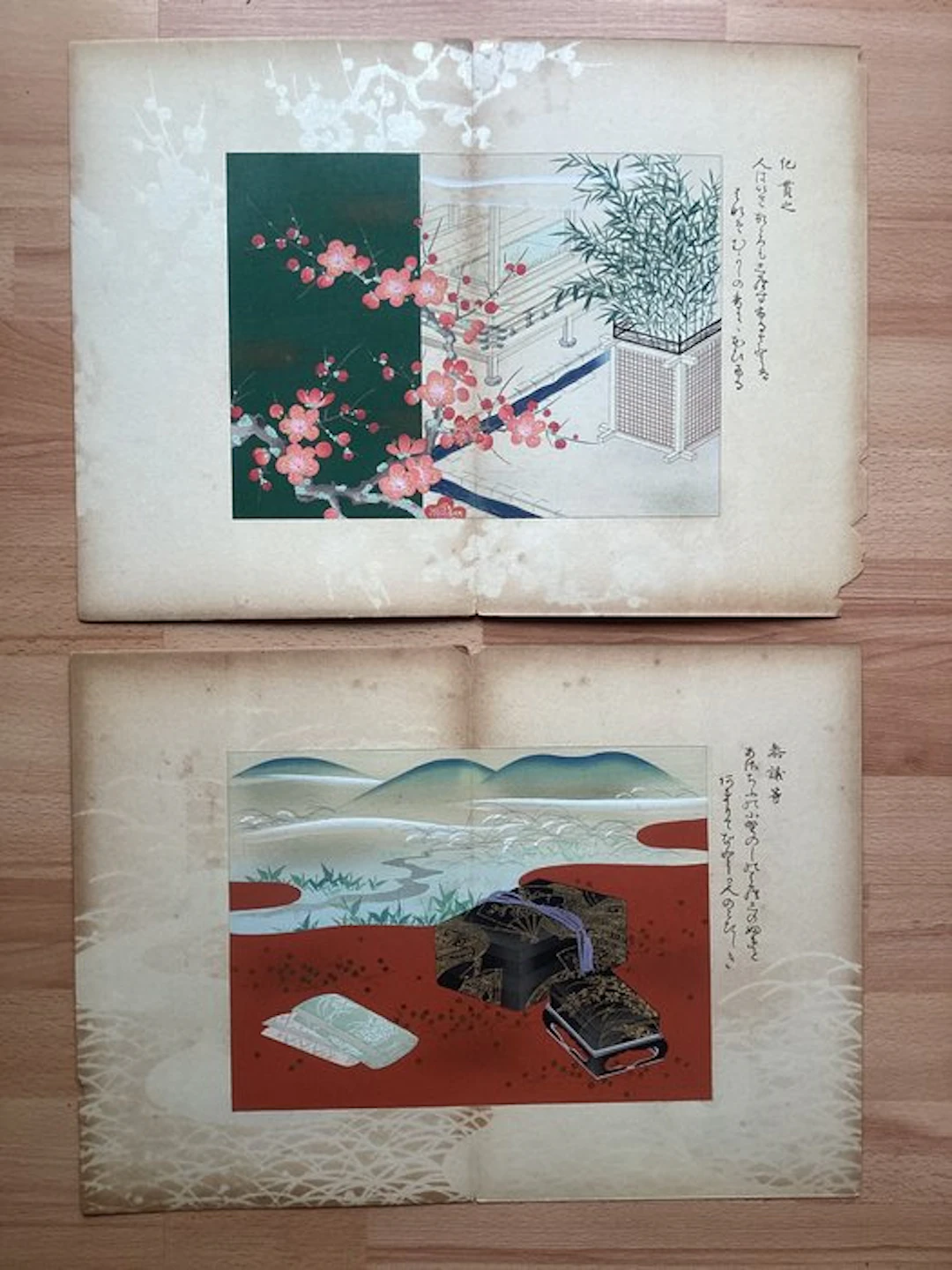
The first print is a beautiful traditional Japanese woodblock print (ukiyo-e or from a later period, such as the Meiji) that pays homage to classical poetry. Key elements of the work: The poet and the text: In the upper right corner, the name of Ki no Tsurayuki (纪贯之)—one of the most celebrated poets of the Heian period and the principal compiler of the famous imperial anthology *Kokin Wakashū*—is inscribed. Beneath his name, one of his most famous poems (*waka*) is written in cursive calligraphy. The poem: The composition evokes the renowned verses the author dedicated to plum blossoms upon returning to a place after a long absence: *Hito wa isa / kokoro mo shirazu / furusato wa / hana zo mukashi no / ka ni nioikeru* (I do not know what has become of people's hearts, but in my old home, the flowers still retain the same fragrance of yesteryear). Visual iconography: The image perfectly illustrates the poem by dividing the scene into interior and exterior planes. It shows red plum branches in full bloom in the foreground, juxtaposed with a traditional Japanese garden featuring bamboo shoots behind a white lattice screen and the eaves of palatial architecture. The print is mounted on heavy backing paper that shows natural signs of aging (small spots of oxidation or "foxing"), which is very common in this type of antique art print. The calligraphed text on the plate corresponds to poem number 35 of the famous imperial anthology Ogura Hyakunin Isshu (One Hundred Poems by One Hundred Poets), composed by Ki no Tsurayuki in the 10th century. The original reading, its exact word-for-word translation and the historical background that gives it meaning are detailed below. 1. The Original Text and its ReadingThe right column indicates the author and the following columns contain the poem in Old Japanese using cursive kana characters (hentaigana):Author: 紀貫之 (Ki no Tsurayuki)Poem:人はいさ 心も知らず ふるさとは花ぞ昔の 香ににほひけるTranscription (Romaji):Hito wa isa / kokoro mo shirazu / furusato wa / hana zo mukashi no / ka ni nioikeru 2. Breakdown Translation (Word by Word)The poem is formally divided into the 5 classic meters of waka (5-7-5-7-7 syllables):人はいさ (Hito wa isa):Hito: "The people", "the people". In this specific context, it refers to a particular person (the host or owner of the house). *Wa*: Topic particle ("As for..."). *Isa*: An archaic expression meaning "who knows," "it is uncertain," or "I do not know." *Kokoro mo shirazu*: *Kokoro*: "Heart," "feelings," or "intentions." *Mo*: "Even" or "also." *Shirazu*: "Without knowing" or "I do not know." Meaning of the phrase: "As for people, who knows? I cannot know their ever-changing hearts." *Furusato wa*: *Furusato*: In Old Japanese, this does not simply mean "hometown," but rather "a place deeply familiar to me, visited over a long period." *Wa*: Topic particle. *Hana zo mukashi no*: *Hana*: "Flowers" (specifically the plum blossoms seen in the illustration). *Zo*: Emphasis particle (strongly highlighting the flowers in contrast to humans). *Mukashi no*: "Of olden times" or "of yesteryear." *Ka ni nioikeru*: *Ka ni*: "With the scent" or "with the fragrance." *Nioikeru*: In the Heian period, the verb *niou* meant not merely "to smell," but "to shine with visual and aromatic splendor." The suffix *-keru* denotes a reflective exclamation regarding the past ("how they have bloomed!"). Meaning of the phrase: "Yet in this familiar place, the flowers indeed continue to bloom with the same beautiful fragrance as in days of old." 3. Historical Context: A Witty Response. The key to this poem—and the reason it features plum trees—lies in an anecdote recorded in the official notes of the *Kokin Wakashū*: Ki no Tsurayuki used to stay at the same inn whenever he made a pilgrimage to the Hasedera temple. After several years without visiting, he decided to return. Upon his arrival, the innkeeper reproached him with a touch of irony: "Well, your lodging remains exactly as it was before, yet you seem to have forgotten us (changed your mind)." Demonstrating remarkable poetic agility, Tsurayuki broke off a small branch from the blooming plum tree in the garden, offered it to the innkeeper, and recited this poem. It was an elegant retort: he was implying that while the innkeeper’s heart might have changed—growing cold or suspicious over the years—nature (the plum blossoms he cherished) remained faithful, offering the same warm welcome as always. The second Japanese woodblock print is titled *Hyakunin Isshu zukō Ogura no nishiki* (百人一首図考 小倉のにしき), originally published around 1935. Artwork Details—Style and Illustration: The print depicts a traditional still life featuring elements of classical calligraphy and poetry. It shows luxurious lacquerware boxes (*suzuribako*, or writing-tool boxes) decorated with gold *maki-e* style motifs, alongside papers and envelopes beautifully adorned with natural designs—all arranged against a stylized landscape of hills and flowing water. Subject Matter: This series of volumes is inspired by the *Ogura Hyakunin Isshu*, the famous classical poetry anthology that compiles one hundred poems by one hundred different poets. The vertically written calligraphy on the right corresponds to one of the traditional poems incorporated into the work's lyrical and visual composition. The poem calligraphed on the right side of the print belongs to the famous *Ogura Hyakunin Isshu* anthology. It is Poem Number 15, composed by Emperor Kōkō (光孝天皇, Kōkō-tennō). The vertical inscription combines kanji characters with *hentaigana* (ancient cursive calligraphic variants of the classical syllabaries). The standard transcription in modern Japanese characters is as follows: Transcription in Japanese characters: 君がため 春の野に出でて 若菜摘む 我が衣手に 雪は降りつつ. Reading (in Latin alphabet / rōmaji): *Kimi ga tame / Haru no no ni idete / Wakana tsumu / Waga koromode ni / Yuki wa furitsutsu*. Translation and interpretation: The title heading the text block at the top right reads "Shun'ei tō" (Spring Poem). The verses are classically translated as follows: "For your sake, I went out to the spring fields to gather young herbs, while upon the sleeves of my robe, the snow kept falling." The poem evokes a deeply romantic, courtly image: the act of venturing into the frozen fields of early spring to gather the first green shoots (*wakana*) as a gift for a loved one, demonstrating devotion by enduring the cold snow that accumulates on the long sleeves of traditional attire. This harmonizes visually with the delicate wrapping papers and the stylized green shoots set against the print's red background. Both illustrations are enhanced with metallic inks (gold and silver). Works with some foxing (see the photos). Second-hand. Please refer to the provided photographs for a better understanding of the item´s condition. Provenance: The seller can certify that the lot was legally purchased Shipping method: registered mail, securely packaged. All items are shipped 12/24 hours after payment is made. Import duties, taxes and charges are not included in the item price or shipping charges. These charges are the buyer´s responsibility. Please check with your country´s customs office to determine what these additional costs will be before bidding.
估價:$1.13
前往拍賣頁查看所有物品來自Catawiki或Ancient Art