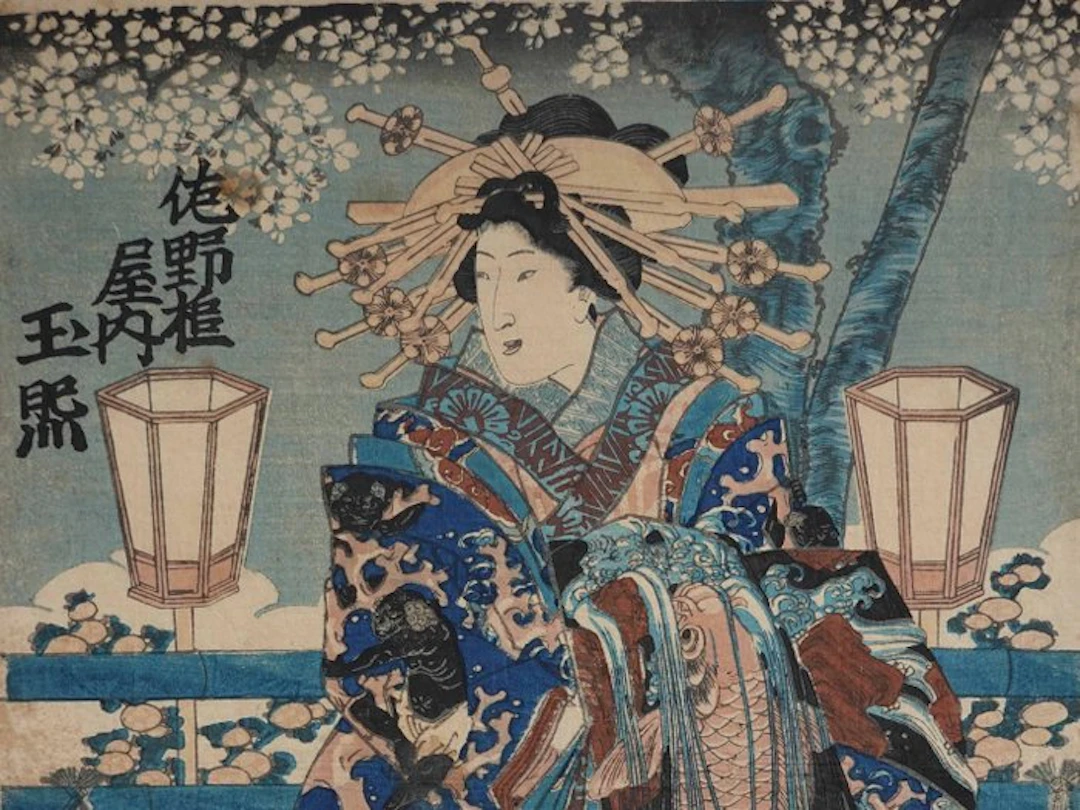
Courtesan Tamateru of the Sano-Tsuchi House - Utagawa...
This artwork is an original Japanese woodblock print (ukiyo-e) created in ca 1848 by Utagawa Yoshifuji (歌川芳藤) (1828-1887), a pupil of the famous Utagawa Kuniyoshi (歌川国芳). Identification of the maker was possible by comparing one of other prints from the same often-unsigned series of courtesans in Yoshiwara pleasure district of Edo (modern-day Tokyo). A signed version in this series (next to unsigned ones) is Courtesan Yamato of the Doikoku House (see a recent auction of miwajapaneseart, and search "yamato-of-the-daikoku-house-utagawa-yoshifuji"). Artwork Details Title: Courtesan Tamateru of the Sano-Tsuchi House (Sanoya-Tsuchiyauchi Tamateru). The Sano-Tsuchi House is located in Shin-Yoshiwara pleasure district. Sano-Tsuchiya was categorized as an Ōmise (‘Grand House’), meaning it featured a massive lattice storefront display where only the most exclusive, elite class of courtesans resided. Subject Courtesan Tamateru: An oiran (a supreme class of courtesan) identifiable by the elaborate configuration of numerous tortoiseshell hairpins (kanzashi) and her high, three-pronged black wooden clogs (koma-geta). Tamateru (玉照) was a highly celebrated, top-tier lineage name passed down through successive generations of elite courtesans residing at the Sano-Tsuchi house. Because high-ranking courtesans in the Shin-Yoshiwara pleasure district were treated like modern-day celebrity icons and fashion tastemakers, the name Tamateru carried massive commercial and cultural brand power in 19th-century Edo. Key Visual Motifs: Striking motifs on Tamateru’s robe are the black monkey clinging to a rope and the red carp, which are a brilliant exercise in Edo-period visual storytelling. Rather than choosing simple decorative flowers, the artist used powerful, dynamic symbols that reflected both the internal struggles of a courtesan and the pop-culture trends of 19th-century Edo. In Japanese art, the monkey holding a rope or reaching for a tether carries deep spiritual and societal meanings. It symbolizes in Buddhist philosophy the restless, untamed human mind, driven by temporary desires, passions, and attachments. A monkey tightly grasping a rope beautifully reflects the emotional state of an oiran, whose life in the pleasure quarters was bound by strict contracts and professional performance, all while keeping her true heart locked away. The carp is one of the most powerful and auspicious symbols in East Asian mythology. According to the ancient legend of Kōryūmon, a carp that successfully swims upstream against fierce currents and leaps over a massive waterfall and turns into a powerful celestial dragon. It is the ultimate symbol of strength, iron will, and overcoming overwhelming adversity. Parallel to the life of a Yoshiwara courtesan, which was incredibly harsh, requiring immense resilience to survive the grueling hierarchy. A carp powerfully navigating a waterfall on her dress served as a metaphor for her own strength, an icon of a woman rising to the absolute top of her profession through sheer endurance. Original Japanese print on Japanese paper, without backing. The sheet shows some staining and signs of wear consistent with age. Overall, the print is in good condition. Please examine the photographs carefully, as they form an important part of the condition description, and assess the condition before bidding. The print will be shipped flat and carefully packaged to ensure adequate protection during transit. Any applicable customs duties, import taxes, or other charges are the responsibility of the buyer. These charges do not apply to buyers within the European Union. Buyers outside the EU are advised to check any applicable import regulations or restrictions in their country before bidding.
估價:$169.9
前往拍賣頁查看所有物品來自Catawiki或Ancient Art