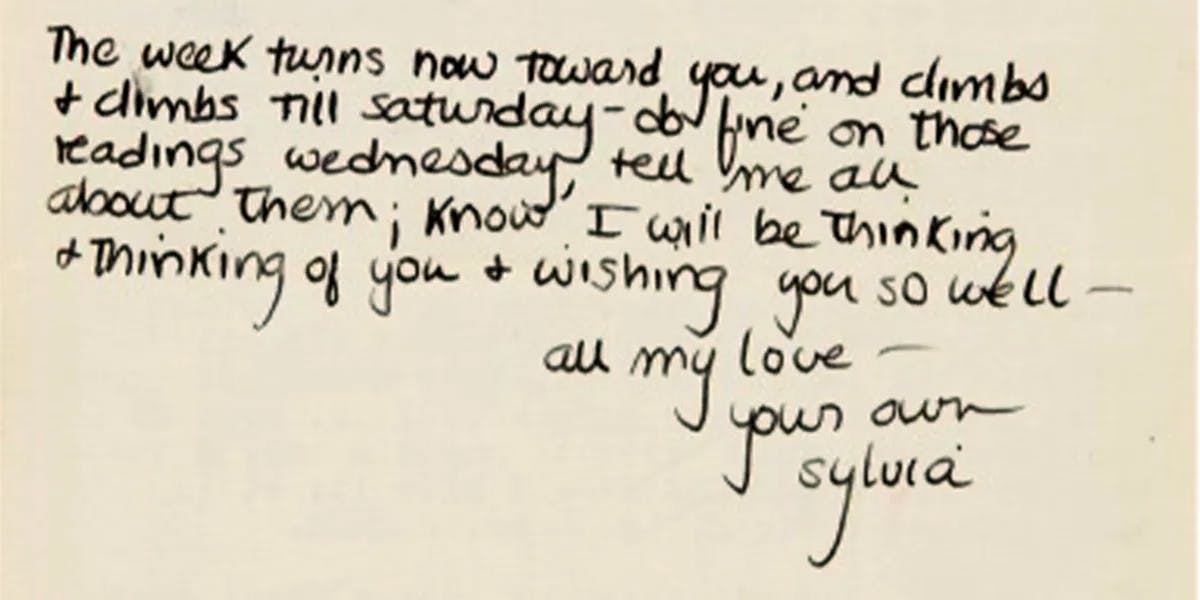
Sylvia Plath's writing has fascinated and inspired many generations of readers around the world. Through her intense and vibrant poetry, Plath explored themes of identity, mental illness, love and death. Born in Boston on October 27, 1932 to immigrants of German and Austrian origin, she became best known for her poetic collections The Colossus (1960) and Ariel, published posthumously in 1965. Plath also wrote a semi-autobiographical novel entitled The Bell Jar, which was published under the pseudonym Victoria Lucas in 1963, shortly before she took her own life at the age of only 30.
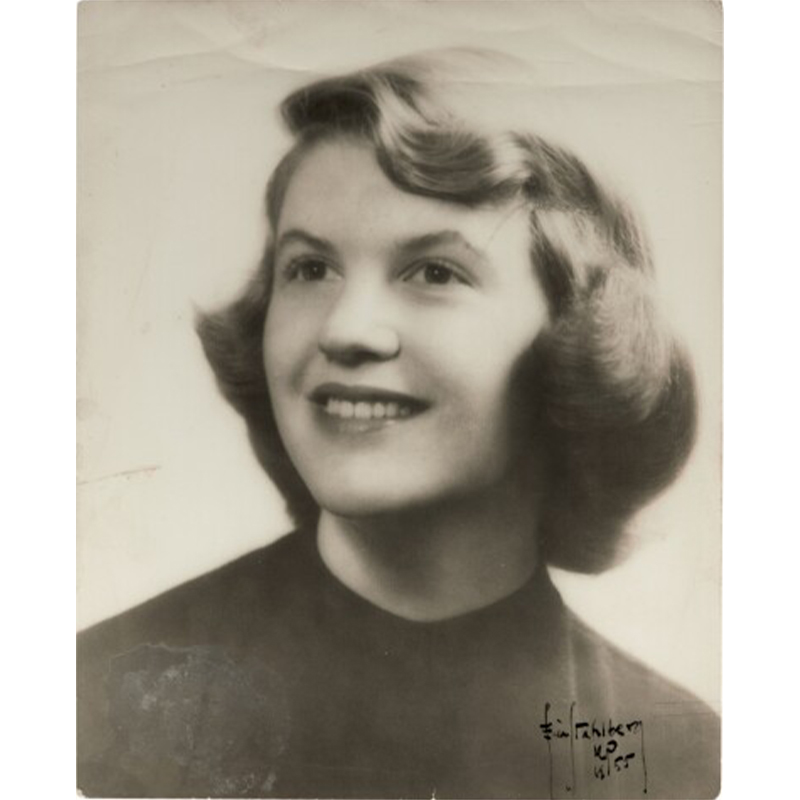
In addition to these publications, the letters Sylvia exchanged with significant people in her life, including those with her husband Ted Hughes, her mother Aurelia, her psychiatrist friend Ruth Barnhouse and the poet Anne Sexton, are worth reading in order to fully understand her. Plath's letters are important for several reasons: they provide valuable information about her life and personal relationships, allowing for a deeper understanding of her inner struggles and creative process; they shed light on the intellectual environment in which she lived; and they serve as a historical document, outlining the social and cultural context of the mid-20th century and revealing the experiences of a talented and ambitious woman who had to contend with the expectations of her time.
Related: 7 Greats and Their Favorite Fountain Pens
Sylvia and Ted: Inspiration and Conflict
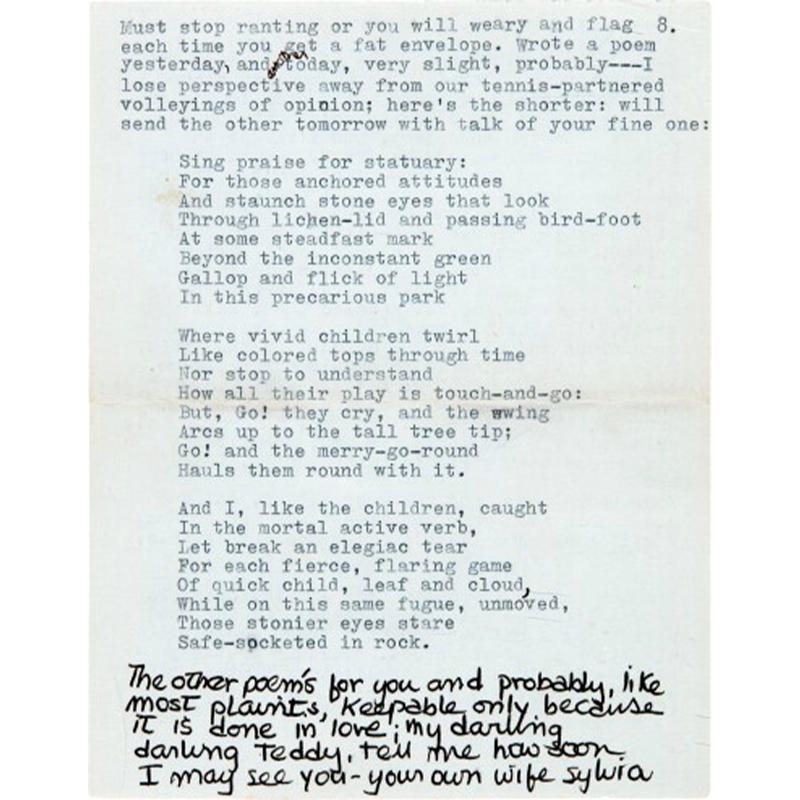
The letters exchanged between Sylvia Plath and the English poet Ted Hughes, whom she met during a stay at Cambridge University, tell a complex story of love, mutual inspiration, and conflict. Their tumultuous relationship had a significant impact on the poet and her writing. The missives written by Sylvia for her 'Teddy' testify to the deep emotional and intellectual bond that united them, but also to the tensions and difficulties they faced. In 2021, Sotheby's organized an online auction named Your Own, Sylvia featuring a collection of Plath's letters to her husband, alongside other items, owned by their eldest daughter Frieda Hughes. These exchanges are passionate and full of love, but also of determined literary ambition. They reveal the collaboration between the two young authors, who found in their relationship a source of inspiration. They also reveal the emotional vulnerability of Plath, who feels she has invested so much in that relationship. Their love life was indeed turned upside down in 1962, when Ted began an affair with Assia Wevill, wife of the Canadian poet David Wevill. The separation was difficult and probably contributed to the deterioration of the poet's fragile mental state.
Related: Auction Record for Bob Dylan's Love Letters
The complex relationship with her mother
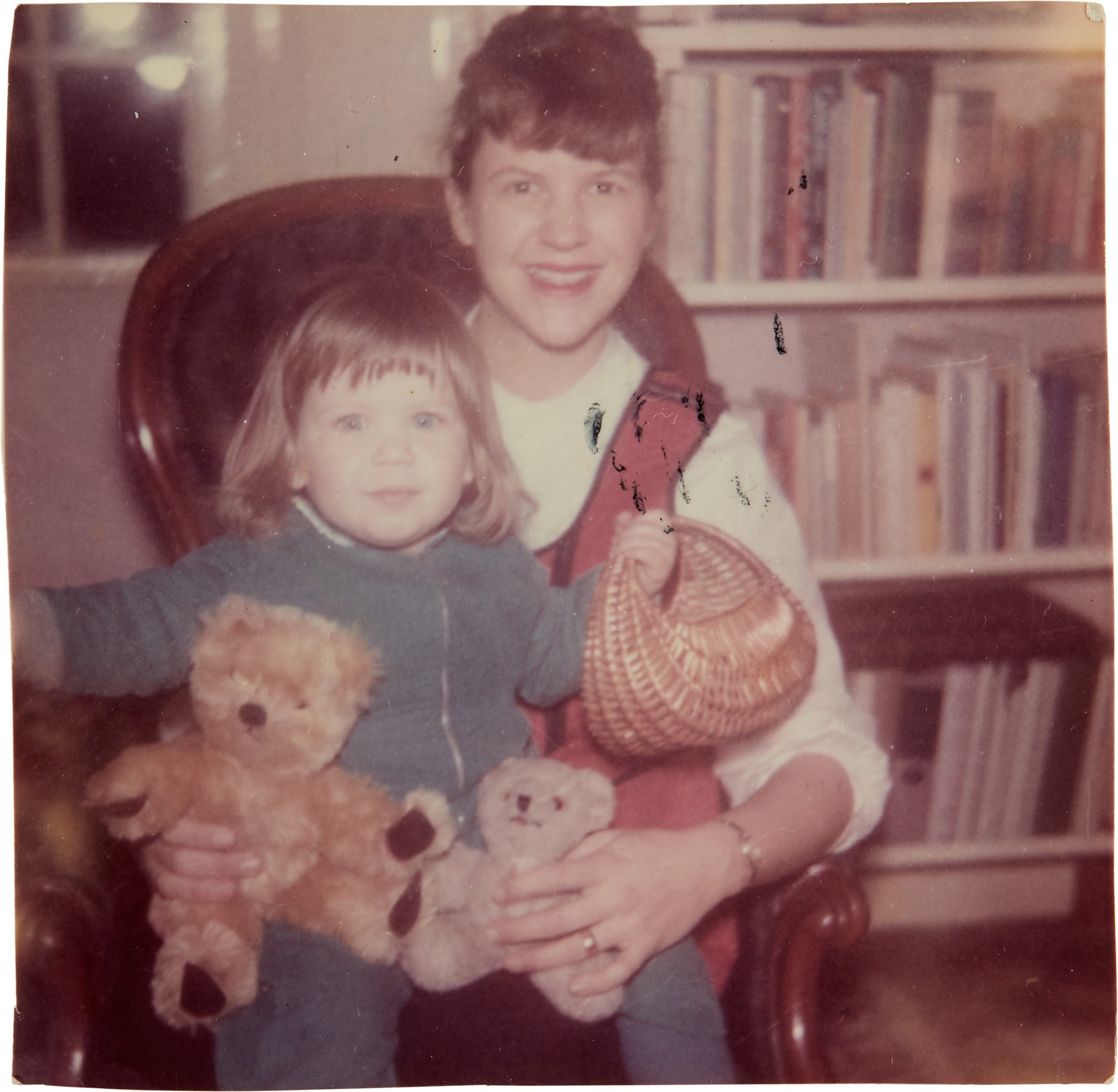
The collection Letters Home comprises Sylvia Plath's correspondence from the early 1950s until her death. The letters are mainly addressed to her mother Aurelia and provide an insight into Sylvia's personal and professional life, her thoughts, aspirations, struggles and emotional journey. In them, Sylvia openly discusses her passion for writing as her main reason for living and her deep desire for emancipation and independence. In a society in which women were still seen primarily as wives and mothers, she had the ambition to become a full-time author, free from binding routines and oppressive restrictions. In a letter dated February 10, 1955, the young woman opens up to her mother with these words: '...for me writing is the first pleasure in life. [...] everything that does not allow me to write [...] is not only limiting, but blocking.' These letters suggest a close and confidential relationship between the two – though some conflictual aspects also emerge. In the semi-autobiographical novel The Bell Jar, the protagonist Esther Greenwood blurts out the sentence 'I hate her' while talking to her analyst about her mother. In some of the poems, the figure of the mother is transfigured as the 'eely tentacle' of Medusa. In the entire poem The Disturbing Muses – inspired by Giorgio de Chirico's well-known painting – a very complex relationship is revealed, in which the mother perhaps exercised excessive and oppressive control over her daughter.
Want more articles like this delivered straight to your inbox? Subscribe to our free newsletter!
Confessions to a psychiatrist friend
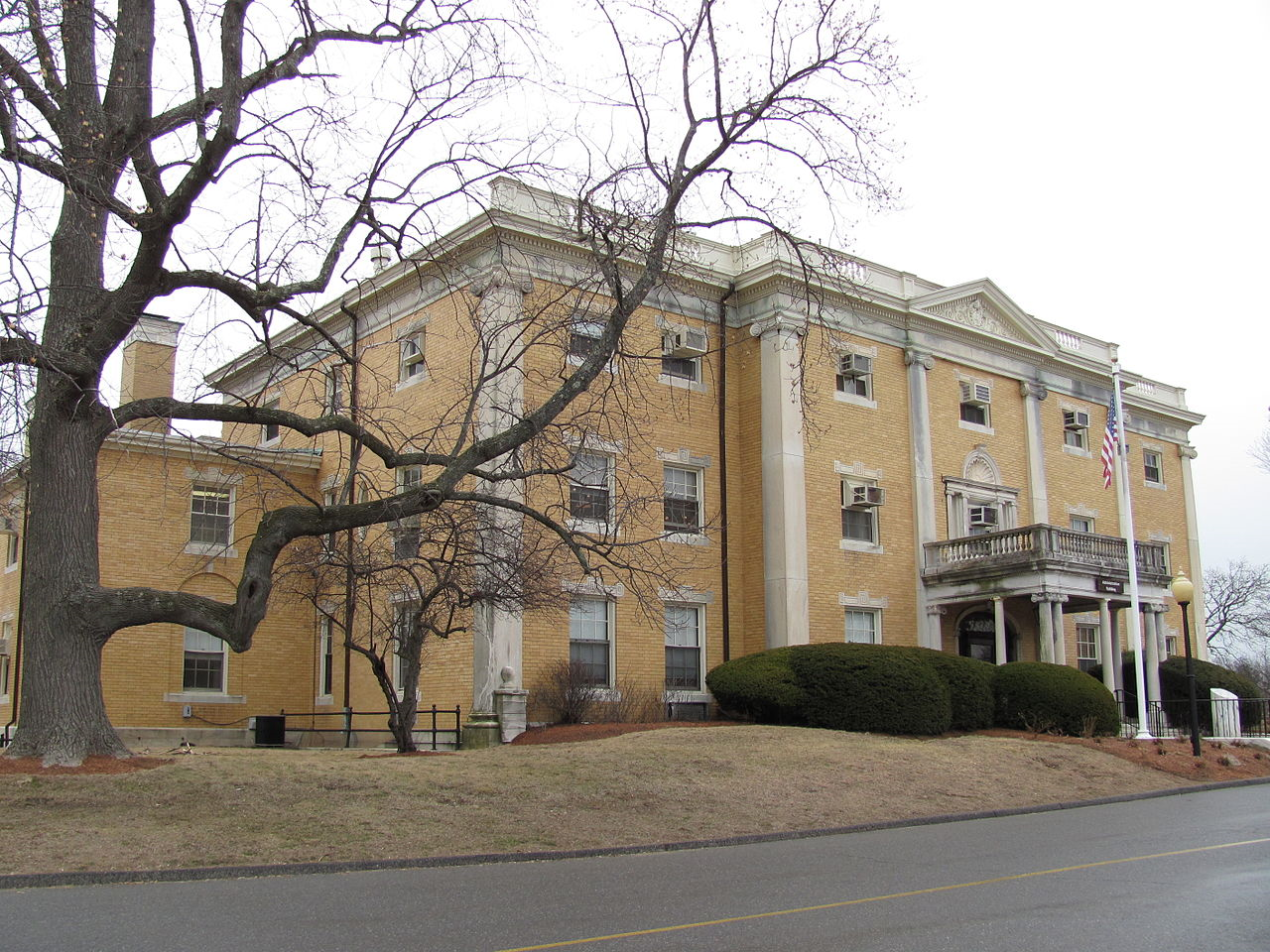
Ruth Tiffany Barnhouse (also known by her married name, Beuscher) was a psychiatrist resident at MacLean Hospital when she first met Sylvia Plath. It was 1953 and the poet was admitted to the psychiatric facility after a suicide attempt. A beautiful understanding developed immediately between them, which later led Plath to include Barnhouse as one of the characters in her novel The Bell Jar. In an obvious biographical analogy, Barnhouse was turned into the character of Dr Nolan, the doctor who follows the protagonist Esther Greenwood during her stay in a psychiatric hospital. After Plath left McLean, the two remained in constant contact until a week before the poet's death. In her letters to Barnhouse, Plath also revealed her suspicions about her husband Ted's infidelity and the background of their tormented relationship.
Related: 6 Women Who Have Won the Nobel Prize in Literature
Anne Sexton: confidante and rival
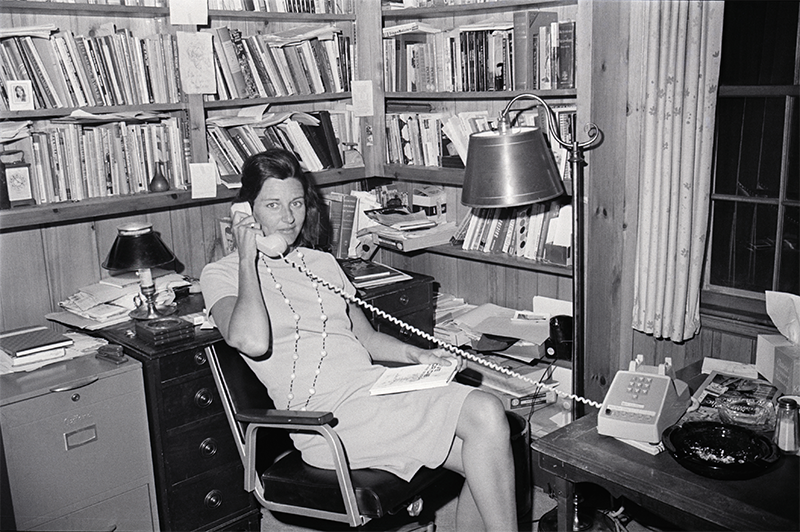
The poet Anne Sexton was a major figure in the life of Sylvia Plath. Both are considered to be the authors who contributed most to the development of the genre of Confessional Poetry. They met in 1959 at a writing seminar held by Robert Lowell at Boston University and often went to the nearby Ritz Hotel for cocktails after class. According to Gail Crowther in her book Three-Martini Afternoons at the Ritz, the two of them exchanged conversations centered on poetry, personal life, the challenges they faced as women writers in the society of the 1950s and 1960s, their relationships and motherhood. Over two or three martinis and munching on peanuts, they also often shared concerns about their mental health and encouraged each other to persevere in their art despite the difficulties they encountered. Theirs was a friendship spiced with a good dose of rivalry, but also one of emotional and creative support. They supported each other in their poetic journey and struggle with mental illness, continuing to exchange letters even after Plath moved back to England with her husband.
Related: The Cocktails that Inspired History’s Creatives
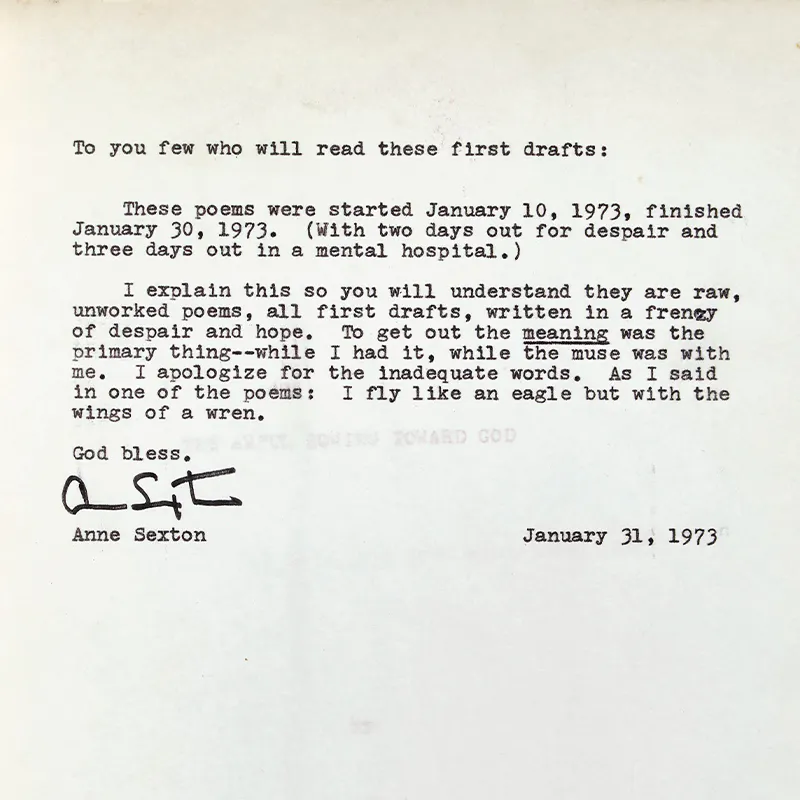
After her friend's suicide in 1963, Sexton continued to struggle with her own mental health issues and wrote poetry as a means of expressing her grief and exploring themes of mortality and female identity. Her poem Sylvia's Death deals with Plath's suicide and the impact it had on her, with deep poignancy and emotional involvement. This and other poems demonstrate Sexton's emotional bond with Plath and the profound influence one's death had on the other's writing. Sexton also often entrusted a very poetic and intimate part of herself to letters. On January 31, 1973, she sent the critic Walter Kerr some poems, which she described as rough, unfinished, and written in a frenzy of despair and hope. She concluded the accompanying letter by quoting a few lines from the poem Words: 'I fly like an eagle but with the wings of a wren' – revealing the insecurity and fragility that lay behind her often brash appearance. She killed himself shortly afterwards, on October 4, 1974, by inhaling carbon monoxide in her garage at home.
Plath and Sexton died, both by their own hand, about ten years apart. But after so many years, their verses live on and continue to fascinate readers for their creativity and depth of thought. The words they exchanged, the confessions they made to each other, the poetry and empathy that brought them together, show us the beauty and strength of the understanding between two artists who found in writing a way to explore their humanity.