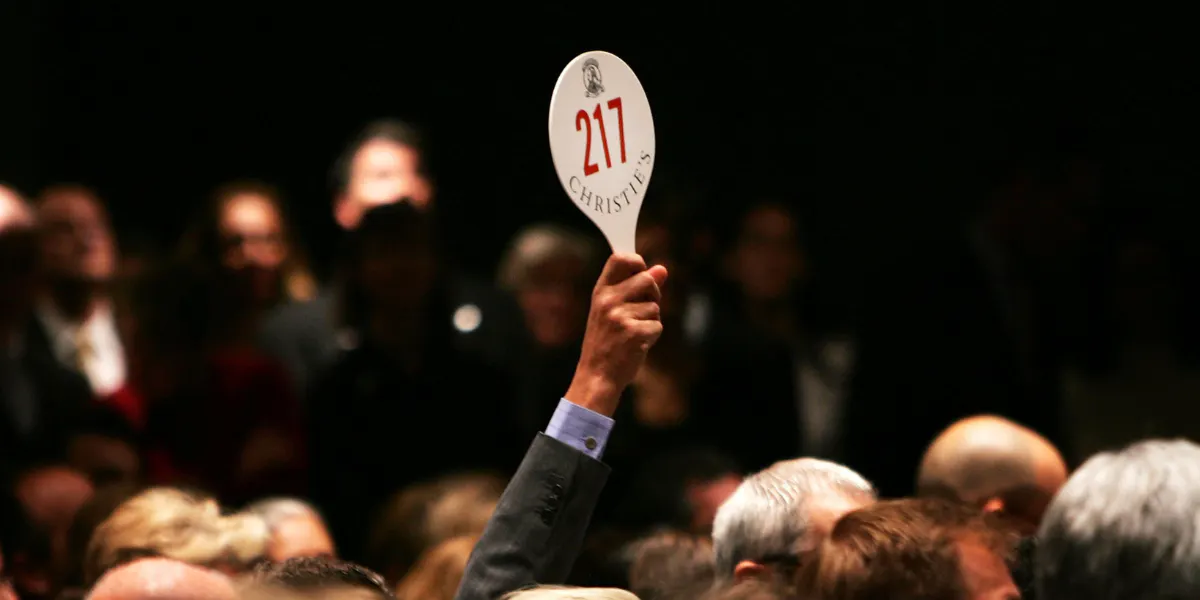
When buying art at auction, understanding the Value Added Tax (VAT) implications is crucial, as they can significantly add to the final cost.
VAT on the Buyer's Premium vs. Hammer Price in the EU
In the European Union, VAT is typically charged on the buyer's premium, which is the auction house's commission. The application of VAT on the hammer price (the winning bid) is more nuanced, especially following significant changes effective January 1, 2025. Previously, many secondary market art sales utilised the VAT Margin Scheme, where VAT was applied only to the auctioneer's or dealer's profit margin, not the full hammer price. However, as of January 2025, the ability to combine a reduced VAT rate on acquisition (for instance, through import) with the Margin Scheme on resale has been significantly restricted by EU Directive 2022/542. This means that for artworks acquired by the seller with a reduced VAT rate, VAT will now be charged on the full hammer price.
VAT Rates on Art Sales by Country in the EU
To remain competitive under these new rules, many EU countries have adjusted their art VAT rates. Rates vary by country: for example, France applies a 5.5% reduced VAT rate (known as TVA) on works of art, antiques, and collector's items. This rate applies whether sold directly by the artist or resold by galleries, provided the Margin Scheme is not applied. Germany has reinstated a 7% VAT rate (known as MwSt) on art, antiques, and collector's items. Notably, Italy has recently reduced its VAT (known as IVA) on art sales from 22% to 5%, effective July 1, 2025. This also applies to import VAT, positioning Italy among the EU countries with the lowest VAT rates on art, though this change is still pending formal parliamentary ratification within 60 days of the cabinet approval. Other member states also have varying rates, with Belgium and the Netherlands, where VAT is known as BTW, currently at 6% and 9% respectively, and Austria, where it's known as USt, at 13%. In the Nordic region, Sweden applies a 12% reduced VAT rate on the sale and import of works of art, collectors' items, and antiques, regardless of who sells them. The standard 25% VAT applies to the dealer's profit margin when the margin scheme is used. Denmark has a standard 25% VAT rate, but a special 5% "Artist VAT" applies to first-time sales of new, original works directly by the artist or their heirs, once annual sales exceed DKK 300,000.
Buyers exporting out of the EU may be eligible for a VAT refund on the hammer price, provided specific conditions and proof of export documentation are met, but VAT on the buyer's premium is generally not refundable.
See also: Need to Know: Tips for Buying at Auction
VAT Rules for Art Auctions in the United Kingdom
The United Kingdom has its own distinct VAT system, and for art at auction, the application of VAT is often more nuanced than a single, flat rate. You will typically encounter three main scenarios, which auction catalogues usually indicate with specific symbols. The UK Auctioneer's Margin Scheme is the most common for second-hand goods, including many artworks, antiques, and collector's items. Under this scheme, the auction house charges VAT only on its buyer's premium (their commission), and not on the hammer price of the artwork itself, with the VAT on the buyer's premium usually at the standard UK rate of 20%. In the case of Standard UK VAT Rules, a 20% UK VAT is applied to both the hammer price and the buyer's premium. This scenario typically applies to new artworks or items consigned by a VAT-registered business where VAT was charged on the original purchase. Additionally, for artworks, antiques, or collector's items imported into the UK from outside the UK (including from the EU post-Brexit) for sale at auction, a reduced Import VAT rate of 5% is generally applied to the hammer price for qualifying items. The buyer's premium in this instance will still be subject to 20% VAT. Buyers exporting artworks from the UK may be eligible for a refund of UK VAT on both the hammer price (if charged) and the buyer's premium, provided strict export conditions and proof of export are fulfilled.
Sales Tax and Tariffs on Art in the United States

In the United States, Sales Tax is applied based on the buyer’s shipping address, with rates ranging from 4% to over 10%. Tax exemptions may apply for registered resellers or institutions with valid certificates. Rates can range from 0% in states like Delaware, Oregon, Montana, New Hampshire, and Alaska (though local taxes may apply) to over 10% in some localities. As of April 2025, new US tariffs of at least 10% on all imports (with higher rates for certain countries) may apply to artworks, which traditionally were exempt from import duties. This could significantly increase the cost of acquiring international art. It's crucial to verify the current tariff status for art imports.
Want more articles like this straight to your inbox? Subscribe to our free newsletter!
VAT and Sales Tax on Art in Asia

Taxation on art purchases in Asia is diverse, with some countries applying VAT or sales tax, while others have different systems or exemptions. Japan has a 10% consumption tax (similar to VAT), Singapore has a Goods and Services Tax (GST) which is currently 9%, China has a VAT system, with a general rate of 13%, and South Korea has a 10% VAT. Some regions in Asia aim to be art hubs by offering tax advantages: Hong Kong is a free port and generally imposes no import duties on art, Taiwan has expanded sales tax exemptions for art sales at exhibitions to promote the art market.
Consult Experts Before Bidding
Because VAT rules differ by country and are currently evolving, buyers should consult the auction house and local tax advisors before bidding, especially for high-value lots or international purchases.
Disclaimer: This article provides general information about VAT on art purchases at auction and is for educational purposes only. It is not intended as, and should not be considered, tax, legal, or financial advice. Tax laws are complex and vary by jurisdiction and individual circumstances. Readers are strongly encouraged to consult with a qualified professional for personalised advice.