
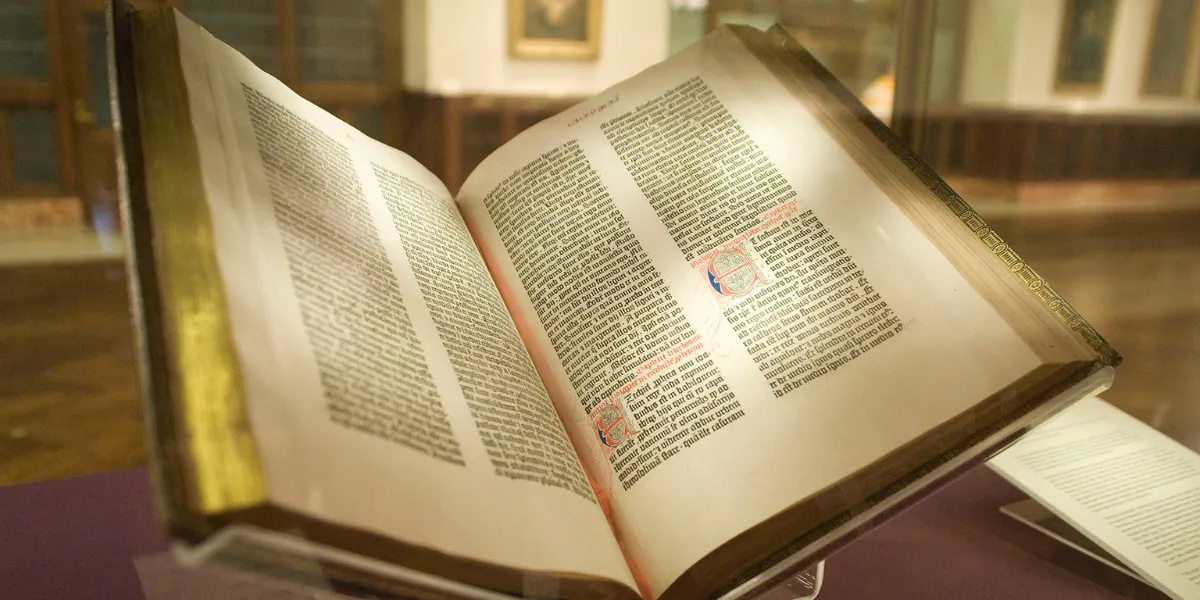
What the world is today, good and bad, it owes to Gutenberg. Everything can be traced to this source...
No invention has changed the world more profoundly than the printing press, which transformed the way humans learned and communicated, setting in motion the Renaissance, the Age of Enlightenment and the Industrial and Information Revolutions. But who was Johannes Gutenberg, the man behind the extraordinary device? Here we look back on the ingenious inventor and his most famous printed book: The Gutenberg Bible.

The year Gutenberg was born has been debated, but it was likely around 1400. He was born in Mainz, in modern-day Germany, to a wealthy patrician merchant and his second wife. Little evidence exists about his early life, but by his 30s he was living in Strasbourg (now modern-day France). There, he was conducting research on movable metal type, an innovation which would lead to the invention of the printing press and enable the mass production of printed text.
Movable type in porcelain was designed by Chinese inventor Bi Sheng around 1040, with metal movable type invented in Korea in 1377. Scholars are divided on whether knowledge of this had reached Europe prior to Gutenberg's invention of the printing press machine, which utilized metal movable type. Before the printing press, printing and binding books was a time-intensive process. These manuscripts had to be handwritten by scribes or printed from wooden blocks, which often took months or years for longer tomes.
Related: The Transformer of Type: The History of the Typewriter
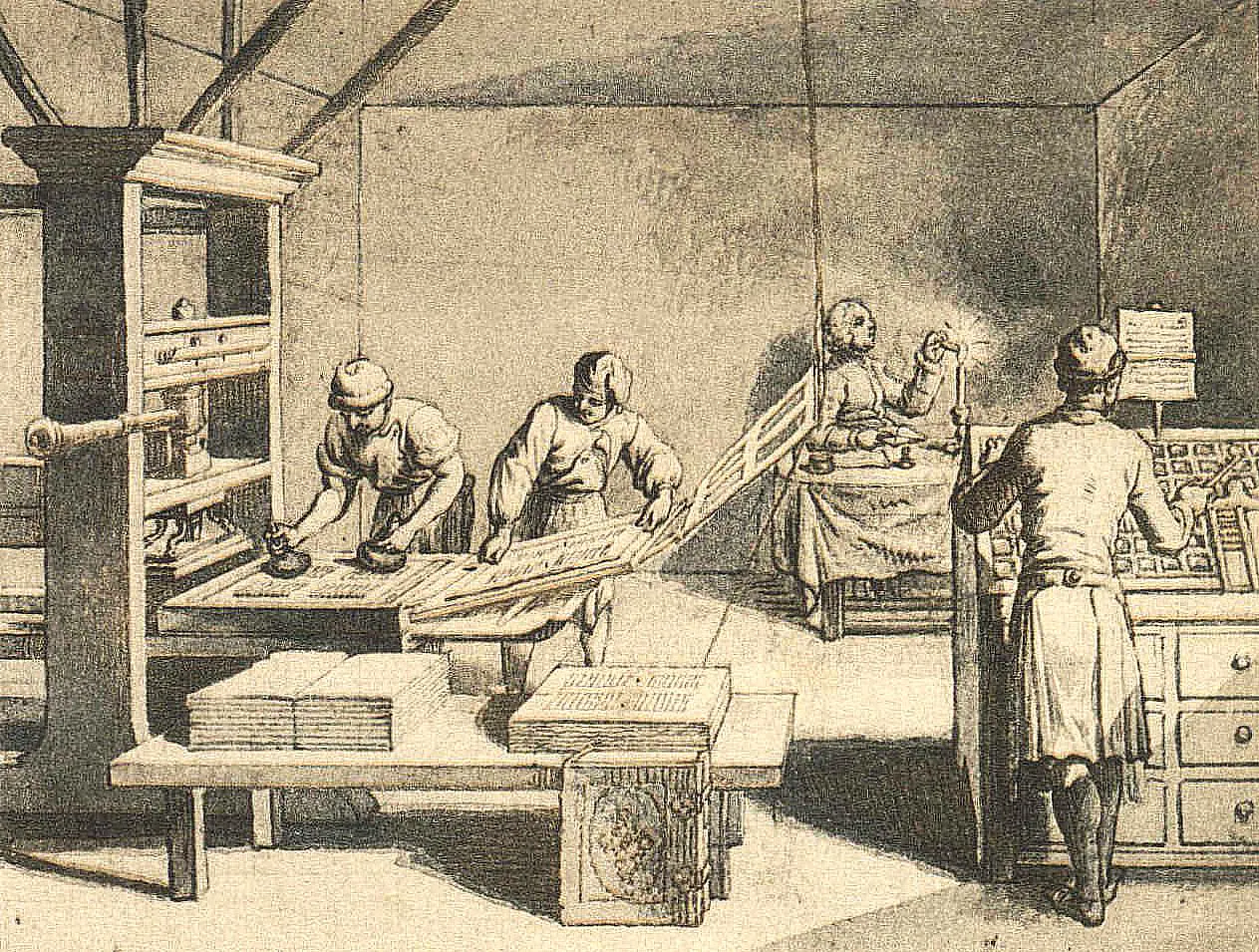
In 1450, Gutenberg set up his workshop at Humbrechthof, a building in Mainz and started producing German poems, religious texts and Latin grammar school books that were fast to print and easily sold. By 1452, he started on the Gutenberg Bible, which was based on the Vulgate, the 4th century translation by Saint Jerome of the Old and New Testament into Latin from the Hebrew and Greek respectively. Approximately 180 copies were printed, each with nearly 1,300 pages divided into two bound volumes, with most on paper and the rest on vellum (a type of animal skin). It took about three years to print these 180 Bibles, while prior to the development of the printing press it would have taken three years for a scribe to produce just one Bible. They were mostly purchased by or gifted to monasteries and universities.
Related: The Story of Leonardo Da Vinci's Unfinished Saint Jerome Painting
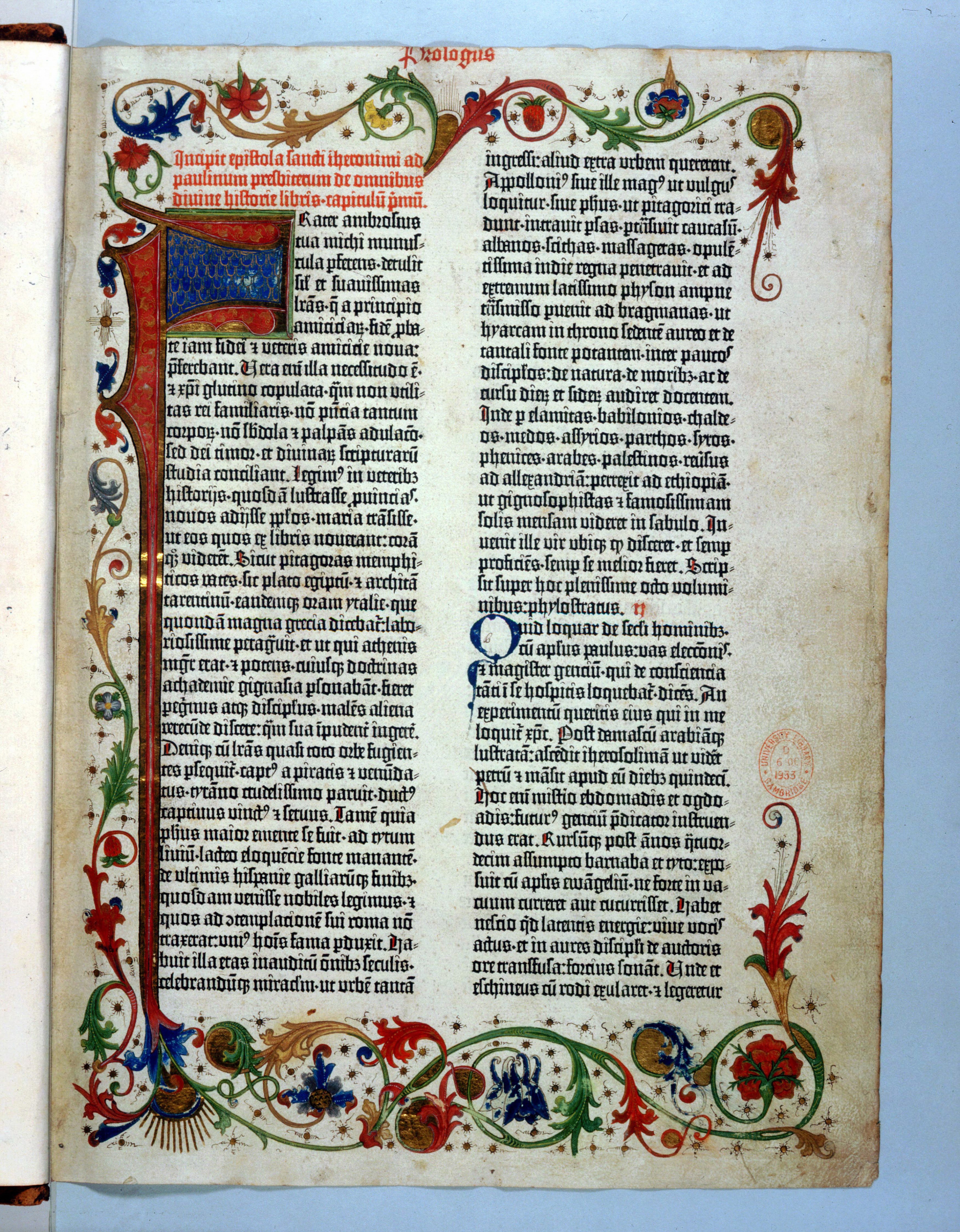
These Bibles are considered some of the most beautiful books ever printed due to their elaborate illustrations and script. The quality and color of the ink from the 15th century is still incredibly vivid. This is because Gutenberg also invented an oil-based varnish ink instead of the water-based ink of the time that would run and smudge easily.
Want more articles like this straight to your inbox? Subscribe to our free newsletter!
However, by 1455, legal woes brewed between Gutenberg and Johann Fust, the wealthy man who loaned Gutenberg the money to develop the printing press in 1450. Fust wanted his return back, and when the court ruled in his favor, Gutenberg was left essentially bankrupt. He moved into his father's house and still continued printing books in the town of Bamberg, Germany. He died in Mainz in 1468. However, his great contribution to history was quickly realized: the technology of the printing press spread swiftly with thousands of printing presses set up in Europe by 1500. As printed books, documents and pamphlets were easily disseminated, the world became increasingly interconnected.
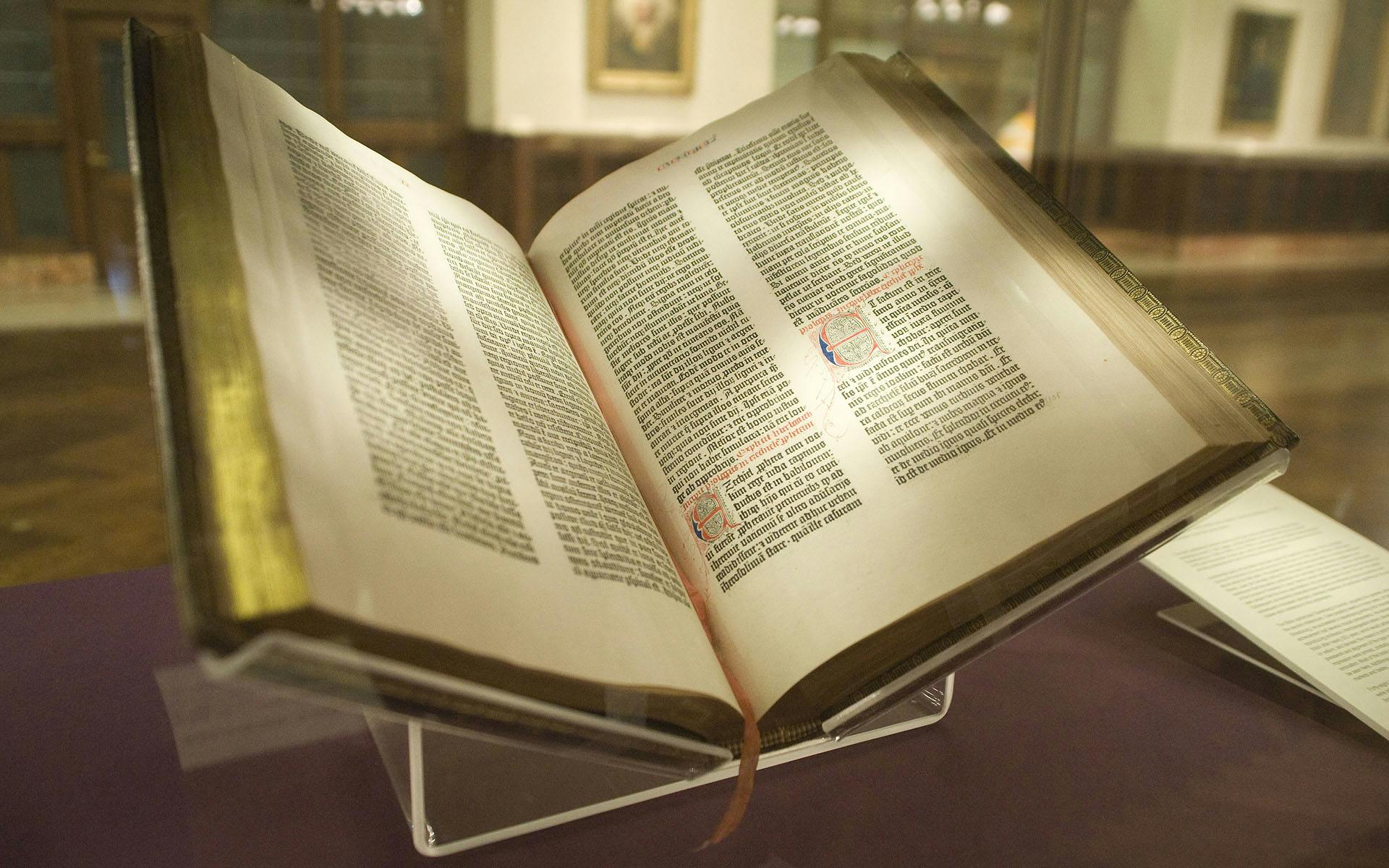
Today, about 49 original Gutenberg Bibles exist, with only 21 complete versions. Almost all of these copies are in Europe or the United States, with just one outside of these regions at Keio University Library in Tokyo, Japan. The Bibles are mostly found at museums, national libraries and universities. Eleven copies are in the United States, including the Library of Congress, the New York Public Library, the Morgan Library and the university libraries of Harvard, Yale, Princeton, Indiana and Texas-Austin. The latter owns the last complete copy ever sold, which the university purchased for $2.4 million in 1978. Today, a complete Gutenberg Bible is considered the rarest antique book in the world.
Related: Oldest Hebrew Bible Fetches $38 Million at Auction
Due to the incredible history and value of these Bibles, they have been the target of thefts. In 1969, a man stole two volumes of the Gutenberg Bible from the library at Harvard University, but fell 40 feet when trying to escape by rope from the library window. The thief was hospitalized, and the volumes recovered. Forty years later, a federal security agent in Russia stole a Gutenberg Bible from the Moscow State University safe in 2009 and attempted to sell it for over $1 million. He was later arrested in 2013 and sentenced to a penal colony in 2014. This was actually the second theft of this particular Gutenberg Bible, as it had been taken by the Soviet army from Germany during their occupation in World War II.

Incomplete versions and fragments of the Gutenberg Bible rarely come up for auction. The most expensive Gutenberg Bible, an incomplete version with just the Old Testament, sold at auction in 1987 for $5.4 million at Christie's to a Japanese buyer. This copy is now held at Keio University in Tokyo. More recently, in 2021, what was referred to as a "noble fragment" of a Gutenberg Bible, consisting of a leaf from the Book of Samuel, sold at Christie's London for £93,750 (about $124,594).
Listen to: Podcast Ep #35 Antique Books: Between the Lines
As the brainchild of the modern printing press and its most enduring and valuable treasure, Johannes Gutenberg powerfully set in motion the world as we know it today. "All the world acknowledges that the invention of Gutenberg is the greatest event that secular history has recorded," Mark Twain wrote in a letter in April 1900 upon the opening of the Gutenberg Museum in Mainz. "What the world is today, good and bad, it owes to Gutenberg. Everything can be traced to this source..."



![Incunabula & Typography. [Meerman (Gerard)], Conspectus ...](https://bbys.imgix.net/3845/e42ded8df18ce544d8c369b0c97f0910e2fc56e69b9331ca11deabfd3165a0ac.jpg?w=3840&h=320&auto=format&cs=tinysrgb&fit=fill&fill-color=white&fill=solid&q=75)