In June 2020, a Spanish art dealer, Cristian López Márquez, claimed he was in possession of the long-lost Frida Kahlo masterpiece The Wounded Table. On behalf of the owner, Marquez said he was seeking a buyer for the work, which was allegedly under high security in London and worth between $45-55 million. Kahlo's most expensive painting Diego e yo sold in November 2021 for $34.8 million. However, the mystery surrounding the painting, and the fanatic obsession with Frida Kahlo that has endured for decades, made experts skeptical about the validity of Marquez's claims, and the work never surfaced.
Related: The 15 Most Expensive Female Artists
The story of this missing masterpiece began 80 years ago, when Frida Kahlo (1907-1954) worked on the painting in the wake of her divorce from Diego Rivera. The couple, who had married in 1929, was 20 years apart, and their relationship was filled with anger, violence, and infidelity. Though they divorced in 1939, their passion for one another was all consuming. The two ultimately remarried the following year in December 1940. During the period of separation in early 1940, Kahlo threw herself into work on The Wounded Table, which explored grief, pain, and her Mexican identity.
The large-scale painting, anchored by a self-portrait of Kahlo at the center, reflects her characteristic themes, as well as her inner turmoil. She is flanked by a mechanical skeleton to her left, who grasps a strand of her dark hair in his wiry hand, and a Judas figure to her right with his arm around her. This figure, surrounded by electrical circuits, is a reference to a similar figure that Rivera kept near his easel. Directly next to her is a Pre-Columbian Nayarit figure. These three figures were already part of her 1938 painting The Four Inhabitants of Mexico City. At one end of the table are her niece and nephew, and at the opposite end is her pet dear Granizo.
Related: 10 Artist Couples You Should Know
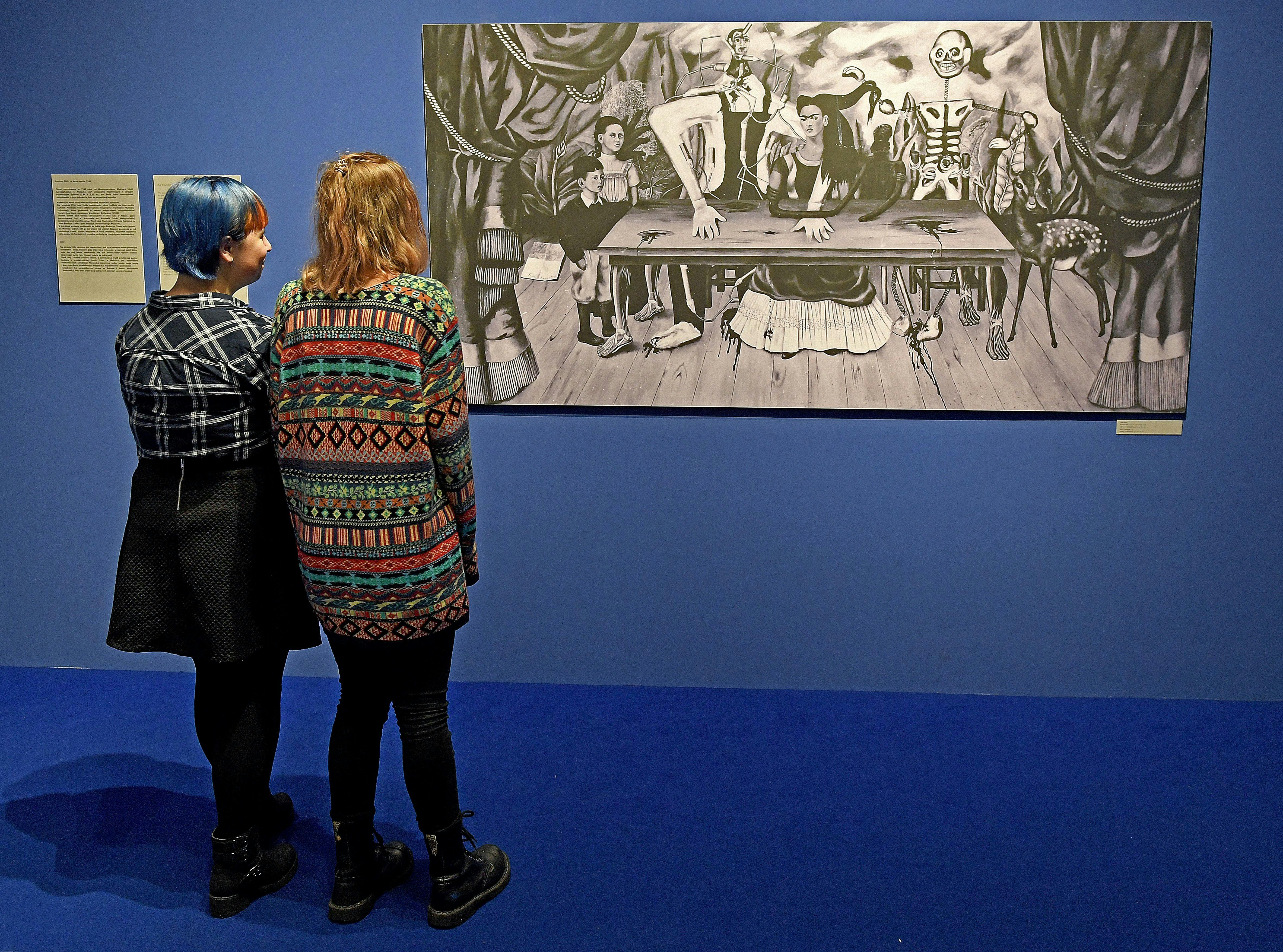
The wooden tabletop breaks open with bloody wounds and sores, which drip onto the floor and the hem of her dress. The table scene is framed by heavy crimson curtains, providing a theatrical quality to the setting, while the background captures a gloomy grey sky and oversized plants bursting up from the ground. Certain elements such as her traditional dress and Nayarit figures are a nod to Mexicanidad, the revival of a traditional Mexican identity that emerged in the wake of the Mexican Revolution (1910-20), a backlash to Spanish colonial rule.
Related: The True Story Behind Frida Kahlo's Iconic Style
The painting was first shown in January 1940 at the International Surrealism Exhibit in Mexico City but was last seen at an exhibit in Warsaw in 1955 before it was schedueld to tour around other Eastern European countries. However, the painting disappeared while in Warsaw and has not been seen since. Theories range from theft to destruction.
Despite its missing status, three photographs were taken of the work between 1940 and 1944. The Kunstmuseum Gehrke-Remund in Baden-Baden, Germany was able to commission a replication of the work, as they hold the only license from the Banco de México Diego Rivera & Frida Kahlo Museums Trust to do so.
Related: The Top 10 Stolen Paintings
Throughout the last 65 years, rumors of the painting's whereabouts have periodically cropped up. In June 2019, a man was arrested in Mexico for allegedly trying to sell the painting to a collector in London in exchange for an Acapulco mansion. However, no evidence of the painting was found.
Then in June 2020, the Spanish dealer Cristian Marquez claimed that he had the painting in London and would show it to anyone who offered $45 million on behalf of the owner. However, experts have disputed the authenticity of the painting in the image Marquez provided. Whether the painting is still in existence, and where it is, remain a mystery, but the enigma of the masterpiece will continue to endure.
Discover more articles on Barnebys Magazine
This is an updated version of the article originally posted on July 17, 2020.