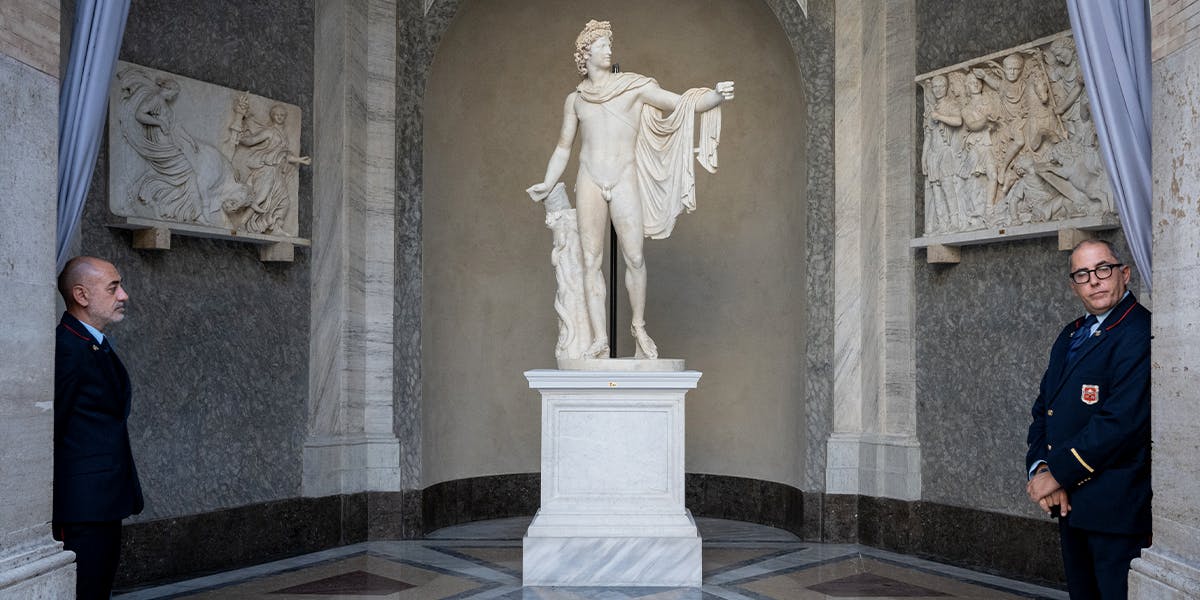
Even gods need a bit of pampering now and then: In 2019, the famous marble statue Apollo Belvedere was taken from its usual place in the Vatican's Belvedere Courtyard for an extensive restoration. Cracks had appeared on its legs and knees, which needed repairing. A laser cleaning was also performed, and a carbon fibre support was added to the back to improve its stability for the future.
See also: 5 Must-See Sculptures in Italy
The Apollo Belvedere is a Roman marble copy of a lost Greek bronze sculpture, created around 330 BC. It is attributed to the late Classical sculptor Leochares, who also worked for Alexander the Great and his father, Philip of Macedonia.
The 2.24-metre-high Roman copy, made from Carrara marble in the 2nd century, was rediscovered in the late 15th century. Shortly after, it was acquired by Cardinal Giuliano della Rovere, who, upon becoming Pope Julius II, had it placed in 1511 in the courtyard of the papal summer palace, Belvedere, in the Vatican. The Apollo Belvedere remains there to this day, housed since 1803 in a pavilion commissioned by Pope Pius VII. Its "neighbours" include the Laocoön Group, another famous piece from Julius II's collection.
See also: How an Ancient Sculpture Changed Renaissance Art
For a long time, the Apollo Belvedere was regarded as the most beautiful sculpture of antiquity, captivating admirers such as Goethe and the archaeologist Johann Joachim Winckelmann.
Want more articles like this delivered straight to your inbox? Subscribe to our free newsletter!
The Vatican Museums are among the most important in the world, housing an extensive collection of artworks spanning several millennia, from antiquity to the present day. The famous Sistine Chapel is also part of this vast complex and undoubtedly contributed to the Vatican Museums being ranked second on the list of the most visited museums in the world last year.