
Frank Stella was born in 1936 in Massachusetts and began his art career in the late 1950s in New York City. When he first introduced his famous Black Paintings in 1963, his pared-down approach helped mark the end of Abstract Expressionism and signified the beginning of object-painting, which later became known as minimalism.
Related: The Essence of Minimalism: Refined Simplicity

His 'Black Paintings' series was a pre-cursor to the colorful geometric works for which he is most recognized today. The black enamel painted canvas with hand-drawn stripes appears simple and monochromatic, but, in actuality, required intense focus to make the stripes appear straight though done by hand. One of these paintings, and Stella's most expensive painting sold at auction, Point of Pines, was painted when he just 23. Sold for $28 million in 2019 at Christie's, it was both a rejection of Abstract Expressionism and a premonition of the repetition and pattern that Pop Art would promote in the coming decade.
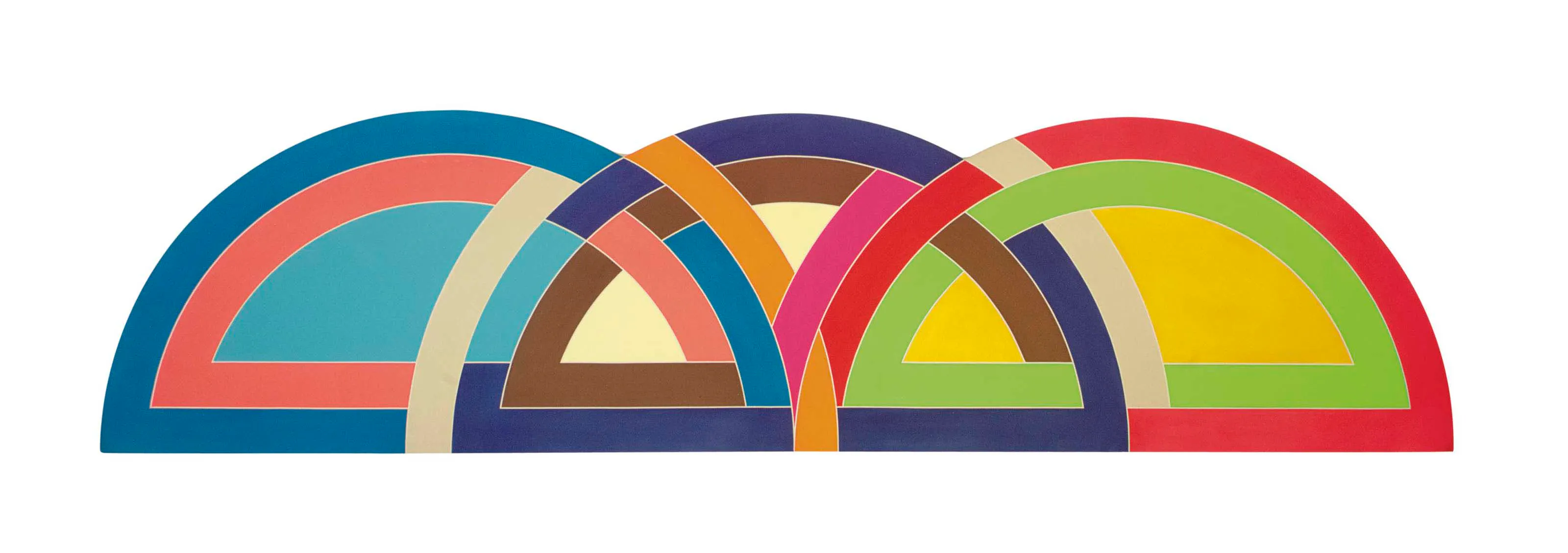
His following canvases, daring for the time, appeared in the late 1960s with geometric precision, fantastical color, and infinite pattern. He also used shaped canvases that differed from the usual rectangular or square format to create increasingly complex and brightly colored polygons, which he introduced with his Irregular Polygon series of 1967. He became the youngest artist to get a retrospective at MoMA in 1970, when he was 34.
Related: Abstract Art: From Genre to Movement

Beginning in the 1970s, he began experimenting more with sculpture, producing works in high relief and incorporating materials like aluminium, glass, and wood. By the 1990s, he had started building monumental sculptures with 3-D computer printing that almost explode with swirling shapes, juxtaposing edges and curves, and dramatic color. He had even offered these artworks as NFTs in the past few years. Though he has experimented with a variety of techniques and mediums, he has always rendered his work in the abstract and has never dabbled in the figurative.

Stella's works are found in major museum collections, including the Whitney Museum of American Art in New York, the Art Institute of Chicago, the Tate in London, and the Peggy Guggenheim Collection in Venice. He was awarded the National Medal of the Arts in 2009 by President Obama.
Want more articles like this straight to your inbox? Subscribe to our free newsletter here!

On May 4, 2024, it was announced that Stella had passed away of lymphoma in New York. He leaves behind a legacy that profoundly changed American art. His iconic canvases exhibited and recognized around the world revealed the shift from Abstract Expressionism that prevailed in the 1950s into the minimalist movement that began in the 1960s.
“After all, the aim of art is to make space, space that is not compromised by decoration or illustration, space in which the subject of painting can live," said Stella in 1983. "This is what painting has always been about.”