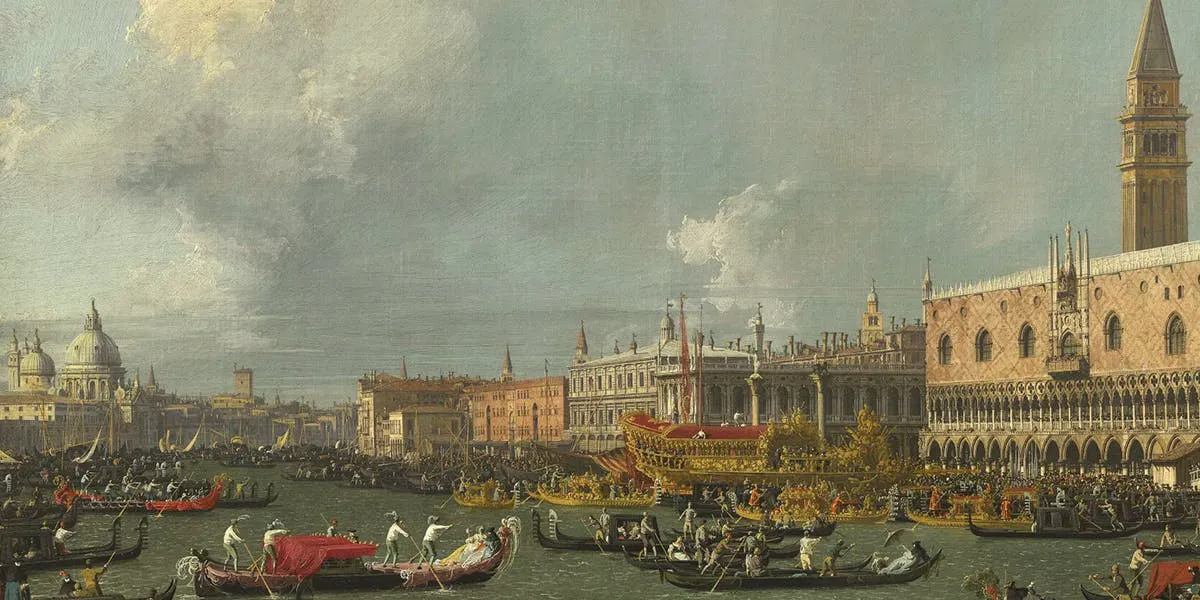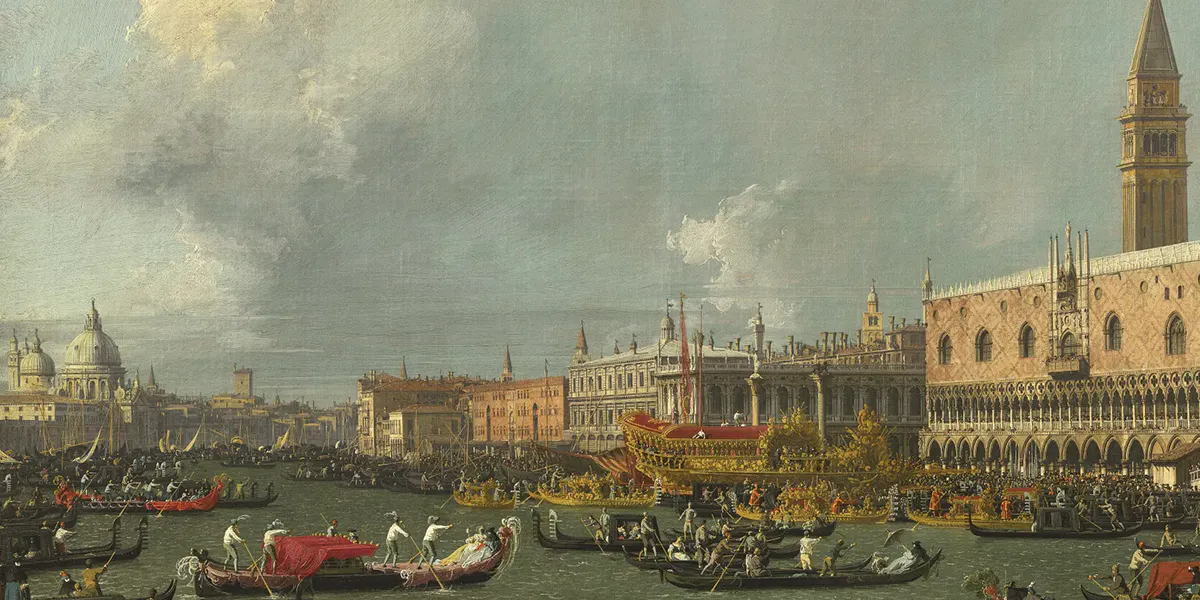
Celebrated annually on Ascension Day, the Festa della Sensa was Venice's most important festival until the fall of the Republic in 1797. The event began with the Sposalizio del Mare (“Marriage of the Sea”) ceremony, during which the Doge symbolically wed the realm of Poseidon from his opulent gondola, the Bucintoro, by casting a golden ring into the waters of the Adriatic Sea. This ritual commemorated Venice's victory over Dalmatian pirates in the year 1000 and affirmed the Serenissima's dominance over that part of the Mediterranean. The Doge's return to the pier at the Palazzo Ducale marked the beginning of an opulent celebration, centered around the bustling fair in St. Mark's Square.
See also: Canaletto: The Spirit of Venice
Many artists captured the splendor of this event in their works, including Giovanni Antonio Canal, known as Canaletto (1697–1768), who dedicated several paintings to it. One of these works now belongs to the Royal Collection at Buckingham Palace, while another once graced the walls of a building just a 20-minute walk away—10 Downing Street, the official residence of the British Prime Minister.
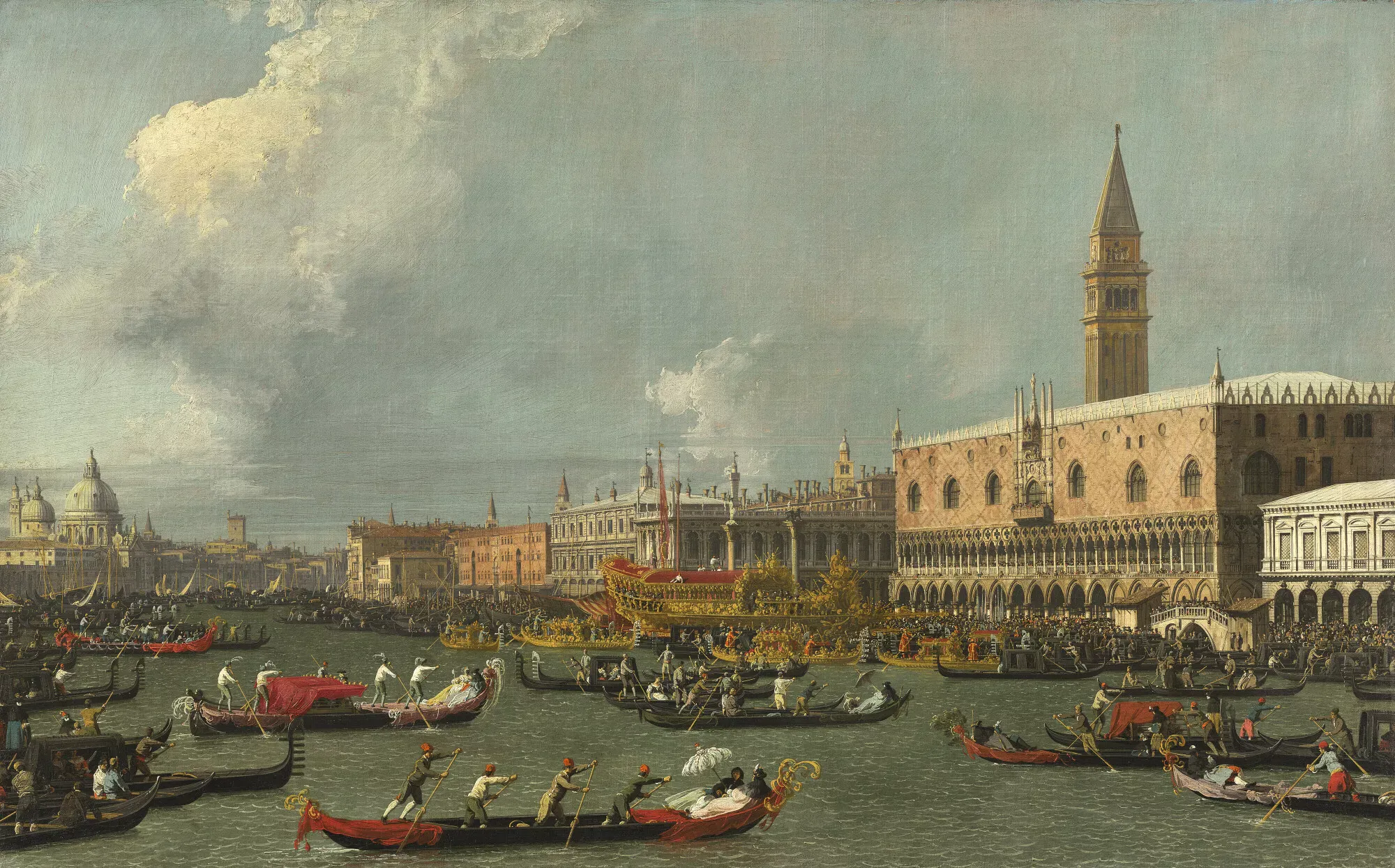
In 1735, Robert Walpole, 1st Earl of Orford (1676–1745), became the first Prime Minister of Great Britain to occupy the newly renovated residence. He brought with him a selection of artworks from his personal collection. An inventory from 1736 lists two paintings by Canaletto: The Grand Canal, Looking North-East from Palazzo Balbi to the Rialto Bridge and Venice, the Return of the Bucintoro on Ascension Day. Both paintings left Downing Street with Walpole in 1742 and were auctioned together in 1751 on behalf of his grandson, George Walpole. After another auction in France in 1993, the pair went their separate ways. The Grand Canal, Looking North-East from Palazzo Balbi to the Rialto Bridge resurfaced at Sotheby’s in London in 2005, setting a record for Canaletto at £18.6 million, a record that still stands today.
Now, Venice, The Return of the Bucintoro is set to return to the auction stage for a third time on Ascension Day as the star of Christie’s Old Masters Evening Sale on July 1 in London, where it will be presented as the top lot.
See also: 7 Paintings of London You Should Know
Andrew Fletcher, Head of Old Masters at Christie’s, stated in a press release: “Seldom does a true masterpiece such as this - particularly by a painter as important as Canaletto - appear on the art market, and it is utterly thrilling to be handling its sale. This extraordinary painting of the grandest and most familiar view of Venice, by the city’s most recognisable painter, dates to Canaletto’s finest period and is as notable for its illustrious provenance as much as for its impeccable condition. It is unquestionably the greatest work by the artist to have come to the market in a generation.”
Want more news like this straight to your inbox? Subscribe to our free newsletter!
The exact circumstances of how Robert Walpole acquired the painting remain unclear. It is likely that it was brought back by his son, Edward, who concluded his Grand Tour of Europe in 1730–31, with a stay in Venice between January 1730 and January 1731. Based on its stylistic elements, Venice, The Return of the Bucintoro on Ascension Day is believed to have been created around 1731–32, but Edward may have commissioned it from Canaletto before his departure.
The painting is estimated to fetch around £20 million (about $24.5 million), reflecting its quality, provenance, rarity in the auction market, and the benchmark set by its companion piece in 2005.