
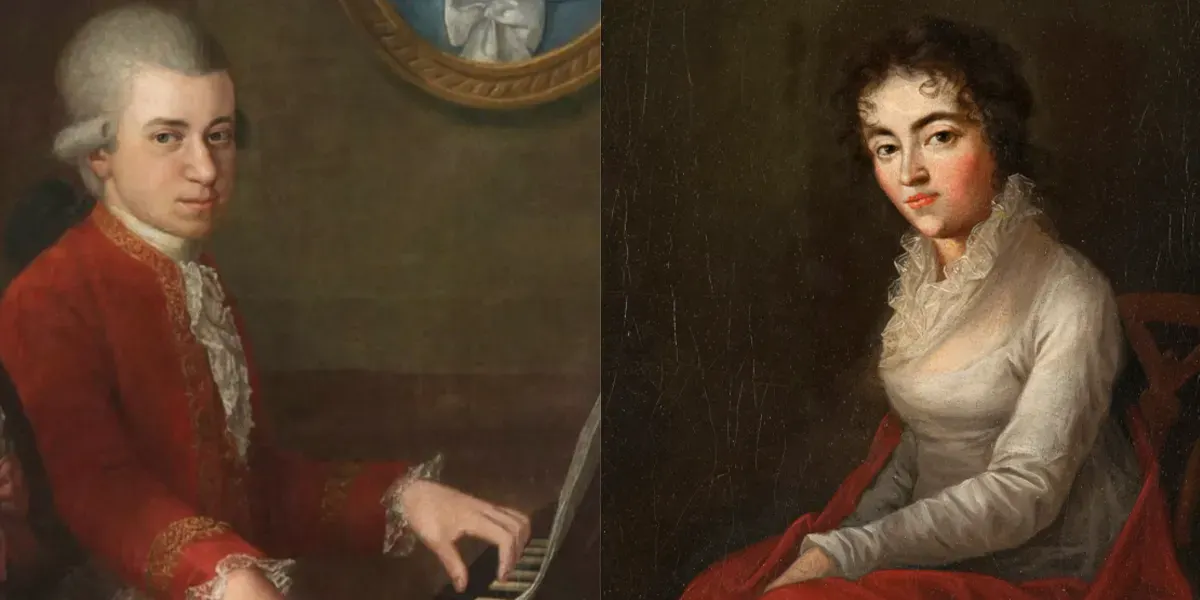
In 1782, Wolfgang Amadeus Mozart (1756-1791) experienced a successful breakthrough in his career. The year before he had moved from Salzburg to Vienna, where he premiered his opera Die Entführung aus dem Seraglio ("The Abduction from the Seraglio") on July 16, 1782 in the Burgtheater for Emperor Joseph II. The opera about the protagonist Konstanze, who was kidnapped in a harem, was an immediate success and, as one of the first German operas, was of historical importance.
But at that time another Constanze dominated Mozart's thoughts...
Wolfgang Amadeus Mozart and Constanze Weber (1762-1842) met in Mannheim in 1777 when Mozart, accompanied by his mother Anna Maria, was trying to find a new job in several cities after he had given up his engagement with the Salzburg court orchestra. In addition to a son, the Webers had four daughters, all of whom were trained as singers, with the second eldest, Aloisia, being the most talented of all. Mozart fell in love with Aloisia; however, since he could not find a job in Mannheim, he and his mother moved on to Paris, where Anna Maria Mozart died on July 3, 1778. Then Wolfgang Amadeus made his way home to Salzburg, in order to work for the local archbishop again.
Related: The 5 Most Expensive Mozart Objects Ever Auctioned
In 1781 both the Webers and Mozart were living in Vienna and they renewed their acquaintance. At this point, Aloisia was already married to the actor and painter Joseph Lange, and Mozart's attention shifted to her younger sister Constanze, who returned his feelings, which her now widowed mother Cäcilia Weber noticed. In fact, Mozart was staying with the Webers at the time. His visit had actually been planned for just one week, but ended up dragging on for longer. Mozart finally had to leave the Weber household at the beginning of September and moved into a "bachelor pad" on the Graben. He continued courting Constanze, but there were problems, given that Leopold Mozart refused to give his son consent to marry.
If young couples in love were denied permission to marry, they had only one option: they had to confront the parents with a fait accompli, in the form of a “kidnapping” of the bride, which usually ended with a secret wedding. In the Mozart-Weber case, the rejected daughter-in-law moved in with her fiancé.
Out of concern for her daughter's good reputation, Cäcilia Weber considered having the police remove Constanze from Mozart's apartment. Constanze's youngest sister Sophie secretly informed the young musician about this. Mozart then wrote a letter to his patron and friend, Baroness von Waldstätten, in which he asked whether such action by the police in Vienna was actually permissible. He also described his future mother-in-law as stupid, since a police operation would draw a lot of unwanted attention to what was happening. Mozart saw only one solution that could protect his sweetheart from such shameful treatment: the wedding, which then took place shortly afterwards, on August 4, 1782.
Want to discover articles like this straight to your inbox? Then register today for our free newsletter!
The marriage of Wolfgang Amadeus and Constanze Mozart, which got off to such a stormy start, turned out to be a happy one, as evidenced by Constanze's six pregnancies within their nine years together (however, four of the children died young). However, their limited finances caused Mrs. Mozart great worry, and when her husband died in 1791 at the age of only 35, she inherited a mountain of debt. In order to reduce this, she organized concerts together with her sister Aloisia and later sold some of Mozart's handwritten scores. In 1809 Constanze married the Danish diplomat Georg Nikolaus Nissen, with whom she worked on the first biography of Wolfgang Amadeus Mozart and later - widowed for the second time - published it. Constanze Mozart-Nissen died in 1842 at the age of 80.
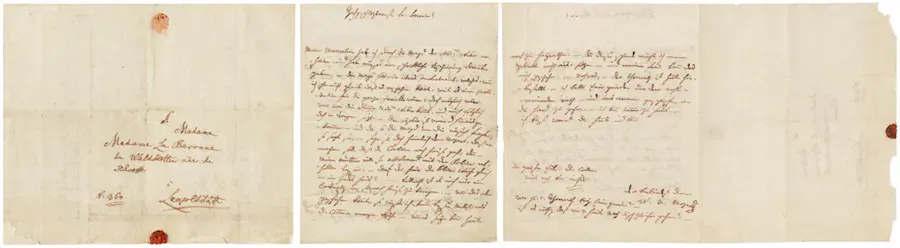
The letter, which Wolfgang Amadeus Mozart wrote to the Baroness von Waldstätten in the summer of 1782, will be sold on July 6 as the highlight of Christie's 'Exceptional Sale' in London with an estimate of £300,000 - 500,000 ($381,000-635,000).
Related: From Haydn to Hip-Hop: Music for Collectors
"Wolfgang Amadeus Mozart is one of the most influential and prolific composers of all time, and we are delighted to unveil such a personal letter to the world," said Thomas Venning, Head of Christie's Books & Manuscripts, London. "Mozart letters are scarce at auction, and it is hard to think of any iconic historical figure where you have an equivalent unfiltered insight into such an important and private moment. The letter has always been in private collections, and has not been seen by the public or scholars since 1989. Christie’s offered the most recent autograph letter and manuscript by Mozart sold at auction, and we are proud to follow that with such an exciting letter and opportunity for Mozart aficionados worldwide."
Check out Barnebys Magazine for more news from the auction market!


![Maud Stevens Wagner, Trapeze artist and first known female tattoo artist in the United States, circa 1907. Image CCØ [detail]](https://images.prismic.io/barnebys/a6433f30d692ecc0c440afd7fc1d4df10558b480_hero.jpg?auto=compress,format)