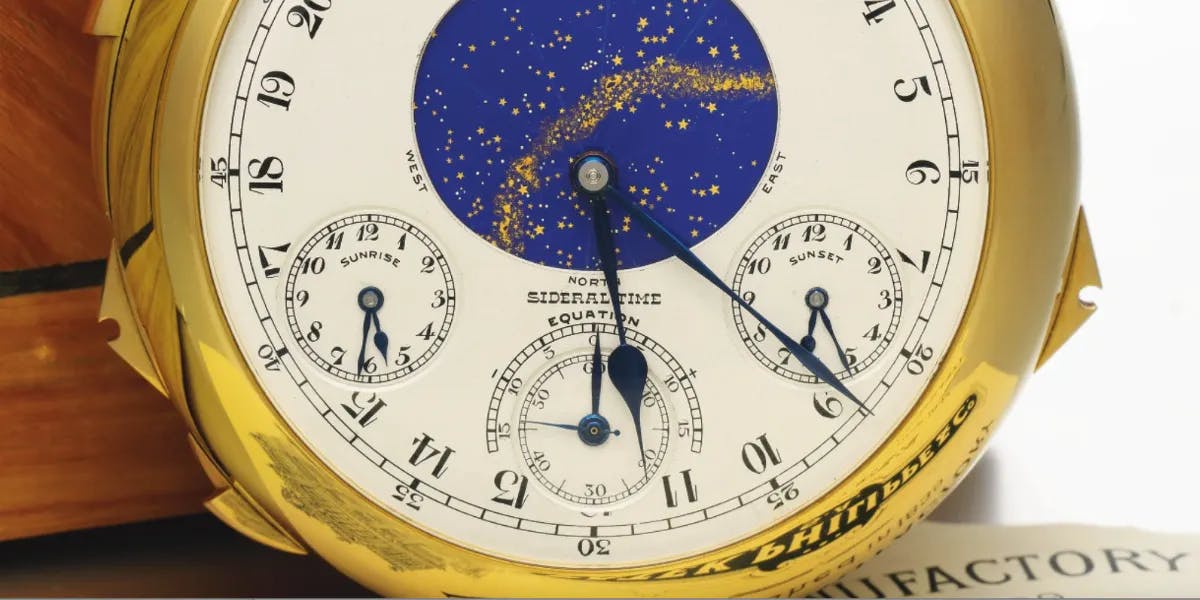
The Henry Graves Jr. Supercomplication pocket watch was produced by Patek Philippe in 1933 following the commission of the eminent New York banker Henry Graves Jr. in 1925. This absolute masterpiece of horological art was for 56 years the most complicated analog watch in the world. It took three years to design and five years to manufacture this gold timepiece comprising 920 different parts including 430 screws, 110 wheels and 70 precious stones. In addition, the greatest talents of the time, in particular the sons of Victorin Piguet from the Vallée de Joux, were called upon to collaborate on the production of this pocket chronograph in gold with minute repeater and eastern Westminster chime.
Related: Patek Philippe: A Timely Investment
What makes the Supercomplication unique is its handmade manufacture, without the aid of technical devices. This pocket watch has 24 different functions. It displays the time of sunset and sunrise in New York, the moon phases, and the sky chart, as well as a perpetual calendar which will be reset in 2100. For 56 years, these functions made the Henry Graves Jr. Supercomplication the most complex analog in the world, later supplanted by computers. This pocket watch is the only example of its kind in yellow gold, with its platinum equivalent being part of the Patek Philippe Museum in Geneva.
Related: Pocket Watches: History, Revival, Trends & Tips
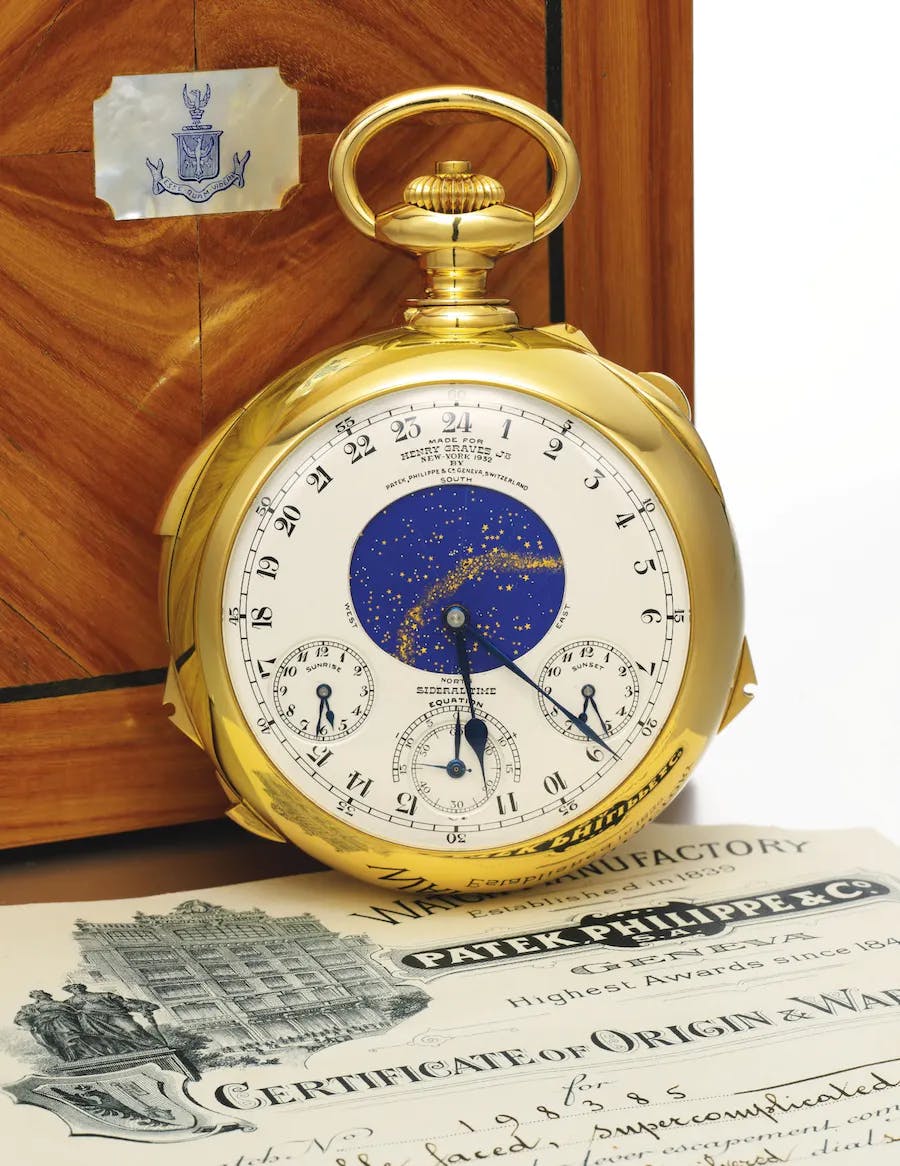
This incredible treasure obviously has its price: the piece was sold for the first time in December 1999 for $11 million, smashing its low estimate of $3 million as part of the “Time Museum” sale. It then took the place of the most expensive pocket watch in auction history when it was put on sale again in November 2014. The chronograph sold for more than double its previous record, selling for $24 million at Sotheby's in Geneva. In 2019, it was dethroned by the Patek Philippe Grandmaster Chime Ref. 6300A wristwatch acquired for $31 million in Geneva as the priciest watch in the world. Today, among the 10 most expensive watches in history, the Supercomplication is the only pocket watch and the oldest produced.
Related: This Is The World's Most Expensive Watch
In watchmaking, a complication designates any function with a more complex display than that of a "simple movement", i.e. a timepiece indicating only the hours, minutes and seconds. Complications can be found in any mechanical clock, but they are most noticeable in mechanical watches where the small size makes them difficult to design and assemble and therefore also increases the value. There are several levels of complication. Simple complications range from dual and triple time zone functions to moon phase indication, simple calendar with day/date and annual calendar.
Want to receive our latest articles straight to your inbox? Subscribe to our newsletter!
More sophisticated complications (supercomplications) include functions such as the perpetual calendar (changing of the date automatically), the chronometer to the second, to the tenth, even or to the nearest thousandth of a second, the tourbillon to improve the precise mechanical movements, the display of the position of the stars, the display of two or even several time zones on the same dial, the display of the phases of the moon, an alarm clock or even the possibility of playing music.
Related: Inner Beauty: The World of Watch Complications
Supercomplicated watches are produced in strictly limited numbers, as is the case with Henry Graves' Supercomplication. Perhaps the most famous watch houses for creating such pieces are Breguet, Patek Philippe and Vacheron Constantin. The first supercomplicated watches appeared thanks to the ambitious attempts of watchmakers who wanted to combine a large number of functions in the same case. Mechanical clocks with multiple functions, for example, astronomical indications, inspired ideas for the designers of the first pocket watches. The thinner and smaller the case, the more complicated and expensive the work. Today supercomplicated pocket watches and wristwatches can sell for many millions at auction, with the Henry Graves Jr. model as the original trailblazer.