
全部拍賣 / Ancient Art / YOSHITOSHI

YOSHITOSHI
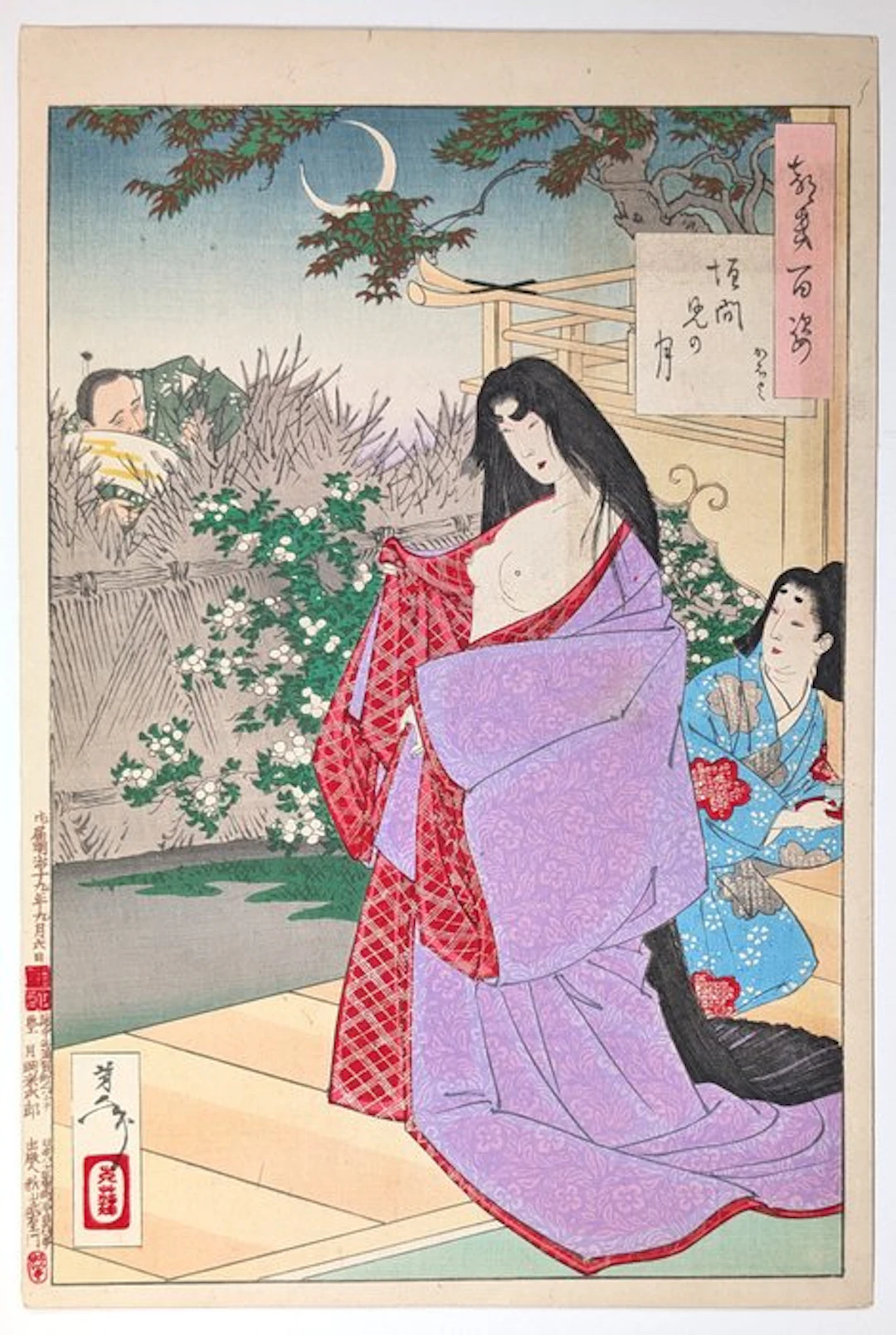
** The peeping moon: Kō no Moronao spies on the beautiful Kaoyo, the root of the Chūshingura revenge. This is the only erotic sheet from the series. Very sought-after design and rarely seen on the market ** TSUKIOKA YOSHITOSHI (1839–1892) Title: 月百姿 垣間見の月 かほよ (Kaimami no tsuki – Kaoyo), A Glimpse of the Moon: Kaoyo Series: Tsuki Hyakushi (月百姿) — One Hundred Aspects of the Moon; Stevenson no. 44 Date: Meiji 19 (1886) — red date cartouche 御届明治十九年六月五日 printed in the left margin Publisher: Akiyama Buemon (秋山武右衛門) Format: Ōban tate-e — approx. 36 × 24 cm Technique: Woodblock print (mokuhanga), polychrome (nishiki-e) Condition Excellent impression, with excellent colour throughout. The burnishing textile on the rope is very well preserved and flashes when the sheet tilted to light. The bokashi is present. The sheet carries an album backing. The publication block is preserved: date cartouche, guild seals, the artist's own address seal, and the Akiyama Buemon / Kokkeidō. There is a minor soiling around the center and right margin. Nothing obtrusive and can be professionally cleaned. Very good overall! The Scene Kaimami (垣間見) means "a glimpse through a gap in the fence." In classical Japanese literature, it was the way a man first caught sight of a secluded court lady. Yoshitoshi gives this courtly motif a darker turn. The story comes from the Taiheiki, the 14th-century war chronicle. Kō no Moronao (d. 1351) was the chief steward of the shogun Ashikaga Takauji and one of the most powerful men of his day. He became obsessed with the wife of Enya Hangan Takasada, a woman famed for her beauty. In the British Museum's description of this print, Moronao is spying on Kaoyo as she dresses. A crescent moon hangs above the scene, and he hides behind the fence, peering over his fan. Moronao then sent her a love letter. According to tradition, it was ghost-written by the poet-monk Yoshida Kenkō, the author of Tsurezuregusa. She rejected him. In revenge, Moronao accused her husband of treason, and Takasada was hunted down in 1341. His death and the death of his wife followed. Four hundred years later, this episode became the opening of Kanadehon Chūshingura (1748), the great drama of the forty-seven loyal retainers. Censorship forbade staging recent events, so the playwrights moved the real Akō vendetta of 1701–03 back into the 14th century. Moronao stood in for Kira Yoshinaka, and Enya Hangan stood in for Lord Asano. In the play, Moronao's desire for Kaoyo sets off the whole chain of insult, ritual suicide and revenge. This print therefore shows the first spark of Japan's most famous story of loyalty. The Series — Yoshitoshi's Late Masterpiece Tsuki Hyakushi (One Hundred Aspects of the Moon), published by Akiyama Buemon between 1885 and 1892, is universally regarded as the crowning achievement of Yoshitoshi's career and one of the last great monuments of the ukiyo-e tradition. Across one hundred designs drawn from history, legend, literature, and — as here — the living festival culture of Edo, the moon serves as the unifying thread. This sheet, published in June 1886 during the strong early run of the series, preserves the full publication block in the margin: the red date cartouche and the Akiyama Buemon address. Yoshitoshi trained under Utagawa Kuniyoshi and is widely regarded as the last great master of ukiyo-e. Impressions of this design are held by the Library of Congress, the National Museum of Asian Art (Smithsonian), the Art Gallery of New South Wales, and other major collections.
估價:$1,008.39
前往拍賣頁查看所有物品來自Catawiki或Ancient Art
估價:
$1,008.39
類似物品
類似物品的拍賣結果

讓您的拍賣觸及全球收藏家!
立刻發佈上架