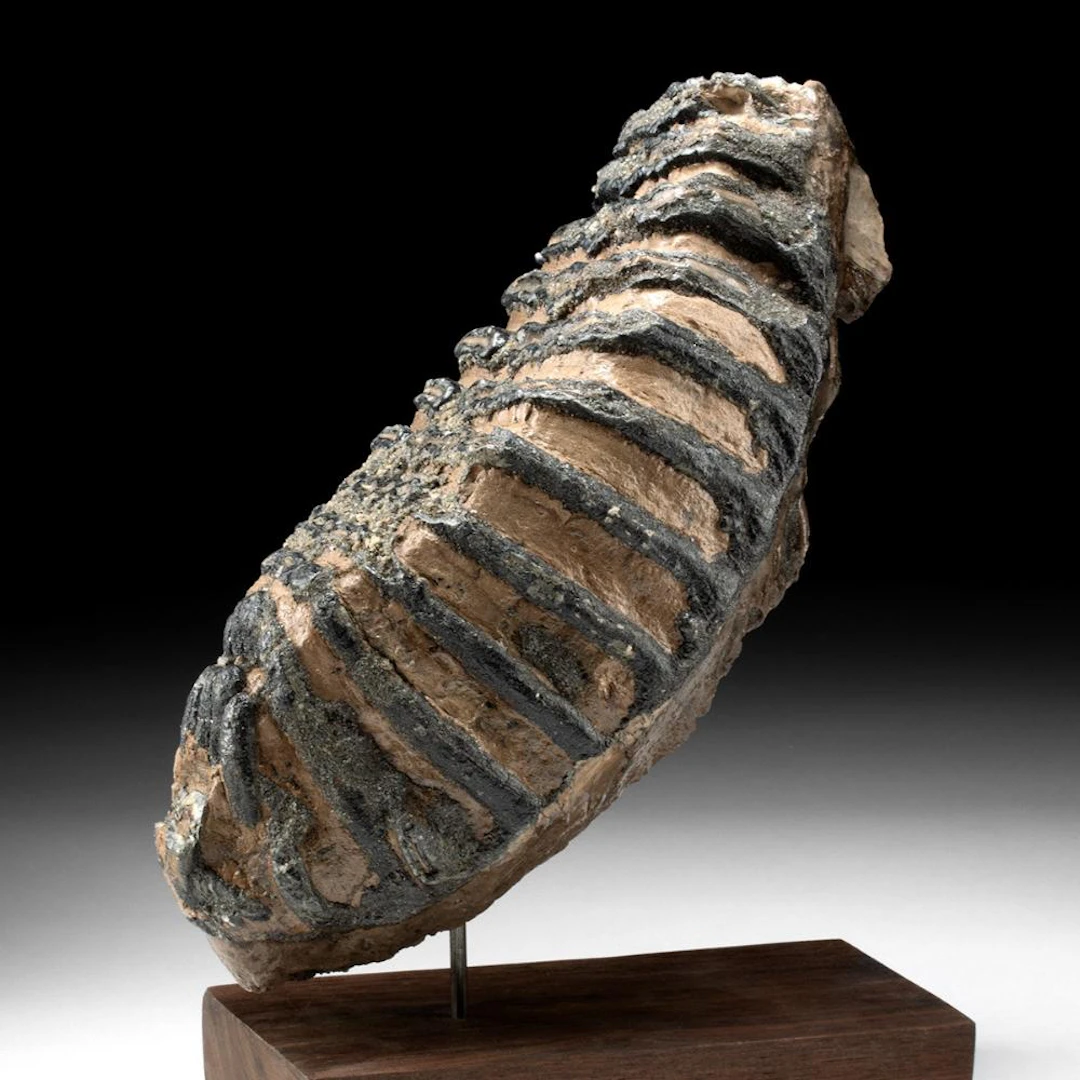
Southern Mammoth Tooth, Mammuthus meridionalis, Early Pleistocene
Early Pleistocene, Eurasia. A fossil grinding tooth of the southern mammoth, Mammuthus meridionalis, set on a dark wooden stand. It is probably a molar. The crown is built from a series of transverse enamel plates (lamellae), stacked like the leaves of a closed book. On the occlusal surface they wear into a row of looped, folded enamel ridges with pale dentine between them. Along the side the plates show as bold dark bands set into tawny brown cementum, and a glittering mineral crust clings to the furrows. Mammoths chewed by grinding the jaw back and forth, and each ridge acted as a rasp on coarse grasses, browse, and shrubs. Large, heavy, and dense with structure, the tooth is a substantial relic of one of the earliest mammoths to spread across Europe and Asia. Mammuthus meridionalis is the first species of true mammoth widely recorded in Europe. It appeared there around the start of the Pleistocene and later gave rise to the steppe mammoth and, in time, the woolly mammoth. Its teeth are easy to tell apart from those of its descendants. The plates are fewer and more widely spaced, and the enamel is thicker. This suited a mixed diet in the milder, wooded settings of the Early Pleistocene, before the cold grasslands of the ice ages favored the many thin plates of later mammoths. Elephants and mammoths did not replace their teeth from below. New teeth moved forward along the jaw, so only one or two large grinders worked in each quarter of the jaw at any time. Item # 205062
估價:$900
前往拍賣頁查看所有物品來自Artemis Fine Arts或Ethnographic