拍品/roman glass miniature jug with ribbon handle WYnJNg2 633076800 / 在售
拍品/roman glass miniature jug with ribbon handle WYnJNg2 633076800
在售價格走勢
拍品/roman glass miniature jug with ribbon handle WYnJNg2 633076800
在售價格走勢
讓您的拍賣觸及全球收藏家!
立刻發佈上架讓您的拍賣觸及全球收藏家!
立刻發佈上架訂閱即表示您同意 隱私政策。可隨時取消訂閱。
Barnebys HQ
Brahegatan 10
BOX 5038
114 37 Stockholm
全部拍賣 / Glass / Roman Glass Miniature Jug with Ribbon Handle

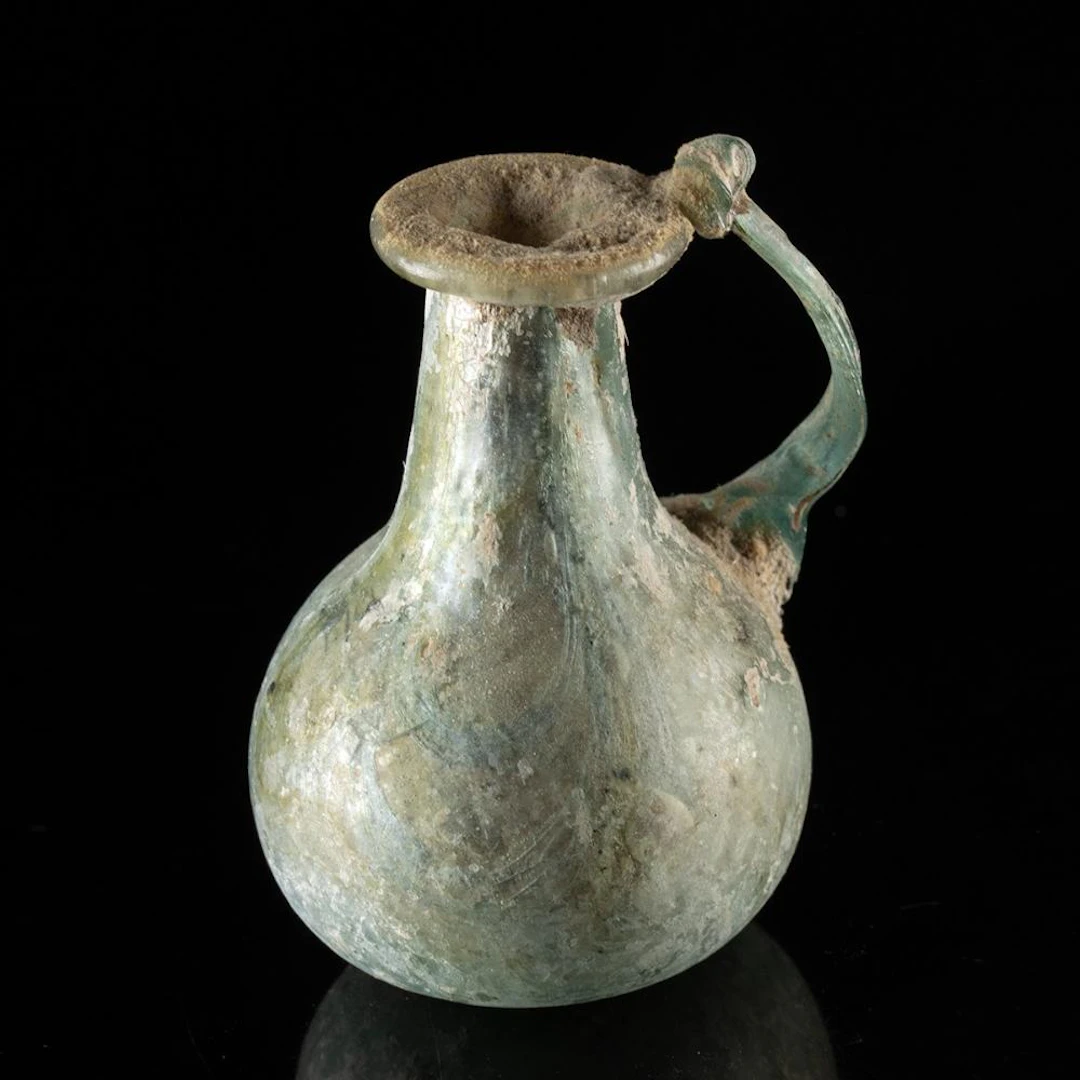
Roman, Imperial period. A miniature free-blown jug of translucent blue-green glass, its globular body drawn up into a slender cylindrical neck and finished with a broad, outfolded disc rim. A single ribbon handle of the same metal was applied hot, drawn from the shoulder and pressed against the rim in a thumbed attachment that still preserves the glassworker's tooling. The natural aqua tint comes from iron impurities in the sand rather than deliberate coloring, and centuries of burial have laid down silvery iridescence and earthen encrustation across the surface. Vessels at this small scale served as containers for perfumed oils, unguents, and cosmetics, dispensed drop by drop from the narrow neck, and they accompanied the dead into the tomb as often as they stood on the dressing table. Supplied with a custom display stand. The invention of glassblowing in the Syro-Palestinian region around the middle of the 1st century BCE transformed glass from a luxury for the few into an everyday material across the Roman world. Where core-forming and casting had demanded days of labor per vessel, a blower could shape a juglet like this one in minutes, and workshops from Sidon to Cologne turned out unguentaria, flasks, and jugs by the thousand. Pliny the Elder, writing in the 1st century CE, remarked on the speed and cheapness of the new craft. The iridescent bloom admired on ancient glass today is a product of decay rather than design: alkali leaches from the surface during long burial, leaving microscopically thin layers that refract light into shifting silver, gold, and violet sheens the Roman owner never saw. Item # 205129
估價:$250
前往拍賣頁查看所有物品來自Artemis Fine Arts或Glass
估價:
$250
讓您的拍賣觸及全球收藏家!
立刻發佈上架
GÖRAN WÄRFF. GLASSKULPTUR, KOSTA BODA, SIGNERAD.
09/29/2026
$139.47
估價: $100.39