
全部拍賣 / Ancient Art / Kaburaki Kiyokata · Kuchi-e · Beauty and Parrot · Meiji...

Kaburaki Kiyokata · Kuchi-e · Beauty and Parrot · Meiji...
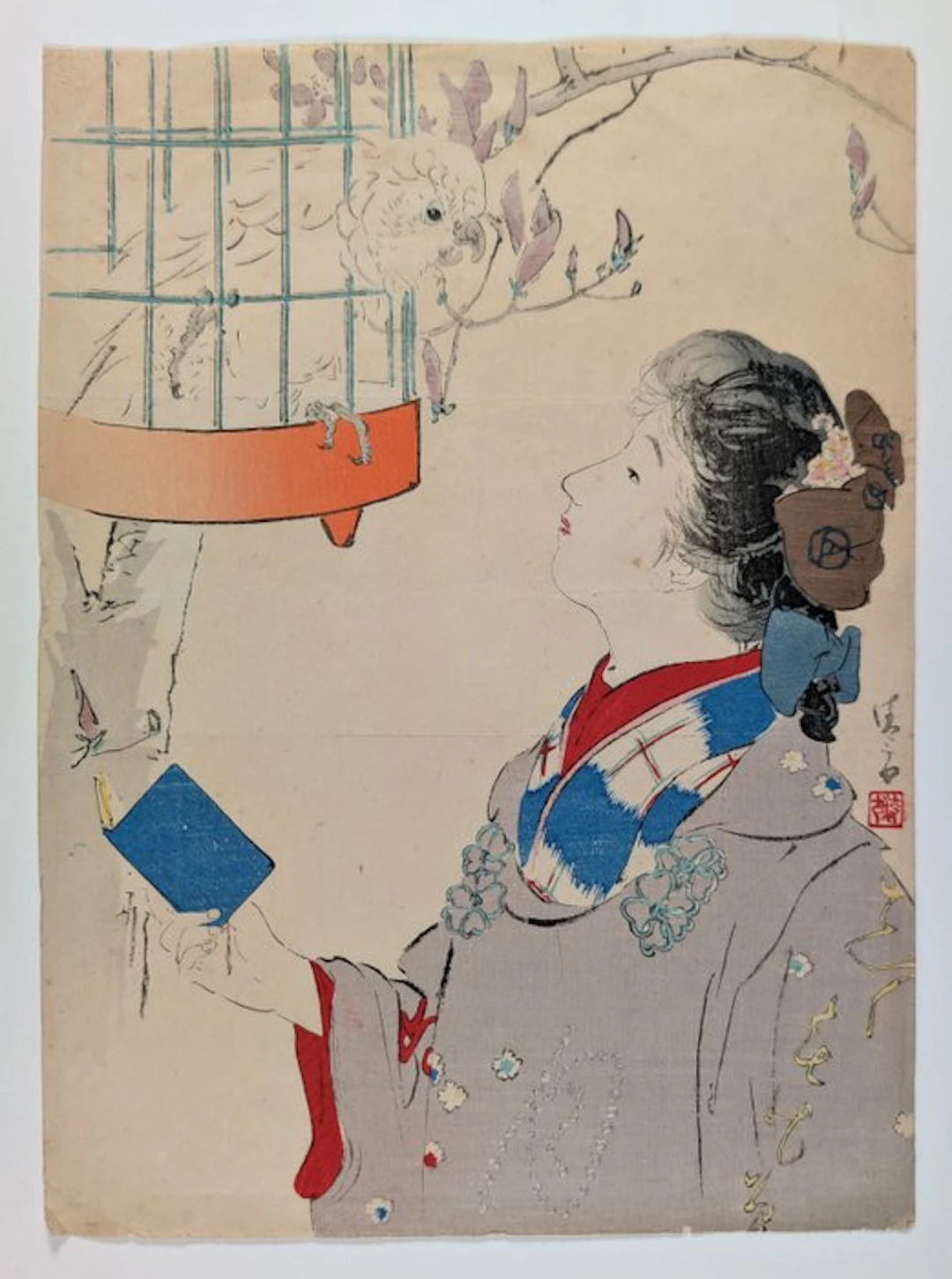
鏑木清方 — KABURAKI KIYOKATA (1878–1972) Beauty and Parrot, kuchi-e frontispiece Technique: Woodblock print (mokuhanga), polychrome, on Japanese washi Date: 1907 (Meiji 40) Period: Meiji era Format: Kuchi-e, tate-e (portrait orientation), approx. 29 × 21 cm Signature: Signed Kiyokata (清方), with red artist's seal, right Condition: The colors and impression are well perserved. The paper has some minor foxing and some creases along the margins! Good condition. Please check the images before bidding. Description: This frontispiece by Kiyokata is known in the trade as "Beauty and Parrot" and dates from 1907. It is a year that matters in his career: it was his last year working mainly as an illustrator before he turned to painting for exhibitions. His kuchi-e from these years are sought after as the best of his printed work, made while he was at the height of his popularity as a book illustrator. THE ARTIST Kaburaki Kiyokata was born in Kanda, Tokyo, in 1878. His father was Jōno Saigiku, a popular novelist who wrote as Sansantei Arindo and co-founded the Tokyo Nichinichi and Yamato newspapers. In 1891 Kiyokata became a pupil of Mizuno Toshikata, himself a pupil of Yoshitoshi, and received the name Kiyokata in 1893. Until 1907 he worked as an illustrator for newspapers and literary magazines, and he designed frontispieces and covers for novels by Izumi Kyōka, Shimazaki Tōson and other leading authors. When the government's Bunten exhibition opened in 1907 he turned to painting. His first entry was rejected, but in 1910 he won a prize for "Onna Kabuki", and he went on to become one of the great bijin-ga painters of the 20th century. His painting "Tsukiji Akashi-chō", lost for decades, caused a sensation when it was rediscovered in 2019. His former home in Kamakura is now the Kaburaki Kiyokata Memorial Art Museum. The family has confirmed that the correct reading of his name is Kaburaki, although it is often written Kaburagi. THE KUCHI-E TRADITION Kuchi-e are single-sheet woodblock prints that were folded and bound into the front of Japanese novels and literary magazines, from the 1890s until the early Taishō period. They continue the ukiyo-e tradition, often with carving and printing finer than Edo-period work. More than a hundred artists designed them. The first generation included Takeuchi Keishū, Tomioka Eisen, Mizuno Toshikata and Kajita Hankō. Kiyokata and his friend and rival Hirezaki Eihō, both descended from the Yoshitoshi line, were the two most popular designers of the next generation. In 2020 the Ōta Memorial Museum of Art in Tokyo devoted an exhibition to the two of them.
估價:$168.55
前往拍賣頁查看所有物品來自Catawiki或Ancient Art
估價:
$168.55
類似物品
類似物品的拍賣結果


讓您的拍賣觸及全球收藏家!
立刻發佈上架