拍品/henri matisse 1869 1954 after nu au bracelet FpDn6Ah 633028471 / 在售
拍品/henri matisse 1869 1954 after nu au bracelet FpDn6Ah 633028471
在售價格走勢
拍品/henri matisse 1869 1954 after nu au bracelet FpDn6Ah 633028471
在售價格走勢
讓您的拍賣觸及全球收藏家!
立刻發佈上架讓您的拍賣觸及全球收藏家!
立刻發佈上架訂閱即表示您同意 隱私政策。可隨時取消訂閱。
Barnebys HQ
Brahegatan 10
BOX 5038
114 37 Stockholm
全部拍賣 / Miscellaneous / Henri Matisse (1869-1954) after - Nu au Bracelet

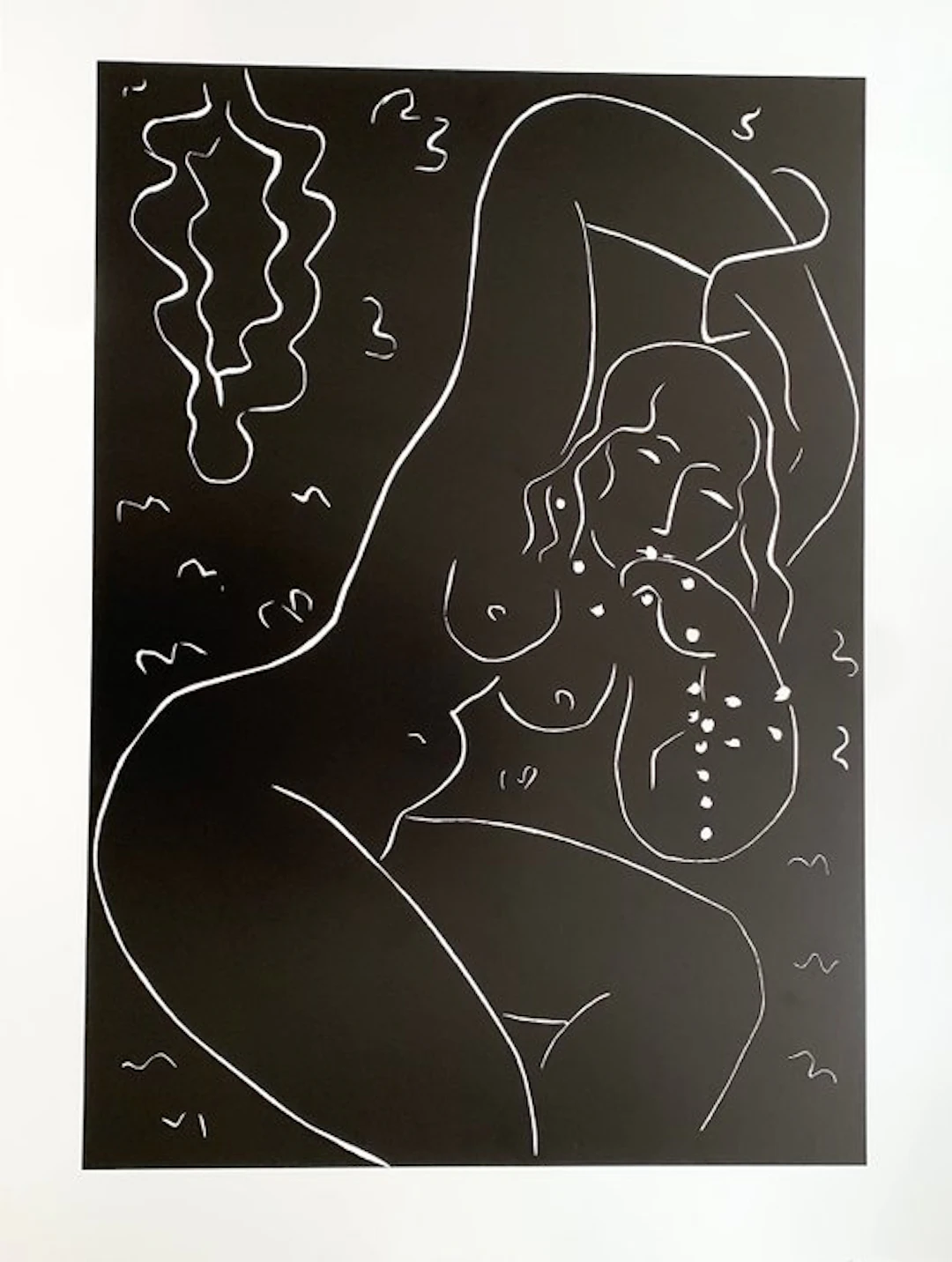
- OUR LAST EXEMPLAR IN THIS AUCTION - Beautiful, expressive fine art print by Henri Matisse in the format 80 x 60 cm titled Nu au Bracelet (1940). The work is a high-quality print on stiff paper and in good condition, slight scratches in the black color area. Artist: Henri Matisse Title: Nu au Bracelet Type: Fine art print Technique: Offset printing on stiff paper Originality: Reproduction Sheet size: 80 x 60 cm Condition: very good condition Origin: Kunstverlag Era: Modern art Nationality: French art Henri Matisse: Henri Matisse, born December 31, 1869 in Le Cateau-Cambrésis, France, and died November 3, 1954 in Nice, France, was one of the most important artists of the 20th century and a leading figure of Fauvism. With his bold use of color and form, Matisse revolutionized painting and profoundly influenced modern art. His works, characterized by a vibrant color palette and a masterful simplification of form, influenced numerous artists and art movements. Matisse began his artistic career relatively late, after initially studying law. He moved to Paris to study at the Académie Julian and later at the École des Beaux-Arts. In Paris, Matisse came into contact with the works of the Impressionists, especially Claude Monet and Pierre-Auguste Renoir, whose loose brushwork and interest in the effect of light on color deeply impressed him. Monet’s Water Lilies series and Renoir’s Le Moulin de la Galette exemplify the influence of the Impressionists on Matisse. A pivotal moment in Matisse’s career was his encounter with the work of Paul Cézanne, which inspired him to simplify forms in his paintings and structure the composition. Cézanne’s geometric treatment of nature, as seen in works like Mont Sainte-Victoire, inspired Matisse to reduce painting to its essential elements of form and color. These influences led to a radical simplification of form and a more intense use of color, clearly expressed in his Fauvist work. Fauvism, the name of which was coined by a critic who described Matisse’s works at the Salon d’Automne in 1905 as les fauves (the wild beasts), was a short but influential movement. Artists like André Derain, Maurice de Vlaminck, and Raoul Dufy, who were also part of Fauvism, shared Matisse’s passion for pure, luminous colors and an expressive, simplified form language. Matisse’s Woman with a Hat (1905) and The Dance (1910) are iconic examples of Fauvism, demonstrating a bold, emotional use of color that characterizes the movement. Derain’s Charing Cross Bridge and Vlaminck’s Bateaux à Chatou reflect the same intense color and freedom in painting. Matisse’s influence extended to the development of Abstract Art. Artists like Wassily Kandinsky and Piet Mondrian saw in Matisse’s color and form reduction a way to reduce painting to its essential elements. Kandinsky’s Improvisations and Mondrian’s Composition with Red, Blue and Yellow reflect this development. Both artists recognized in Matisse’s work the possibility of using color and form as independent expressive means, regardless of the depiction of the real world. The relationship between Matisse and Pablo Picasso was complex and mutually inspiring. Although their approaches were different—Matisse preferred color and decorative forms, while Picasso focused on form and structure—they influenced each other strongly. Picasso’s Cubist works such as Les Demoiselles d’Avignon sit in dialogue with Matisse’s Fauvist paintings, and both artists shared an interest in breaking with traditional conventions of art. This rivalry and friendship between Matisse and Picasso propelled the development of modern art and set new standards in artistic innovation. Matisse was also a pioneer in the use of cut-outs, a technique he developed in the later years of his life as his mobility became restricted. These works, such as Icarus (1947) and the Jazz series (1947), illustrate his masterful ability to achieve strong visual and emotional impact with simple shapes and bold colors. These cut-outs influenced later artists such as Ellsworth Kelly and Henri Michaux, who also experimented with reducing form and color. Kelly’s large fields of color and Michaux’s gestural abstractions show how Matisse’s cut-outs inspired a new direction in modern art. Matisse’s work also left a mark on American art in the 20th century, particularly with Abstract Expressionists like Mark Rothko and Barnett Newman. Rothko’s large color fields and Newman’s Zip paintings show a deep connection to Matisse’s intense, flat color use. Like Matisse, both artists sought a pure, universal form of expression that goes beyond traditional representation. Matisse’s influence remains alive in modern art. Artists such as David Hockney and Jeff Koons have incorporated Matisse’s experimental spirit and his engagement with color and form into their own work. Hockney’s colorful landscapes and portraits and Koons’ sculptural works, often with strong color impact, demonstrate how Matisse’s approaches live on in contemporary art. Hockney’s A Bigger Splash and Koons’ Balloon Dog are examples of continuing Matisse’s color and form experiments in modern art. In summary, Henri Matisse remains a central figure in art history, with influence spanning numerous movements and generations of artists. His innovative use of color and form, his commitment to reducing art to essentials, and his ability to achieve deep emotional effect with simple means have profoundly shaped modern art. From the Fauves to the Abstractionists to contemporary artists, Matisse has significantly influenced 20th-century art and beyond and remains a vibrant legacy in the art world. Shipping information: We roll prints onto sturdy hardboard rollers, wrap them in cardboard, and ship them in sturdy cartons. Shipping includes a tracking number for shipment tracking. About us: We have been active in the art trade for over 20 years and have extensive experience in the professional handling and shipping of artworks. - No shipping to the Canary Islands -
估價:$169.9
前往拍賣頁查看所有物品來自Catawiki或Miscellaneous
估價:
$169.9
讓您的拍賣觸及全球收藏家!
立刻發佈上架