
全部拍賣 / Arts & Graphics / Francisco Sánchez Manso (1935) - Le Lac des montagnes

Francisco Sánchez Manso (1935) - Le Lac des montagnes
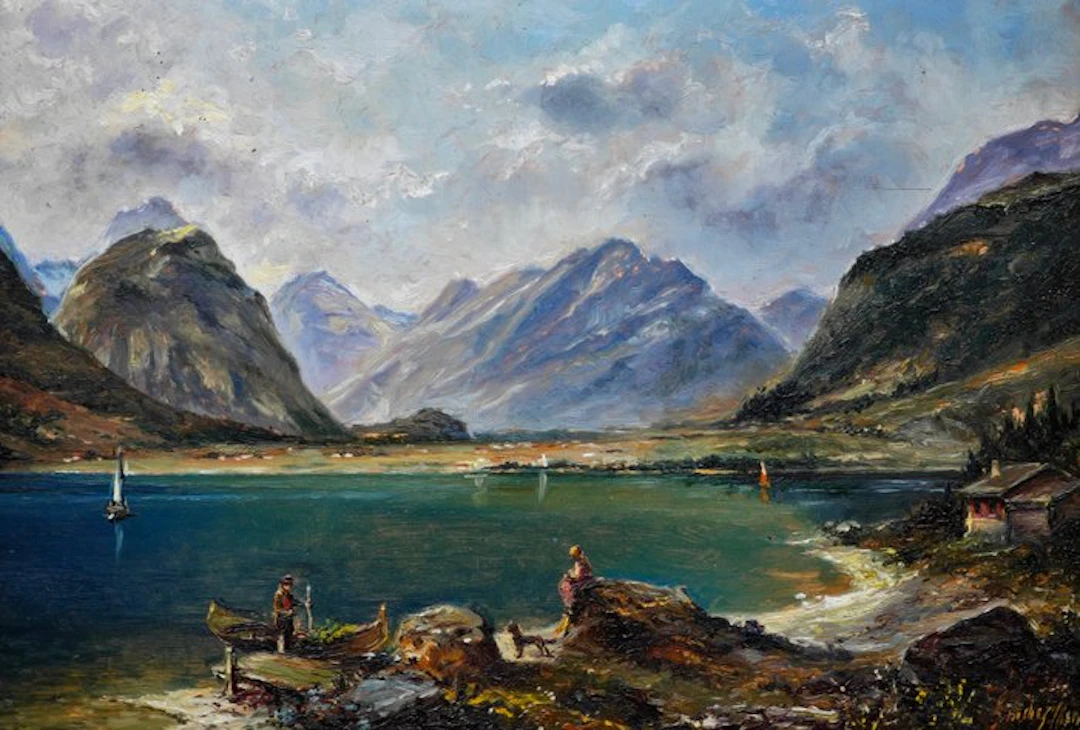
Francisco Sánchez Manso (1935) Landscape of the mountains with lake and figures – Oil on copper Interesting original oil painting on copper by the Spanish artist Francisco Sánchez Manso (1935), which depicts an evocative mountainous landscape centered on a wide lake with blueish waters, surrounded by imposing rock formations and accompanied by small human figures and boats. The work stands out for the richness of its composition, the handling of light, and the meticulous detailing, especially evident in the figures, the boats, and the buildings by the shore. The artist develops a figurative and naturalistic landscape interpretation, combining a traditional classical composition with expressive brushwork and a palette of great intensity. The landscape presents a serene and evocative atmosphere, in which the monumental mountains contrast with the delicacy of the small scenes of human activity. The composition shows affinities with the tradition of Romantic and European naturalist landscape painting, especially in the prominence of the mountains, the spaciousness of the scene, and the importance given to atmospheric effects. The use of copper as a painting support is a particularly interesting feature of the work, since it is a material historically used for small-format, highly precise paintings. The artist: Francisco Sánchez Manso (1935) Francisco Sánchez Manso, a Spanish painter born in 1935 and linked to Madrid according to various references in auction catalogs, developed an artistic production focused mainly on figurative and landscape painting. Among the documented themes of his work are natural landscapes, architectural views, genre scenes, and compositions inspired by Orientalism. His production shows a particular interest in evocative landscapes, traditional buildings, and picturesque settings. The artist worked with different techniques, including oil on copper, a support documented in several of his works offered on the art market. Among the known compositions are views of Venice, Mediterranean landscapes, North African scenes, and representations of traditional architecture. There are also works on paper made with gouache and ink. His painting is characterized by a figurative approach to the subjects depicted, with special attention to the organization of the landscape and the integration of small narrative elements. The use of small formats reveals his interest in precise details and in constructing compositions of great spatial depth. His work participates in the tradition of Spanish 20th-century figurative landscape painting, with visual references to different European and Mediterranean territories. The presence of his paintings in Spanish and French auction catalogs helps document part of his artistic production. Description of the work The composition presents a broad mountainous landscape dominated by a lake with blue-green waters. In the horizon rise various tall mountain formations, whose irregular profiles create a succession of planes extending into the distance. On the left, a rocky-looking mountain stands out, with a pronounced silhouette and surfaces worked with gray, bluish, and greenish tones. In the center there are other elevations of lesser color intensity, whose atmospheric representation helps suggest distance. Toward the right, a large mountain slope of dark tones develops, descending toward the water’s edge. The alternation between illuminated mountains and shadowed areas creates a notable visual contrast. The lake occupies much of the central space and the foreground. Its waters display tones ranging from intense blue to emerald green and turquoise hues. The surface is treated with horizontal brushstrokes that suggest the water’s calm and its luminosity variations. In the distance small sailing boats are discernible, represented by delicate touches of color. Their white sails introduce bright points that stand out against the bluish background of the lake. In the left foreground there is a small boat near the shore, accompanied by a human figure. The character is depicted with precise brushstrokes that allow recognizing their posture and relation to the boat. In the central area of the foreground rocks of different sizes are distinguished, worked with a combination of browns, grays, ochres and small luminous accents. On one of these formations another human figure appears, contributing to introduce a narrative dimension into the landscape. In the right sector an irregular shore develops, with small patches of sand or gravel and dark-toned vegetation. Next to the water there is a small building, possibly a house or shelter, integrated into the mountainous surroundings. The architecture is represented with synthetic brushstrokes, with a dark roof and small color details. The sky occupies the upper zone of the composition and presents a combination of blues, whites, grays and violet tones. The clouds introduce atmospheric variations that help reinforce the depth and evocative character of the scene. Style and artistic influences The painting is related to the tradition of European naturalist and Romantic landscape painting, showing a particular sensitivity toward the representation of monumental nature. During the 19th century, many European artists developed a special interest in mountain landscapes, lakes, and large natural spaces. The representation of the Alps and other mountainous territories gained notable importance within landscape painting. These subjects allowed exploring the relationship between the vastness of nature and human presence. This work participates in that tradition through a composition in which the mountains visually dominate the landscape, while human figures appear represented on a small scale. This relationship helps reinforce the monumentality of the surroundings. The treatment of the mountains shows affinities with Romantic landscape painting, especially for the importance given to rocky profiles and atmospheric effects. On the other hand, the representation of water and vegetation shows characteristics close to naturalism. The artist combines traditional spatial construction with relatively free brushwork, especially visible in the mountains and in the rocky surfaces. The presence of boats and small figures introduces a dimension of genre that enriches the whole. The result is a painting of evocative character, in which the landscape is the main protagonist. The tradition of Alpine landscape painting The representation of Alpine landscapes is one of the great themes of European painting. From the late 18th century and throughout the 19th, artists found in the mountains a source of inspiration linked to concepts of nature, grandeur, and the sublime beauty. Mountain lakes offered particularly attractive compositions for the possibility of combining water surfaces, rock formations and atmospheric effects. The alternation between tranquil waters and rugged mountains allowed creating strong visual contrasts. The present work recalls this tradition through the organization of its elements. The lake occupies the center of the composition, while the mountains rise on both sides and on the horizon. The small boats introduce scale references and help reinforce spatial depth. Human figures appear integrated into the landscape, without diminishing their protagonism. Although the scene evokes certain Alpine or Central European landscapes, it is not possible to safely identify the depicted location. Its artistic interest lies mainly in the interpretation of the landscape and in the sensitivity with which the artist combines the different natural elements. Light and color treatment One of the most attractive aspects of the painting is its chromatic richness. The artist uses a palette dominated by blues, greens, grays, ochres, and earth tones. The lake presents an intense range of blues and greens, which constitutes one of the main visual focal points. The alternation between dark areas and small luminous reflections helps suggest the depth of the water. The distant mountains are worked with bluish and grayish tones, enriched with violet hues. These color variations allow representing atmospheric distance. The nearer slopes display deeper colors, especially deep greens, browns, and grays. The lake shore introduces warm accents through ochres and browns. The small human figures and boats are represented with color touches that stand out against the dominant tones. The sky presents a combination of blues and whites, with clouds of grayish tones. The overall brightness of the composition helps create an open and natural atmosphere. Technique: Oil on copper The work is executed in oil on copper, a technique with notable historical tradition. Copper began to be used as a painting support in a particularly prominent way during the 16th and 17th centuries, achieving wide diffusion among many European artists. Its smooth, compact surface allowed for highly precise compositions, especially suitable for small-format paintings. Unlike textile supports, copper provides a rigid base that enables delicate brushstrokes and small details. This feature is especially interesting in landscape compositions with figures, boats, and small architectural elements. In this work, the artist takes advantage of the support’s possibilities to develop a composition of notable visual richness. The mountains show relatively free execution, while the figures and boats display a more precise treatment. The water surface is worked with horizontal brushstrokes that suggest small luminosity variations. The rocky areas show a more materia-like execution, with small chromatic accents that reinforce the sense of relief. The combination of these procedures yields a balanced composition, where the freedom of brushwork coexists with attention to detail. The use of oil on copper is also a documented feature in other works by Francisco Sánchez Manso. Composition and spatial depth The painting presents a horizontal composition organized by a succession of planes. In the foreground appear the rocks, the shore, and the small human figures. The lake occupies the central space and acts as a transition element toward the mountains. The distant elevations establish the horizon and contribute monumentality. The artist uses a progressive decrease in scale and a reduction in chromatic intensity to suggest distance. The farthest mountains present bluish tones and relatively soft outlines. In contrast, the nearby rock formations show more intense colors and defined contrasts. The boats distributed on the lake contribute to reinforcing the sense of depth. The arrangement of the mountains on both sides creates a natural frame that directs the gaze toward the center. The sky completes the composition and adds breadth. The result is a scene of great spatial balance, in which the different elements are organized harmoniously. The human figure in the landscape The incorporation of small human figures is one of the traditional resources of European landscape painting. These characters allow introducing scale references and providing a narrative dimension to the composition. In this work several figures associated with the lakeside environment appear. One is beside a boat located in the left foreground. Another figure appears on the rocks near the shore. Their presence suggests a scene of everyday activity by the lake. The artist represents these characters with small brushstrokes, avoiding a meticulous development of their features. The figures do not compete with the landscape, but are part of it. Their small size helps reinforce the monumentality of the mountains. This relationship between nature and human presence is one of the most evocative aspects of the composition. Artistic and decorative interest The work constitutes an attractive example of Francisco Sánchez Manso’s landscape production, notable for its oil on copper technique and for the richness of its composition. The landscape combines mountains, water, boats, small buildings, and human figures, offering a scene with notable spatial depth. Using a palette dominated by blues and greens provides brightness and balance. The composition shows affinities with the Romantic and European naturalist landscape tradition, reinterpreted through a figurative sensibility of the 20th century. The use of copper as a support constitutes a feature of special interest for collectors of small-format paintings. The work is especially suitable for collections of Spanish 20th-century painting, European landscape, copper painting, and mountain scenes. Frame and presentation The painting is framed by a wide ornamental frame with an aged gold and silver finish, with a structurally deep design. The frame features a stepped design, with broad surfaces in light and gold tones, enriched with a patinated finish that adds a traditional character. The inner golden moulding directly delineates the painting, highlighting the painting’s chromatic intensity. The ensemble offers an elegant presentation with significant decorative presence. The frame’s breadth contrasts with the painting’s small format, emphasizing its visual prominence. The frame is offered as a gift to the buyer, with no commercial value, and is not an integral part of the work, so any possible damage to it will not be a reason for complaint. It is recommended to carefully examine all photographs, which form part of the description, to adequately assess the conservation state of the painting and its framing. Characteristics Artist: Francisco Sánchez Manso (1935). School: Spanish, 20th century. Technique: oil on copper. Genre: mountain landscape with figures. Subject: lake surrounded by mountains, with boats and figures by the shore. Style: figurative landscape in the naturalist tradition, with influences from European Romanticism. Presentation: framed. Shipping The work will be carefully and professionally packaged, using appropriate protective materials to ensure its safety during transport. Shipments to destinations outside the European Union may be subject to taxes, duties, import fees, clearance charges, and/or customs procedures. Any such costs will be the exclusive responsibility of the buyer and are not included in the winning bid price or shipping costs. Also, shipments to islands, insular territories, or remote or hard-to-access areas as considered by the transport companies may incur additional charges. Any surcharge applied by the transport company for this reason must be borne by the buyer. Prospective buyers are advised to check in advance the customs conditions and any applicable transport surcharges for their destination.
估價:$560.11
前往拍賣頁查看所有物品來自Catawiki或Arts & Graphics
估價:
$560.11
類似物品

類似物品的拍賣結果


MAKODE LINDE (Sverige, född 1981). "Phantom Blot", signerad och numrerad
10/23/2026
$147.1
估價: $252.33
ROBERT HÖGFELDT. Komposition, blyertsteckning, signerad.
10/23/2026
$35.24
估價: $100.93
OIDENTIFIERAD KONSTNÄR. Blomsterstilleben, signerad och daterad -49, gouache.
10/23/2026
$30.2
估價: $80.7
讓您的拍賣觸及全球收藏家!
立刻發佈上架