
全部拍賣 / Coins & Banknotes / FRANCE. 1724-G Louis d'or Mirliton, grandes palmes. Poitiers Mint.

FRANCE. 1724-G Louis d'or Mirliton, grandes palmes. Poitiers Mint.
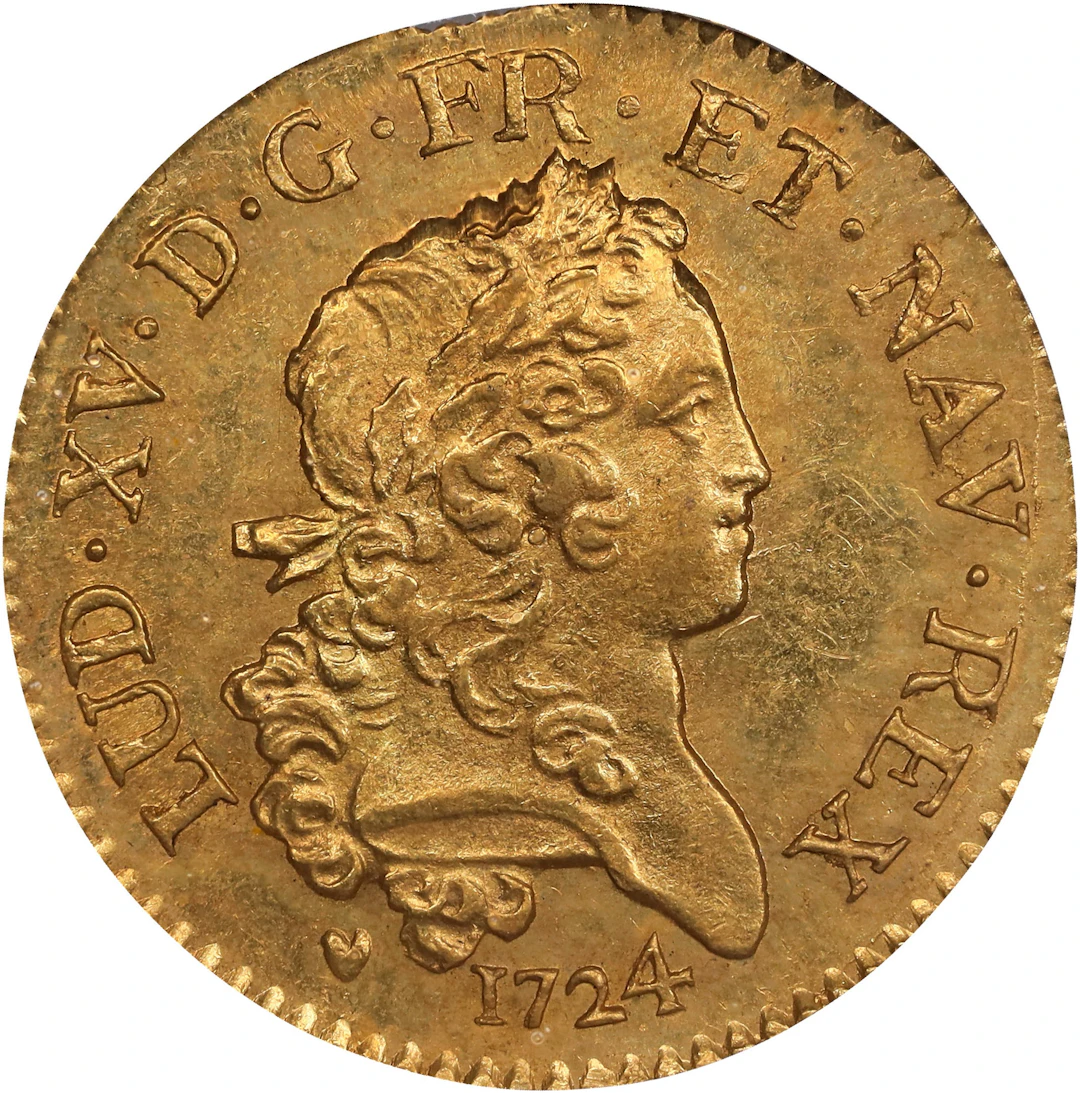
FRANCE. 1724-G Louis d'or Mirliton, grandes palmes. Poitiers Mint. Gadoury-339. MS-63 (PCGS). Spectacular bright gold with nearly full mint luster showing on both sides. Rim imperfect (lightly clipped) at 12 o'clock relative to the obverse. A quite remarkable specimen from a quality standpoint, especially given its exciting history. Le Chameau (The Camel) was a 48-gun French military transport ship, constructed in 1717. When she left La Rochelle, the main New World-facing port on France's Atlantic Coast, in July 1725, she was bound for Fortress Louisbourg, the dominating French fort that controlled entry to the interior of Canada. She carried 316 passengers, including at least 100 soldiers and the new appointee for the position of Intendant of Canada. She also carried thousands of French coins, both gold and silver. The treasure aboard Le Chameau exceeded 82,000 livres tournois, several million dollars today, all intended to pay the troops who made Fortress Louisbourg the most formidable defensive structure in the entire New World. Late August is hurricane season in the North Atlantic, and when Le Chameau approached the coastline of Nova Scotia's Cape Breton Island the night of August 25, the seas were unquiet and the winds were strong. During the overnight hours on the morning of August 26, within sight of Louisbourg, the ship hit an outcropping known today as Chameau Rock. It was a total loss, and daylight revealed the telltale signs of a nautical disaster up and down the beaches nearby. Salvage operations began soon thereafter, but the swirling sand and surf amidst the currents where the St. Lawrence and the Atlantic join made diving on the wreck nearly impossible. A few thousand livres tournois were recovered washed up on the shore, but then the site was abandoned to history. Two decades later, New Englanders attacked and captured Fortress Louisbourg in the name of King George II; they were disheartened when the prize was given back to the French at the treaty table. In 1759, the fortress fell again, and all of Canada was turned over to the English in 1763. What was Acadia became Nova Scotia, but thousands of French coins that were royally authorized for New World circulation remained beneath the waves just off shore. On September 19, 1965, three men from Cape Breton Island - Alex Storm, David MacEachern, and Harvey MacLeod - found the first coins to be salvaged from Le Chameau in more than 200 years. Gold coins and a trove of artifacts followed, and worldwide celebrity visited upon the three men in April 1966. Television appearances and a book deal made them household names in Canada, but within a week Storm was served with a lawsuit. A partnership to find the vessel was undertaken by Storm and others in 1961, and never legally terminated, though it did peter out. In December 1967, a judge awarded three-quarters of the treasure to Storm and one-quarter to his earlier partners. Under Canadian Treasure Trove law, Provincial authorities got first crack, and many of Le Chameau's relics (as well as all base metal coins found) are currently the property of Parks Canada. The first lease on the wreck site of Le Chameau recovered 878 Louis d'ors and 7,861 silver ecus, as recounted by Jim Charlton in the Canadian Numismatic Journal in 1976. The December 1971 Parke-Bernet sale included 513 Louis d'ors and subsequent salvage operations have found more coins, but gold has been sparse and quality has been poor; the 1999 Stack's Americana sale included many hundreds of mostly poor ecus but just two Louis d'ors. The 72 lots in our (Stack's) Ford XIII were cherrypicked by Ford prior to the treasure's dispersal and represent some of the choicest specimens known; this is one of those coins. The bulk of the coins recovered were Louis XV ecus, mostly dated 1724 and 1725 and predominantly struck at the mint in La Rochelle. The gold coins were mostly Louis d'ors aux mirlitons, almost all dated 1723 to 1725. Some smaller coins were shipped as well, along with a handful of other issues. Each of these types was carefully cataloged by Walter Breen for his 1988 Encyclopedia, and they've been popular among Canadian, American, and French collectors since their rediscovery. Provenance: From the Emerald Coast Collection. Earlier ex Le Chameau shipwreck, sunk 1725; our sale of the John J. Ford. Jr. Collection, Part XIII, January 2006, lot 424. PCGS# 141018. Click here for certification details from PCGS.
估價:$1
前往拍賣頁查看所有物品來自Stack's Bowers或Coins & Banknotes
估價:
$1
類似物品




類似物品的拍賣結果

讓您的拍賣觸及全球收藏家!
立刻發佈上架