
全部拍賣 / Ethnographic / Elephant bird

Elephant bird
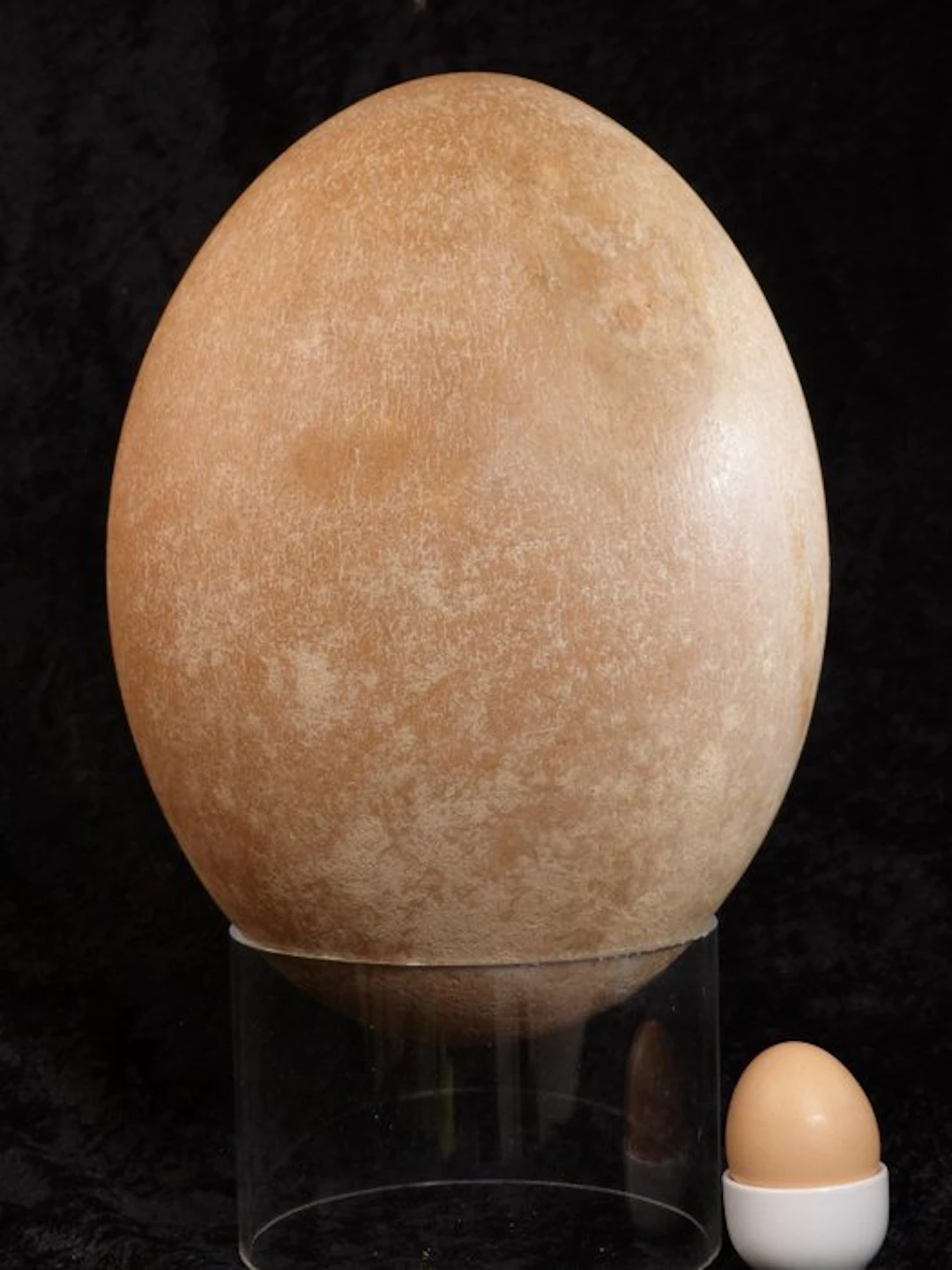
Absolute rarity! Completely preserved, original, non-reconstructed egg of Aepyornis maximus No. 007, Weight: 2360 g, Circumference across (measured at the midline) : 70 cm, Circumference along the long axis (midline) : 82 cm, Height 30 cm, Width / maximum diameter at the thickest point 22 cm. The Vorompatras were the only giant flightless birds that were still observed, hunted, and exterminated by humans. The endemic “elephant bird,” native only to Madagascar, is said to have lived from the Pleistocene until the 17th century. Up to its extinction it served as a food source for locals and passing ships. The legends of the Malagasy (ethnic groups Mahafaly, Atandroy and Antanosy) report that in “ancient times” even the settlements of the indigenous people were placed close to the nesting sites of the flightless birds, as they represented excellent food sources. These places were regarded as holy even after the birds were wiped out and were treated as sacred knowledge. To this day, eggs remain in family possession, treated as heirlooms and “curious treasures,” but are only sold in absolute exceptional cases. In science, first described in 1870 by the French researcher Granddidier as “Aepyornis maximus” or earlier also Aepyornis titan (the largest of four species of the genus Aepyornis), it was similar to the modern African ostrich. A giant flightless bird, its height over 3 m, with a weight of about 500 kg. The eggs are larger than any dinosaur eggs discovered so far. Since they were the largest eggs in the world, biologically they are the largest known cells in the world. The Aepyornis was the prototype for the bird “Rock” in the tales from One Thousand and One Nights, which recounts the adventures of Sinbad the Sailor. In Arab tales the “elephant bird” is often mentioned, said to be so strong that it could seize an elephant and fly away with it. The “elephant birds” lived roughly at the same time as the renowned extinct New Zealand giant flightless birds, the Moas, which disappeared in the 19th century. As with the extinct Moas, the living Australian emus and South American rheas, the elephant bird had three toes. The Aepyornis was not related to the New Zealand Moas. The contents amount to 8 to 9 liters, 6 times more than the African ostrich, 150 times more than a chicken egg. The chick from the present egg never hatched. Many of the found elephant bird eggs have strange holes. The most probable cause could be humans who bored the slits in to reach the nourishing contents and then used the egg as a container (similar to a calabash). But there is also evidence of desiccated eggs in sediment sand that had these holes and in which organic residues were found. Therefore, it is also likely that specialized predatory animals existed, such as birds, or snails with a radula, which breached the thick shell to savor the contents. The egg would then have been completely consumed by insects. In the CT scans, one clearly sees the integrity of the shell, but also an old hole that was sealed with glue. Presumably this was done to increase the egg’s value, without considering that a completely empty egg is entirely illogical. Therefore, intact eggs without a hole always require an X-ray. Unprocessed, unbroken eggs, without additives, are postfossil rarities and extremely rare. We offer you one of these treasures. These specimens have already fetched prices of over €100,000. My father lived and worked for an extended period in the mid-70s in Madagascar. This egg comes from a wealthy family that owned a large sisal farm near Fort Dauphin. They were collecting dinosaur bones and other fossil treasures even back then and selling them to tourists and “Vazaha.” At the time export required only a permit from the Fokotany (local mayor) and an accompanying commercial invoice. Today export from Madagascar is strictly prohibited. Delivery includes a Plexiglas ring as stand, certificate, and a technical brochure by Ernst Probst about all findings related to elephant birds. If you are seriously interested, I can provide copies of all available provenance documents for the object. Delivery and viewing by arrangement. Delivery to Switzerland or outside the EU requires many documents and may delay the delivery time. Please contact me and inquire in your country about any import formalities. If export is refused, I must cancel the purchase. The photos were taken under different light sources but were not digitally edited. Source of the photos: Von Monnier source, Von Monnier digimorph org, Wikimedia, private collectio
估價:$22,404.68
前往拍賣頁查看所有物品來自Catawiki或Ethnographic
估價:
$22,404.68
類似物品


類似物品的拍賣結果


讓您的拍賣觸及全球收藏家!
立刻發佈上架