
全部拍賣 / Miscellaneous / École valencienne (XX), signé Monleón - Le Panier de fleurs - NO RESERVE

École valencienne (XX), signé Monleón - Le Panier de fleurs - NO RESERVE
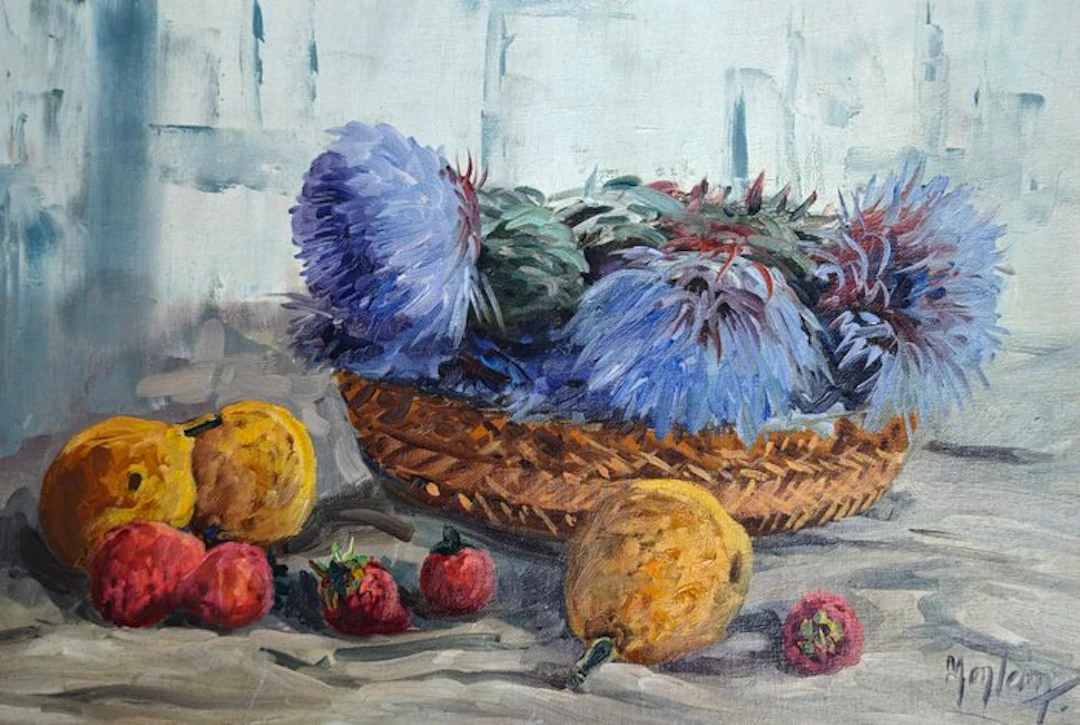
Valencian School of the 20th Century – Signed Monleón Still life of flowers and fruits – Oil on canvas adhered to panel Interesting oil painting on canvas adhered to panel, signed “Monleón” in the lower right corner, belonging to the pictorial tradition of the Valencian school of the 20th century. The work represents an elegant still life composition, featuring a wicker basket filled with blueish-violet flowers, accompanied by different fruits arranged on a light surface. The painting stands out for its chromatic richness, its spontaneous and expressive brushwork, and the appealing contrast between the cool tones of the flowers and the warm colors of the fruits. The artist develops a personal interpretation of the traditional still life, combining naturalistic observation with a painting approach of marked freedom, in which color and matter take on special prominence. The work shows affinities with impressionist and post-impressionist traditions, especially for the use of visible brushstrokes, the simplification of certain volumes, and the importance given to color relationships. Description of the work The composition represents a still life organized around a central wicker basket, slightly shifted to the right. Inside appears an abundant set of flowers with elongated petals, depicted through an intense range of blues, violets, purples, and small reddish nuances. The flowers have a rounded, voluminous structure built from numerous short, overlapping brushstrokes. The artist uses different shades of blue and violet to suggest the depth of the corollas and the effect of light on the petals. Among the flowers there are leaves and stems in green, grayish and bluish tones, adding color variety and helping to integrate the whole. The basket is rendered with ochres, browns and small orange accents. Its surface shows a diagonal and crosshatched brushwork that suggests the wicker texture. The treatment of the container introduces an attractive contrast between the geometric structure of the weave and the organic shapes of the flowers. In the foreground appear different fruits distributed on a light surface. On the left, two pieces of fruit in yellow and orange tones stand out, rendered with broad, expressive brushstrokes. Next to them are several small fruits of intense red color, reminiscent of pomegranates and other round fruits. In the center and toward the right appears another larger fruit, represented with yellows, ochres and small greenish nuances. Its volume is built through color patches that suggest the irregularity of the surface. At the bottom right edge is a small red fruit, introducing a final color accent and helping to balance the composition. All these elements rest on a surface in white, gray and bluish tones, possibly a cloth or a table covered with a light fabric. The background is resolved with broad brushstrokes of whites, grays and soft blues, without concrete spatial references. This simplification allows concentrating all attention on the flowers, the fruits and the basket. Style and artistic influences From a stylistic point of view, the painting relates to the tradition of the Valencian still life of the 20th century, showing affinities with impressionist and post-impressionist currents. The work preserves a recognizable representation of objects, but its execution moves away from the more meticulous academic approaches. The artist builds volumes with color patches and visible brushstrokes, giving special importance to chromatic interpretation. The flowers show a particularly free execution, based on small overlapping strokes that suggest the texture and movement of the petals. This way of working allows connections with certain impressionist procedures, especially due to the importance given to light and the vibrancy of color. Moreover, the intensity of blues, violets, yellows and reds brings the work closer to some post-impressionist tendencies. The artist uses color not only to describe objects but also as an expressive resource aimed at organizing the composition. The wicker basket introduces a relatively defined structure, while the flowers and fruits present a more spontaneous execution. This alternation between drawing and pictorial freedom constitutes one of the most interesting aspects of the work. The Valencian still life tradition Still life has occupied a prominent place in the history of Valencian painting. From the great Spanish bodegones of previous centuries to the generations of 20th-century artists, flowers, fruits and everyday objects have been recurrent motifs of representation. During the 19th century and the early 20th, Valencian painting experienced important transformations thanks to the influence of naturalism, impressionism and the new European artistic currents. The progressive liberation of brushwork and interest in luminous effects favored new interpretations of the still life. Artists began to grant greater importance to spontaneity of execution, to relationships between colors, and to personal expression. Flowers and fruits offered a particularly suitable field for these investigations, due to the richness of their forms, textures and tonalities. The present work participates in this tradition by means of a composition that combines classical elements of the genre with a modern painting execution. The basket of flowers constitutes the visual center of the painting, while the fruits in the foreground provide formal and chromatic variety. The overall effect conveys a sense of abundance and vitality, features common in Mediterranean still-life representations. The treatment of the flowers One of the most notable aspects of the painting is the representation of the flowers. The artist uses an intense range of blues, violets and purples, enriched with small reddish and greenish accents. The corollas are built with numerous short strokes, applied in different directions. This technique allows suggesting the radial arrangement of the petals and provides a notable sense of volume. Deep blues are combined with lighter tones, creating contrasts of light and shadow. The violets and purples introduce nuances that enrich the painted surface. The flowers are not represented with rigid, detailed drawing, but through a free interpretation of their shapes. The result is a highly dynamic set, in which the brushstrokes seem to transmit the vibration and delicacy of the petals. The presence of green leaves and stems helps to establish color transitions between the flowers and the basket. Color and composition The painting presents an especially attractive palette, based on the contrast between cool and warm tones. Blues and violets of the flowers dominate the upper and central areas. The yellows, ochres and reds of the fruits introduce a warm counterpoint in the foreground. The wicker basket acts as a transitional element between the two color groups. Its brown and orange tones establish a visual relationship with the fruits, while its central position helps organize the composition. The light background provides luminosity and allows the colors of the flowers and fruits to stand out more intensely. The supporting surface shows white, gray and bluish brushstrokes, which partially reflect the colors of the objects. This chromatic interaction helps integrate the different elements into a balanced whole. The distribution of the fruits in the foreground creates a horizontal visual line, while the flowers introduce a higher and more voluminous structure. The result is a stable yet richly endowed and dynamic composition. Technique and painting execution The work is executed in oil on canvas adhered to panel, a technique that combines the textile surface of the canvas with the rigidity provided by the wooden support. The painting shows a visible brushstroke execution and expressive character. The flowers are worked with small overlapped strokes, providing texture and variety to the surface. The basket features diagonal and crosshatched brushstrokes intended to suggest the wicker weave. The fruits are built with relatively broad color patches, enriched with small accents of light. The background is resolved more synthetically, through clear and partially overlapped brushstrokes. The alternation between more detailed areas and areas with greater freedom provides variety to the whole. The artist shows special interest in the expressive possibilities of painting material, using brushwork as a fundamental resource in constructing the forms. Still life as an artistic genre Still life constitutes one of the most important genres of European painting. Throughout the centuries, artists have found in flowers, fruits and everyday objects a suitable motive to explore the relationships between composition, color, volume and light. During the 20th century, this genre underwent profound transformations. Impressionist, post-impressionist currents and various vanguard movements favored an increasingly free interpretation of objects. Descriptive fidelity ceased to be the sole objective of representation. Color, structural composition and personal expression gained increasing importance. In this context, still lifes of flowers and fruits allowed many artists to develop a pictorial language based on chromatic intensity and the spontaneity of brushwork. The present work is part of this tradition, combining a classical theme with a modern and expressive execution. Signature and cataloging The painting features a visible signature in the lower right corner reading “Monleón.” The inscription is done in a dark tone on the light surface of the foreground. The work is cataloged as Valencian School of the 20th century, signed Monleón. The signature reads the same as that on another landscape work presented under the same surname, allowing these two paintings to be related within the same study corpus. Nevertheless, the definitive identification of the artist would require broader documentary and stylistic comparison. For this reason, a prudent cataloging is maintained, based on the visible signature and the painting characteristics. Frame and presentation The painting is framed with a classic-inspired molding, finished in gold and cream tones. The frame has a slightly aged surface, with small ornamental details that add depth to the ensemble. Its light tone provides a balanced contrast with the strong chromaticity of the flowers and fruits. The frame helps enhance the painting’s luminosity and offers a presentation particularly suitable for a still life. The frame is offered as a gift to the buyer, with no commercial value, and is not an integral part of the work, so any possible damage to it will not be grounds for complaint. It is recommended to carefully observe all photographs, which are an integral part of the description, to adequately assess the conservation state of the painting and its framing. Features Author: Valencian School of the 20th century. Signature: Monleón, in the lower right corner. Date: 20th century. Technique: oil on canvas adhered to panel. Genre: still life. Theme: basket of blue and violet flowers accompanied by fruits. Style: Valencian figurative painting of impressionist and post-impressionist influence. Presentation: framed. Shipping The work will be carefully and professionally packaged, using appropriate protective materials to ensure its safety during transport. Shipping outside the European Union may be subject to taxes, duties, fees of import, clearance costs and/or customs procedures. Any such charges will be the sole responsibility of the buyer and are not included in the strike price or shipping costs. Furthermore, shipments to islands, insular territories or remote or hard-to-reach areas by the transport companies may incur additional charges. Any surcharge applied by the transport company for this reason must be borne by the buyer. Buyers are advised to pre-check customs conditions and possible transport surcharges applicable to their destination.
估價:$1.12
前往拍賣頁查看所有物品來自Catawiki或Miscellaneous
估價:
$1.12
類似物品

類似物品的拍賣結果

讓您的拍賣觸及全球收藏家!
立刻發佈上架