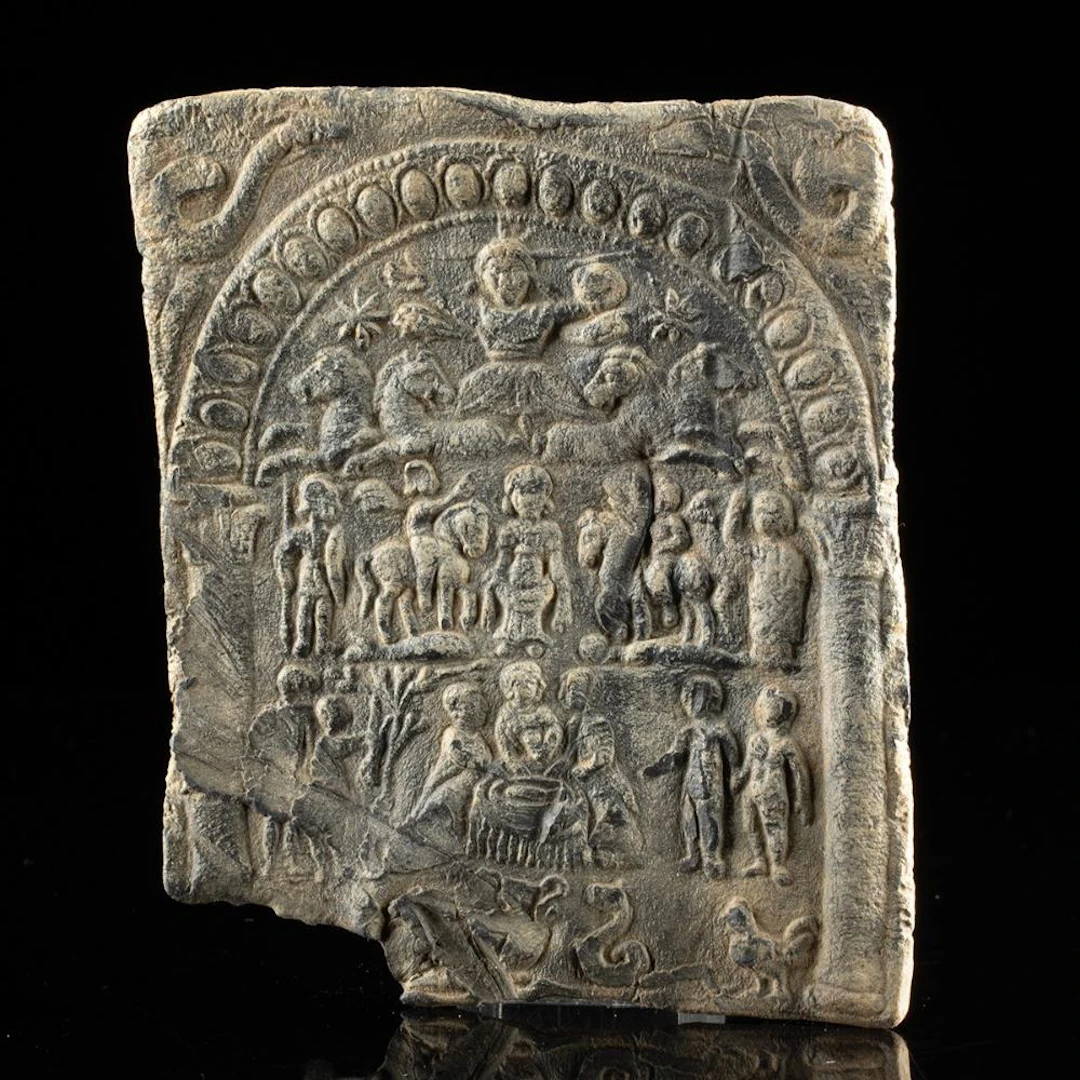
Danubian Riders Votive Plaque with Sol in Quadriga - Roman Balkans
Roman, Balkans, Moesia or Dacia, Danubian Riders cult. A dense, arch-topped devotional tablet cast in lead, its surface crowded with the enigmatic iconography of the so-called Danubian Riders. Three registers stack the cosmos: above, a bust of Sol driving his quadriga rides an arcade of studded bosses representing the vault of heaven; at center, a frontal Great Goddess stands flanked by two mounted riders whose horses trample prostrate figures, attendants and a ram at either margin; below, banqueters gather at a table before a vessel, the ritual fish meal that anchors the cult's initiatory practice. A serpent coils through the lower field. Small enough to be held in the palm or hung, plaques of this type functioned as personal talismans, likely carried by soldiers garrisoned along the Danubian limes who read in these compressed symbols meanings now largely lost. The cult of the Danubian Riders, sometimes named from its presumed divinities as the cult of Domnus and Domna, is known entirely from its images. No literary source describes it and votive epigraphy is effectively absent, so everything proposed about its doctrine has been read out of roughly 150 catalogued stone reliefs and some 1200 to 1300 lead-alloy plaques concentrated in Moesia Inferior and Superior and Dacia. The workshops that produced them also cut the two- and three-register Mithraic stelae of the same region, which explains the borrowed compositional grammar: a heaven register, a central epiphany, a lower zone of ritual implements. The scheme fuses local Thracian Rider imagery, in which a single hero spears his prey, with a doubled pair of horsemen recalling the Dioskouroi, and subordinates both to a central female deity. Later plaques, from the second half of the third century, amplify the solar figure at the top, an iconographic shift that tracks the ascendancy of Sol Invictus in imperial coinage struck at Serdica and Siscia. Because no comparable pre-Roman imagery has surfaced in Illyricum, the cult may be a creation of the Roman colonial encounter rather than a survival, or a pre-existing practice thoroughly recast in a Hellenistic-Roman visual vocabulary and carried outward by the multiethnic garrisons of the frontier. Item # 204863
估價:$400
前往拍賣頁查看所有物品來自Artemis Fine Arts或Asian Art