拍品/carolus boers 1746 1814 jona willem te water ByyFRaC 633174680 / 在售
拍品/carolus boers 1746 1814 jona willem te water ByyFRaC 633174680
在售拍賣結果
拍品/carolus boers 1746 1814 jona willem te water ByyFRaC 633174680
在售拍賣結果
讓您的拍賣觸及全球收藏家!
立刻發佈上架讓您的拍賣觸及全球收藏家!
立刻發佈上架訂閱即表示您同意 隱私政策。可隨時取消訂閱。
Barnebys HQ
Brahegatan 10
BOX 5038
114 37 Stockholm
全部拍賣 / Medals, Arms & Armor / Carolus Boers (1746-1814) - Jona Willem te Water...

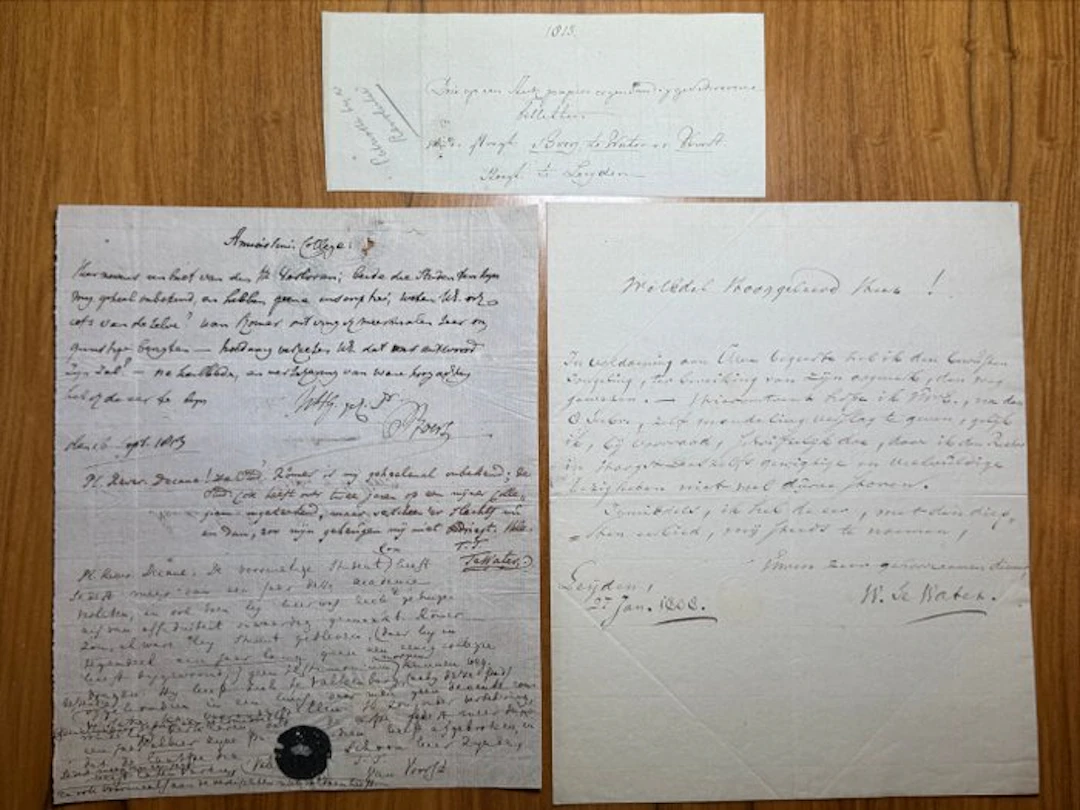
Auction Description (German) Historical Autograph Convolute on Dutch University and Scholarly History – Carolus Boers, Jona Willem te Water & Johannes van Voorst (1800–1813) • Convolute of three original, handwritten documents from the early 19th century, directly connected with leading Dutch theologians, professors and university rectors (Carolus Boers, Jona Willem te Water, Johannes van Voorst and M. Seijgerus van der Eijk). • Included pieces: 1. Letter dated January 27, 1800: Written by W. de Water in Leiden, addressed to the Rector Magnificus of the University of Holland (M. Seijgerus van der Eijk), including a complete address page on the double sheet. 2. Multistage circulating circular and exchange letter of the “Amicitia College” (September 16, 1813): A fascinating working document in which three prominent theologians and university professors (Carolus Boers, Jona Willem te Water and Johannes van Voorst) wrote responses on top of one another by hand and gave their assessments of student cases (including the students Römer and Cox). Includes corrections, marginal notes and remnants of seals. 3. Archive and description slip (1813): Historical cover note with archival notes on the authors and the historical context (including the notable remark on the “Palinodie by de Revolutie”). Biographies of the involved professors and the Rector • Dr. Carolus Boers (also Carel Boers, 1746–1814): He was a prominent Dutch Reformed theologian. After pastorates in Roosendaal and Haarlem, he was appointed Professor of Theology at Leiden University in 1779. Due to his loyal stance toward the House of Orange, he came under pressure during the Batavian-French upheavals: in 1795 he was dismissed from his professorship and deprived of his office. Only after the political change in 1802 was he rehabilitated and again appointed as a regent of the State College. • Dr. Jona Willem te Water (1740–1822): One of the most renowned Dutch Reformed theologians and church historians of his time. He served as professor of church history and Oriental languages in Leiden and repeatedly held the office of Rector Magnificus of the Alma Mater. Te Water was also a member of more than fifteen learned societies as well as the Royal Institute for Sciences and Literature. He was known as a moderately orthodox scholar who opened himself to currents of the Enlightenment and to supranaturalist thinking. • Dr. Johannes van Voorst (1757–1833): A highly esteemed Dutch theologian, church historian and librarian. He was Professor of Theology in Franeker and from 1799 Professor of New Testament Exegesis and Church History at Leiden University. In addition to his academic teaching, he served from 1816 to 1827 as University Librarian in Leiden and markedly shaped the library system. • M. Seijgerus van der Eijk (Rector Magnificus): As a high-ranking academic dignitary of the university at that time, he led the rectorate and represented the administration of the institution to which official administrative letters and petitions were directed in 1800. Historical Context & the Importance of the University in the Early 19th Century The universities of the Netherlands (especially Leiden and Utrecht) were undergoing massive political, institutional and societal upheavals at the beginning of the 19th century. They traversed the era of the Batavian Republic, incorporation into the Napoleonic Empire, and finally the restoration under the House of Orange. In this dense network, professors formed not only the intellectual foundation but also as state-connected advisers, deans and examiners, had to oversee the moral and academic suitability of students. The centerpiece of this convolute—the circular letter of September 1813—captures exactly this administrative work on a small scale just before the collapse of French rule. The attached historical archive slip also points to the political dimension of this era (“Palinode by the Revolution”), as scholars in this turbulent time repeatedly had to adapt or justify their loyalties or academic stances in light of new regimes. Content, Structure and Chronological Sequence of the Circular Letter (September 16, 1813) The central document of the Amicitia College is a classic circular or circulating letter. Since there was no duplicator, a single sheet of paper was passed around the college, and each professor added directly under the previous text his additions, corrections and answers: 1. First Section (Carolus Boers): The letter begins with the reference to the Amicitia College and an incoming letter from Mr. Vorsterman. Boers opens the inquiry by noting that the two students in question are entirely unknown to him and seem to lack sufficient performance or insight. He asks his colleagues if they know anything about these individuals and raises the question of how to proceed or respond regarding the student Römer. 2. Second Section (Jona Willem te Water): Te Water steps in directly, corrects passages and gives his assessment. He notes that the student Römer is completely unknown to him. Regarding the student Cox, he critically remarks that two years ago he enrolled in none of his lectures, but appeared only here and there, if his memory does not deceive him. 3. Third Section (Johannes van Voorst): Van Voorst expands the file and provides a devastating assessment of the students. He explains that the student Römer effectively left his studies, did not attend a single lecture during the entire year, and stayed at an inappropriate place in Valkenburg, which is why no testimonia could be issued. 2. Catawiki Auction Description (English Translation) Historical Autograph Lot on Dutch University and Scholarly History – Carolus Boers, Jona Willem te Water & Johannes van Voorst (1800–1813) • A lot of three original handwritten documents from the early 19th century, directly associated with leading Dutch theologians, professors and university rectors (Carolus Boers, Jona Willem te Water, Johannes van Voorst, and M. Seijgerus van der Eijk). • Included Items: 1. Letter dated January 27, 1800: Written by W. de Water in Leiden, addressed to the Rector Magnificus of the University of Holland (M. Seijgerus van der Eijk), including the complete address field on the double leaf. 2. Multistage circulating Circular and Exchange Letter of the “Amicitia College” (September 16, 1813): A fascinating working document in which three prominent theologians and university teachers (Carolus Boers, Jona Willem te Water, and Johannes van Voorst) handwrote successive responses and provided evaluations regarding student cases (including the students Römer and Cox). Includes corrections, marginal notes, and wax seal remnants. 3. Archival and Descriptive Slip (1813): Historical accompanying note with archival annotations concerning the authors and historical context (including the notable remark concerning “Palinodie by de Revolutie”). Biographies of the Involved Professors and the Rector • Dr. Carolus Boers (also Carel Boers, 1746–1814): A prominent Dutch Reformed theologian. After holding pastorates in Roosendaal and Haarlem, he was appointed professor of theology at Leiden University in 1779. Due to his loyal stance toward the House of Orange, he came under severe pressure during the Batavian-French upheavals: in 1795, he was dismissed from his professorship and deprived of his office. It was only after the political shift in 1802 that he was rehabilitated and re-appointed as regent of the State College. • Dr. Jona Willem te Water (1740–1822): One of the most renowned Dutch Reformed theologians and church historians of his time. He served as professor of church history and oriental languages in Leiden and repeatedly held the office of Rector Magnificus of the Alma Mater. Te Water was also a member of more than fifteen learned societies as well as the Royal Institute for Sciences and Literature. He was regarded as a moderately orthodox scholar open to Enlightenment currents and supranaturalist thought. • Dr. Johannes van Voorst (1757–1833): A highly esteemed Dutch theologian, church historian and librarian. He was Professor of Theology in Franeker and from 1799 onward Professor of New Testament Exegesis and Church History at Leiden University. In addition to his academic teaching, he served as University Librarian in Leiden from 1816 to 1827 and significantly shaped the library system. • M. Seijgerus van der Eijk (Rector Magnificus): As a high-ranking academic dignitary of the university at the time, he led the rectorate and represented the leadership of the institution to which official administrative letters and petitions were submitted in 1800. Historical Context & The Importance of the University in the Early 19th Century The universities of the Netherlands (especially Leiden and Utrecht) underwent massive political, institutional and societal transformations at the beginning of the 19th century. They traversed the Batavian Republic, incorporation into the Napoleonic Empire, and finally the restoration under the House of Orange. In this dense network, professors formed not only the intellectual foundation but also had to act as state-appointed councils, deans, and evaluators ensuring the moral and academic fitness of students. The centerpiece of this lot—the circular letter from September 1813—captures exactly this administrative groundwork on a small scale just before the collapse of French rule. The accompanying historical archive slip also points to the political dimension of this era (“Palinode by de Revolutie”), as scholars in these turbulent times repeatedly had to adjust or justify their loyalties or academic stances in light of new regimes. Content, Structure and Chronological Progression of the Circular Letter (September 16, 1813) The central document of the Amicitia College is a classic circular or circulating letter. Since there was no copier, a single sheet of paper was circulated among the college, and each professor added directly beneath the previous text his additions, corrections and answers: 1. First Section (Carolus Boers): The letter begins with the reference to the Amicitia College and a received letter from Mr. Vorsterman. Boers opens the inquiry by stating that the two students involved are entirely unknown to him and appear to lack sufficient performance or insights. He asks his colleagues if they know anything about these individuals and raises the question of how to proceed or respond regarding the student Römer. 2. Second Section (Jona Willem te Water): Te Water intervenes directly, corrects text passages and gives his assessment. He notes that the student Römer is completely unknown to him. Regarding the student Cox, he critically notes that two years ago he enrolled in none of his lectures, but appeared only now and then, if his memory does not deceive him. 3. Third Section (Johannes van Voorst): Van Voorst extends the file and delivers a devastating judgment of the students. He explains that the student Römer effectively dropped out of his studies, did not attend a single lecture during the entire year, and stayed at an inappropriate place in Valkenburg, which is why no testimonia could be issued. Appendix: Full Transcriptions & Translations of all three documents 1. Document 1: Letter from Leiden dated January 27, 1800 • Dutch (Original): o [Address field:] To the Most Learned, Most Excellent Sir, M. Seijgerus van der Eijk, Rector Magnificus of the Royal University of Holland, [etc.]. o [Body:] Worthy Most Learned Sir! In fulfillment of your request I have pointed the way to the former youth to achieve his goal. Herewith I hope, after February 1, to report to you verbally, as I do in writing for the moment, since I dare not disturb the Rector in his weighty and manifold affairs. In the meantime, I have the honor to profess with the deepest respect that I remain your very obedient servant, W. de Water. Leyden, Jan 27, 1800. • German (Translation): o [Address:] To the highly learned, highly esteemed Sir M. Seijgerus van der Eijk, Rector Magnificus of the Royal University of Holland, [etc.]. o [Text:] Most noble Sir! In fulfillment of your desire I have shown the path to the former youth to achieve his aim. Herewith, I hope to report to you personally after February 1, as I am currently reporting in writing, for I do not wish to trouble the Rector in his important and numerous affairs. Nevertheless, I have the honor to subscribe myself, with the deepest respect, your very obedient servant W. de Water. Leyden, 27 January 1800. 2. Document 2: Circular letter of the Amicitia College of September 16, 1813 • Dutch (Original): o Amicitia College: Here is a letter from Mr. Vorsterman; both students are completely unknown to me and have no insight; do you also know anything about them? Can Römer be received or can he testify very unfavorably — how could we forget what our answer will be? o Pl. Rever. Decana! The student Römer is completely unknown to me; the student Cox has not registered in any of my colleges for two years, but appeared only now and then, if my memory serves me. Vale. T. T. TeWater. o Pl. Rever. Decana, The former student has left this academy more than a year ago, and even when he was here, he rendered himself unworthy of affiliation. Römer would, even if he had remained a student, (for he, on the contrary, did not attend a single lecture for a year) have been unable to produce testimonies. He has stayed in Valkenburg (near this city) in a house where no decent conversation could be conducted. I would, subject to better instruction, possibly think... o — after greeting, and with hope of true respect, I have the honor to be today, Sept. 16, 1813 [signed] Carolus Boers, J. Te Water, J. J. van Voorst. • German (Translation): o Amicitia College: Here is a letter from Mr. Vorsterman; both students are completely unknown to me and have no insight; do Your Honors also know anything about them? Can Römer receive or repeatedly prove very unfavorably — how could we forget what our answer will be? o Most worthy Dean! The student Römer is completely unknown to me; the student Cox did not register at any of my lectures two years ago, but appeared only now and then, if my memory does not deceive me. Farewell. Your devoted TeWater. o Most worthy Dean, The former student left this academy more than a year ago, and even when he was here, he has testimonies... Römer would, even if he had remained a student (whereas for a year he did not attend any lectures) have been unable to produce testimonies. He has stayed in Valkenburg (near this city) in a house where one could not engage in decent conversation. I would, subject to better instruction... o — after proper greeting and in hope of true respect, I have the honor to be on Sept. 16, 1813 [signed] Carolus Boers, J. Te Water, J. J. van Voorst. 3. Document 3: Small archival slip / supplement of 1813 • Dutch (Original): o 1813. Letter on a piece of paper handwritten by Te Water and Van Voorst. Palinodie by the Revolution. • German (Translation): o 1813. Letter on a piece of paper handwritten by Te Water and Van Voorst. Palinody by the Revolution. #C 176 Look to the pictures!
估價:$1.12
前往拍賣頁查看所有物品來自Catawiki或Medals, Arms & Armor
估價:
$1.12
讓您的拍賣觸及全球收藏家!
立刻發佈上架
$2,250.45