Baluster vase - Porcelain - China - Yongzheng (1723-1735) (No reserve price)
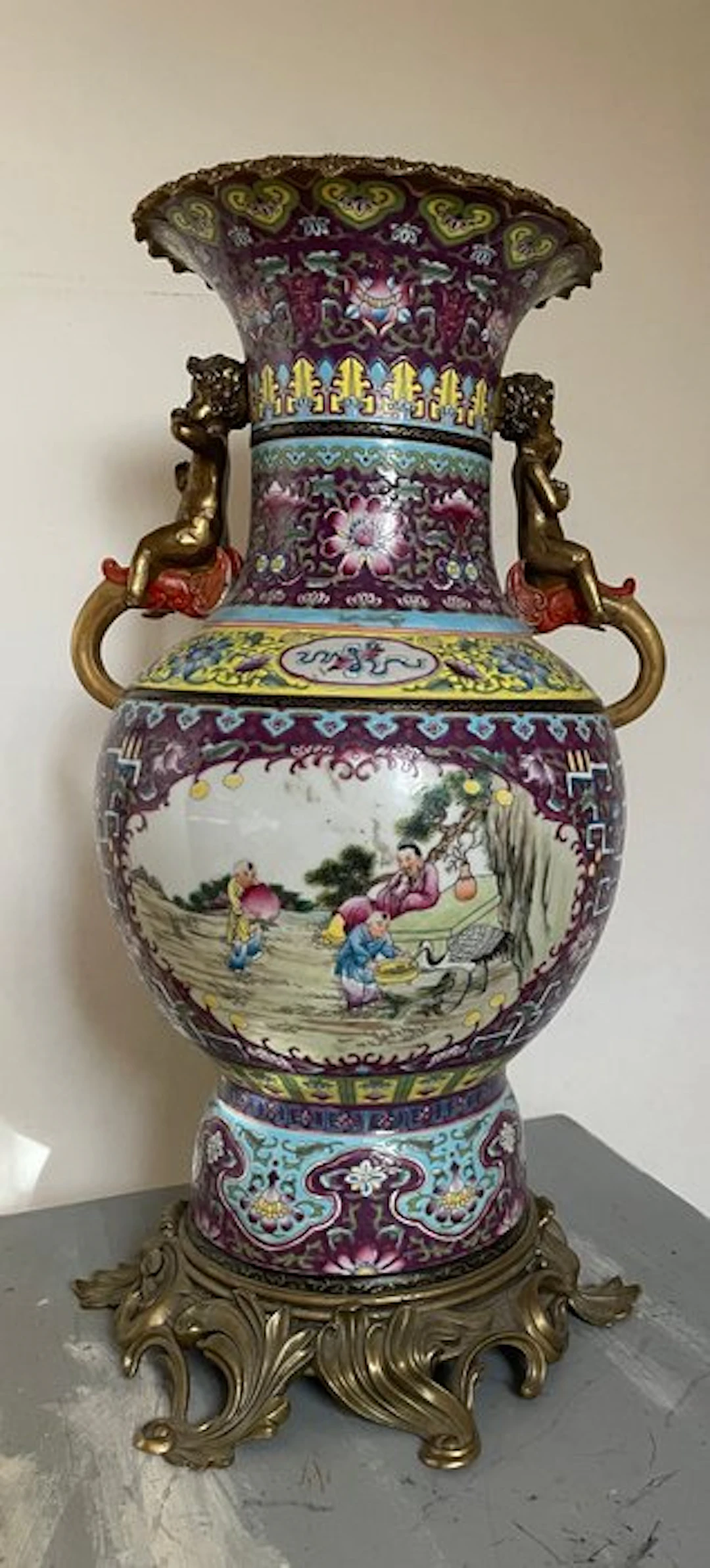
IMPORTANT CHINESE PORCELAIN FAMILLE ROSE PALETTE BALUSTRE VASE WITH GILD bronze mount China, Qing dynasty — Porcelain attributed to the Yongzheng reign (1723-1735). European mount attributed to the late 19th century. Old labels from the Florine Langweil house, from the Dreesmann collection and Spink & Son. I. General description of the work Important baluster vase in Chinese porcelain with a polychrome famille rose decoration, featuring a generously rounded body, a pronounced shoulder, and a long cylindrical neck ending in a wide flared opening. The overall piece rests on a slightly flared foot, now partly concealed by a substantial gilded bronze mount. The decoration stands out for the richness of its palette and the complexity of its composition. A deep purple background hosts two large poly-lobed figurative cartouches, surrounded by floral motifs and tendrils. The decoration combines pink, turquoise, yellow, blue and green enamels, arranged in successive registers. The shoulder displays a wide yellow band adorned with floral motifs, while the neck is rhythmized by several overlapping friezes. The ensemble reveals a pursuit of balance between figurative narration, floral symbolism and geometric ornamentation. The bottom of the vase, turquoise glazed, bears a four-character mark corresponding to a mark of the Yongzheng reign. II. Iconographic analysis: a program devoted to longevity and prosperity The figurative decoration deserves particular attention. The two large cartouches do not appear to have been designed as simple independent ornaments, but as compositions belonging to a coherent symbolic program. 1. First cartouche: the old man and the children The first composition shows an aged figure, dressed in a blue robe, seated in a landscape setting. He is accompanied by young characters, amidst abundant vegetation. The presence of the old man and children evokes traditional themes of longevity and family prosperity. In Chinese iconography, the figure of the old man can be associated with Shoulao, the deity of longevity. The precise identification of the vase’s figure remains to be confirmed. The pairing of the elder with children can also be interpreted as a evocation of generational continuity. Thus the decoration aligns with a tradition in which the depiction of a thriving family, surrounded by favorable symbols, expresses wishes for happiness and long life. Concordance with the Yongzheng period Themes of longevity, old people and children are attested on porcelains from the Yongzheng reign. Their use is therefore compatible with the proposed attribution. This correspondence concerns the subject matter rather than a composition formula exclusively tied to this reign. 2. Second cartouche: the crane, the figures and the children The second scene presents several figures in a wooded landscape, accompanied by a crane. This bird is a central element of the Chinese symbolic vocabulary. Traditionally associated with longevity and immortality, it frequently appears in representations of immortal figures and in compositions expressing wishes for long life. The presence of children strengthens the favorable reading of this scene, introducing the theme of offspring. The fruits visible in the composition, if correctly identified as peaches, would complete this symbolic language. Peach is indeed one of the traditional attributes of longevity. Concordance with the Yongzheng period The association of several favorable symbols in a single composition is characteristic of a large portion of Qing decorative production. Yongzheng porcelains particularly feature compositions pairing peaches with other augural motifs. The symbolic language of this second cartouche is therefore coherent with that used during this reign. The use of these themes persisted under Qianlong and in the 19th century, however, so concordance is not an exclusive dating criterion. III. The floral vocabulary and its organization The floral program contributes to the unity of the composition. The different parts of the vase are covered with stylized flowers, tendrils and motifs arranged in regular sequences. 1. Lotus flowers The large flowers visible on the neck and in the decorative registers seem to belong mainly to the stylized lotus repertoire. The lotus holds an important place in Chinese art. Associated with purity, it also has Buddhist meanings and can enter compositions expressing harmony and prosperity. On this vase, the flowers appear connected by stems and tendrils. Their arrangement creates a continuous ornamentation that contrasts with the two large narrative scenes on the body. 2. Ternary floral compositions Several floral motifs appear organized in symmetrical groupings, sometimes around three elements. This organization can be described as a ternary composition. It primarily serves decorative balance: a main flower may be accompanied by two secondary elements, creating an ensemble centered on a central axis. It is important to distinguish this arrangement from an intentional symbolism of the number three, which is not demonstrated here. 3. Floral tendrils Flowers are linked by sinuous stems that traverse the different zones of the vase. This type of decoration allows a continuity between registers. Tendrils also serve to fill the background without interrupting the reading of the large figurative cartouches. Concordance with the Yongzheng period Yongzheng porcelains feature particularly varied floral décors, ranging from relatively airy naturalistic compositions to stylized and symmetrical arrangements. The refinement of the flowers and the use of pink enamels are relevant points of comparison. However, the density of the floral decoration on this vase also invites comparisons with the production of the Qianlong reign, during which complex polychrome compositions developed considerably. IV. The color palette and Yongzheng technical innovations One of the most interesting stylistic arguments lies in the choice of colors. The vase notably combines: A deep purple background. Pink enamels in the flowers and figures. Turquoise in several registers and under the base. Yellow backgrounds with floral decoration. Blue and green accents. This palette corresponds to the rose china palette, whose pictorial possibilities were particularly developed in the early 18th century. Under Yongzheng, imperial ateliers perfected mastery of opaque enamels and pink nuances, enabling more elaborate modeling and chromatic transitions. Thus the use of these enamels constitutes an important technical concordance with the proposed period.  The purple background, yellow friezes and turquoise areas produce a sought-after chromatic contrast. The whole presents a meticulous organization: the figurative scenes occupy the central zones, while the floral motifs provide articulation between the different parts of the vase. This design shows a sophisticated decorative approach, even if the chromatic characteristics cannot be considered exclusive to Yongzheng’s reign. V. The Yongzheng imperial mark The bottom presents turquoise enamel and a four-character Chinese mark inscribed within a double square frame. The mark appears to read: 雍正御製 — Yongzheng yuzhi Translation: “Made on Imperial order during the Yongzheng reign.” The presence of such a mark is an important element in the study of the object. Its examination should be related to the calligraphy style, the nature of the enamels, the porcelain body and the manufacturing techniques. The mark and iconographic correlations allow for an attribution to the Yongzheng reign, subject to confirmation by material study. VI. The gilded European bronze mount: a late 19th-century transformation The vase is enriched by an imposing gilded bronze mount, likely added in Europe in the late 19th century. This intervention substantially changes its silhouette and gives it a new decorative function. The mount consists of three main elements. The handles: two winged-child figures, echoing putti, are placed on lateral consoles. Their presence introduces an Western figurative vocabulary that contrasts with the Chinese scenes painted on the porcelain. The neck: a gilded metal border underscores the vase’s opening, accentuating its monumentality. The base: the openwork foot features rocaille-inspired volutes and foliage, visually extending the vase’s silhouette and creating a display effect. An adaptation to European collectors’ tastes Adding metal mounts to Chinese porcelains is part of an old European tradition, particularly developed in France in the 18th century. This practice continued in the 19th century, notably in the context of renewed interest in historic styles and the taste for East Asian art objects. European bronziers and dealers thus transformed ancient porcelains into monumental decorative objects for collectors’ interiors. The Institut national d’histoire de l’art specifically documents this activity at Beurdeley, who continued to create modern gilded bronze mounts for ancient Chinese porcelains in the latter half of the 19th century.  The Walters Art Museum also preserves a Chinese vase with a French mount dating to 1870-1880, demonstrating the persistence of this practice in the period under consideration.  In this case, the mount appears to correspond to this approach. It would have been added to adapt a Chinese porcelain to late 19th-century European tastes. The piece thus combines two artistic traditions: that of Chinese porcelain and that of European decorative arts. This intervention constitutes a second stage in the work’s history, distinct from the vase’s own manufacture. VII. Provenance and history of the old collections The bottom preserves several old commercial and collection labels. Their presence provides material clues allowing tracing part of the object’s movement among French, British and Dutch markets. 1. Florine Langweil: a figure in Asian art commerce An old label bears the inscription: “Mme F. Langweil — Objets d’art anciens de la Chine & du Japon — 4, boulevard des Italiens, Paris.” Florine Langweil (1861-1958) was a French art dealer, collector and patron, specializing in Chinese and Japanese antiquities. At the end of the 19th century, she developed a trade in Asian objects that attracted an international clientele of collectors and connoisseurs. Her company occupied 4, boulevard des Italiens from 1887 to 1903, before moving to 26, place Saint-Georges.  This chronology is particularly interesting for the vase’s study. The address on the label precisely corresponds to the period between 1887 and 1903. It allows historically situating the labeling without proving the exact sale date of the vase. Florine Langweil maintained relationships with several important collectors, notably Émile Guimet and Ernest Grandidier. She also contributed to the enrichment of public collections, notably those of the Guimet, Cernuschi, Colmar and Strasbourg museums.  The presence of her label under the vase thus constitutes an interesting testimony to its circulation in the specialized Asian art trade in the late 19th or early 20th century. 2. The Dreesmann collection A second circular label bears the mention: “Collectie Dreesmann.” The Dreesmann name is associated with a prominent Dutch family, notably known for their business activity and interest in the arts. Anton C. R. Dreesmann and his wife Marianne L. Dreesmann-van der Spek built a varied collection including old paintings, drawings, sculptures, furniture, silverware and Chinese porcelains. Part of this collection was shown at a sale in Paris in 2021.  The label preserved under the vase suggests its belonging to a Dreesmann collection. However, identifying the precise collector and the acquisition and transmission dates require documentation from old inventories or catalogs. 3. Spink & Son, London A third label bears the name Spink & Son Ltd, with the note “Est. 1772.” This London firm is historically associated with the trade in art objects and antiques. The presence of its label is an additional hint of the object’s international market circulation. It does not, however, by itself determine when the vase was acquired or sold by this firm. 4. Historical interest of the label combination The preservation of these various testimonies is particularly interesting. Langweil’s label links the vase to the Parisian Asian art trade around 1900. The Dreesmann label suggests its passage into a Dutch collection. Spink & Son’s label hints at a connection to the British market. Together, they imply an international commercial and collecting itinerary, the exact chronology of which remains to be established. VIII. Conclusion: a object with two artistic histories This vase is of special interest for combining an elaborate Chinese decorative program with a major European transformation. Its decoration brings together several themes well documented in Qing decorative arts: longevity, family happiness, prosperity and abundance. The presence of elderly figures, children, a crane, fruits and floral compositions creates a coherent symbolic whole. Several of these depictions find correspondences with the vocabulary used under the Yongzheng reign. The rose palette and the presence of a four-character mark add weight to the attribution study. Nevertheless, the richness of ornament, the layering of registers and the abundance of colored backgrounds also allow comparisons with later productions, notably Qianlong and the 19th century. The gilded bronze mount, attributed to the late 19th century, testifies to the object’s adaptation to European collectors’ tastes. Finally, the old Langweil, Dreesmann and Spink & Son labels contribute to documenting its commercial history and its journey through the world of collections. The piece is thus presented as an important Chinese porcelain polychrome Famille Rose vase bearing a Yongzheng mark and attributed to this reign, enriched by a European gilded bronze mount attributed to the late 19th century, with provenance labels. A viewing of the object is possible within the auction period by appointment and is visible in Reims."
估價:$56.29
前往拍賣頁查看所有物品來自Catawiki或Asian Art