
全部拍賣 / Ancient Art / Ancient Roman Silver Coin pendant - Antoniniano FhiIippus I (No reserve price)

Ancient Roman Silver Coin pendant - Antoniniano FhiIippus I (No reserve price)
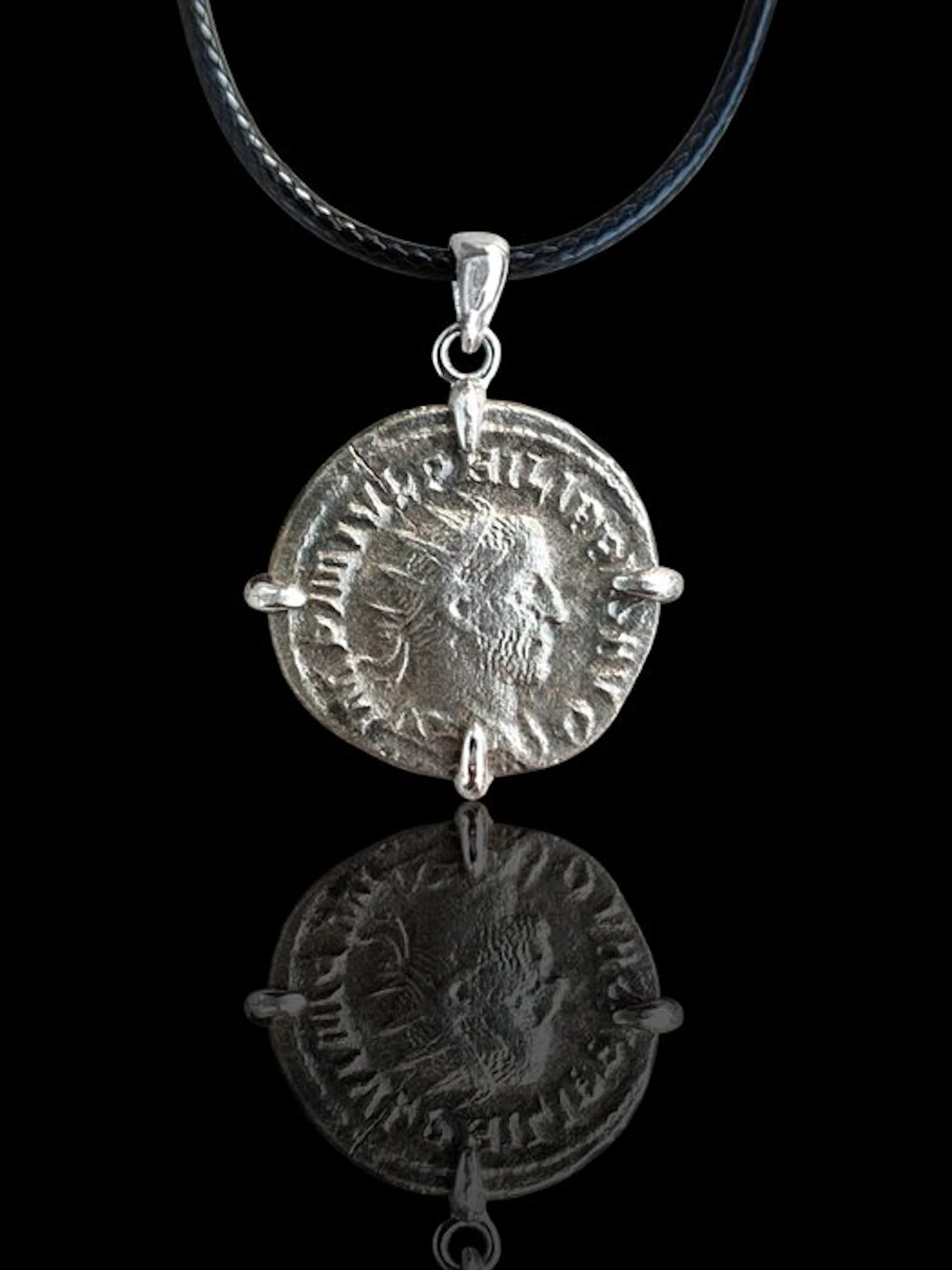
Silver pendant with a 3rd century AD coin of Emperor Philip I “the Arab,” the powerful commemoration of Rome’s 1,000 years in a century of political chaos. “Either Philip or me! —Gordian III said.” “Philip! —his soldiers replied vigorously.” Put yourself in the picture: It was February 244 AD in Zaitha (Iraq) when Marcus Iulius Philippus had just been elected emperor, the first of his line, and had to prove he was more than capable for the office. But before returning to the capital, Philip I “the Arab,” son of chieftain Marino, chose the most efficient option to keep his soldiers alive: pay 500,000 million denarii annually (± 19 million euros) to Sapor I, king of the Sasanian Empire, and leave his brother Gaius Julius Priscus in charge of the eastern provinces. Additionally, he did something productive: he appointed his five-year-old son Caesar, Augustus and high priest, and gave other family members important posts while informing the senate that Gordian III, aged 19, had died of natural causes and sent his ashes to Rome with due deference for deification. Here is the question: for him it was inconceivable that an inexperienced youth like Gordian III could be a capable leader, and Philip I “the Arab” (224–249 AD) was to prove his worth on the road back to the capital: • he visited cities, built roads, and organized a fairer tax system; • defeated several northern tribes; • reactivated trade, secured provisions, and also celebrated games. Thus, the Senate, informed of that display of efficiency, gave the go-ahead to Philip as emperor of a civilization that in April 248 AD would reach 1,000 years, which was celebrated grandly: banquets, spectacles, exotic animals… Preceding that celebration is the silver antoninianus of this pendant, note: - on the obverse: Bust of Philip the Arab in profile, bearded, radiate, draped, eyes with a hollow pupil, looking to the right and surrounded by the legend: IMP M IVL PHILIPPVS AVG (Imperator Marcus Iulius Philippus Augustus); - on the reverse: the goddess Felicitas standing, draped, looking to the left; resting on a staff-like caduceus in her right hand while holding a cornucopia in her left. Around: the legend: P M TR P III COS P P (Pontifex Maximus, third year of office, three-time consul, Father of the Country). And this means it was minted between the years 244–247 AD at the Roman mint. While the millennium celebrations continued, Philip did not see it appropriate to pay tribute to the Goths, who, along with other tribes, invaded Rome, since the legions on the Danube had no emperor to lead them; hence Senator Datius (Dacio) helped redirect the situation, so much so that the soldiers elected him emperor. Ultimately, in other provinces the situation repeated itself: by 249 AD there were three emperors chosen—Philip the Arab, the real one; Julius Jotapianus in Syria and on the eastern Danubian frontier, Decius… whose troops, in September of that year, at the Battle of Verona (Italy), ended the life of Philip and his family. Disclaimer: I am sending you this item from Spain by registered mail with tracking number. If you receive it in an area with a special tax regime, your local customs could seize it while you pay any duty, and as the seller I have no control over that.
估價:$280.92
前往拍賣頁查看所有物品來自Catawiki或Ancient Art
估價:
$280.92
類似物品
類似物品的拍賣結果

讓您的拍賣觸及全球收藏家!
立刻發佈上架