
全部拍賣 / Ancient Art / Ancient Roman

Ancient Roman
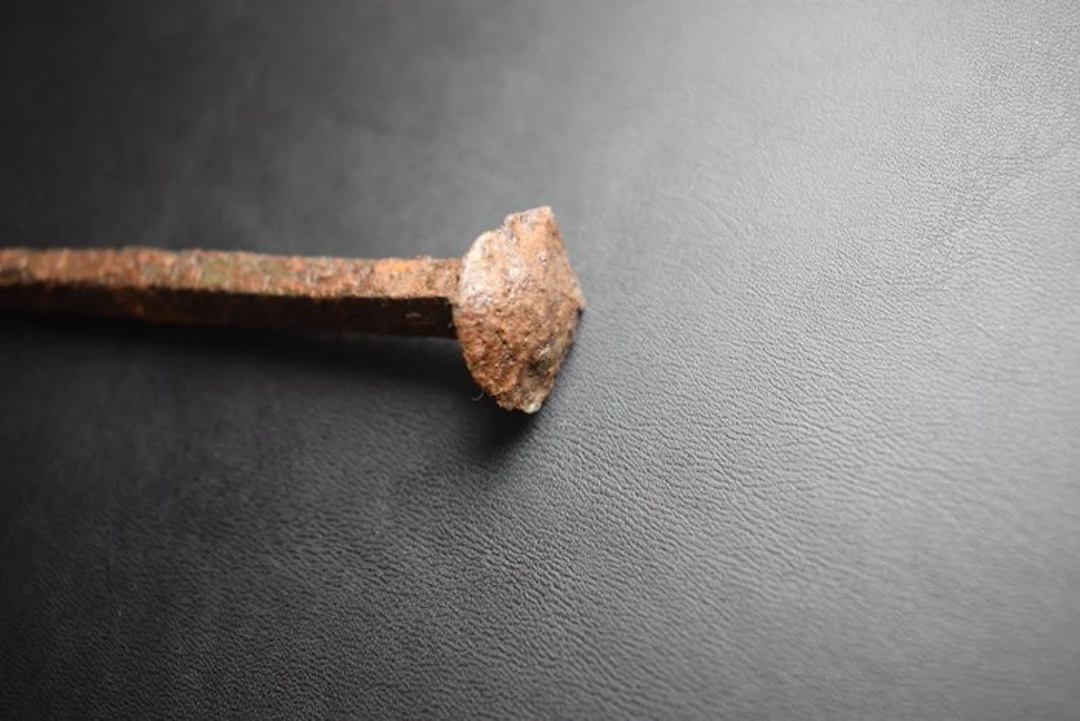
Ancient Roman-Type Iron Nail – Crucifixion Nail Comparison Roman Imperial Period, circa 1st–4th century AD Material: Iron Weight: 47.0 g Dimensions: 164 × 23 × 8 mm (length × maximum head width × maximum shaft width) An impressive and historically fascinating iron nail of remarkable proportions, distinguished by its exceptionally long, massive shaft and substantial mushroom-shaped head. Its dimensions invite a particularly compelling comparison with the iron nails employed in Roman crucifixion practices. Measuring an extraordinary 16.4 cm in length, this substantial specimen features a robust, angular iron shaft, a gradually tapering point and a broad, hand-forged-looking head. The mushroom-shaped head displays an irregular outline, consistent with the extensive corrosion visible across the entire object. The nail exhibits a rich reddish-brown surface with extensive mineral deposits and an appealing, heavily aged appearance. Historical Significance – Roman Crucifixion: Crucifixion was one of the most notorious forms of capital punishment in the Roman world. It was particularly associated with the punishment of enslaved individuals, rebels and those condemned for offences against Roman authority. Victims could be secured to wooden crosses using ropes, iron nails or a combination of both. Historical accounts and archaeological discoveries confirm that iron nails were employed in at least some Roman crucifixions. Of exceptional interest are the dimensions of the present specimen. Medical and historical reconstructions of Roman crucifixion have described substantial, four-sided iron nails measuring approximately 13–18 cm in length and 8–10 mm in thickness. At 16.4 cm in length and with a maximum shaft width of 8 mm, the present nail corresponds remarkably closely to these reconstructed dimensions. Its considerable length would have permitted substantial penetration into timber. It is therefore particularly interesting in relation to reconstructions involving the fastening of the feet to a wooden cross, where secure anchoring was essential. Archaeological Evidence – The Crucified Man of Jerusalem: One of the most significant archaeological discoveries associated with Roman crucifixion was made in 1968 at Giv'at ha-Mivtar, Jerusalem. The remains of a crucified man, commonly known as Jehohanan, were discovered with an iron nail approximately 11.5 cm long still penetrating his heel bone. This extraordinary discovery provided direct physical evidence of the Roman practice of securing crucifixion victims with iron nails. Another important discovery was made at Fenstanton, Cambridgeshire, England, where archaeologists identified a Roman-period skeleton with an iron nail penetrating the heel. These discoveries demonstrate that the use of iron nails in Roman crucifixion was not merely a literary tradition, but an archaeologically documented reality. A Remarkable Comparison: The present specimen is especially noteworthy for the combination of its impressive length, substantial angular shaft and broad mushroom-shaped head. These characteristics make it a compelling object for comparison with the physical requirements and historical reconstructions of Roman crucifixion. An evocative historical artefact offering a tangible connection to ancient ironworking and an opportunity to explore one of the most significant and consequential punishment practices of the Roman Empire. References: Zias, J. & Sekeles, E. (1985). The Crucified Man from Giv'at ha-Mivtar: A Reappraisal. Israel Exploration Journal, 35, pp. 22–27. The Clinical Anatomy of Crucifixion (2019). Clinical Anatomy, 32, pp. 12–21. Archaeological investigations of the Roman-period crucifixion burial at Fenstanton, Cambridgeshire, England. I prove that the lot was obtained legally , provenance statement seen by Catawiki Important information. I guarantee that I am entitled to ship this lot. I will take care that any necessary permits will be arranged. I will inform the buyer about this if this takes more than a few days.
估價:$246.45
前往拍賣頁查看所有物品來自Catawiki或Ancient Art
估價:
$246.45
類似物品
類似物品的拍賣結果

讓您的拍賣觸及全球收藏家!
立刻發佈上架