
全部拍賣 / Ethnographic / A wooden sculpture - Togo (No reserve price)

A wooden sculpture - Togo (No reserve price)
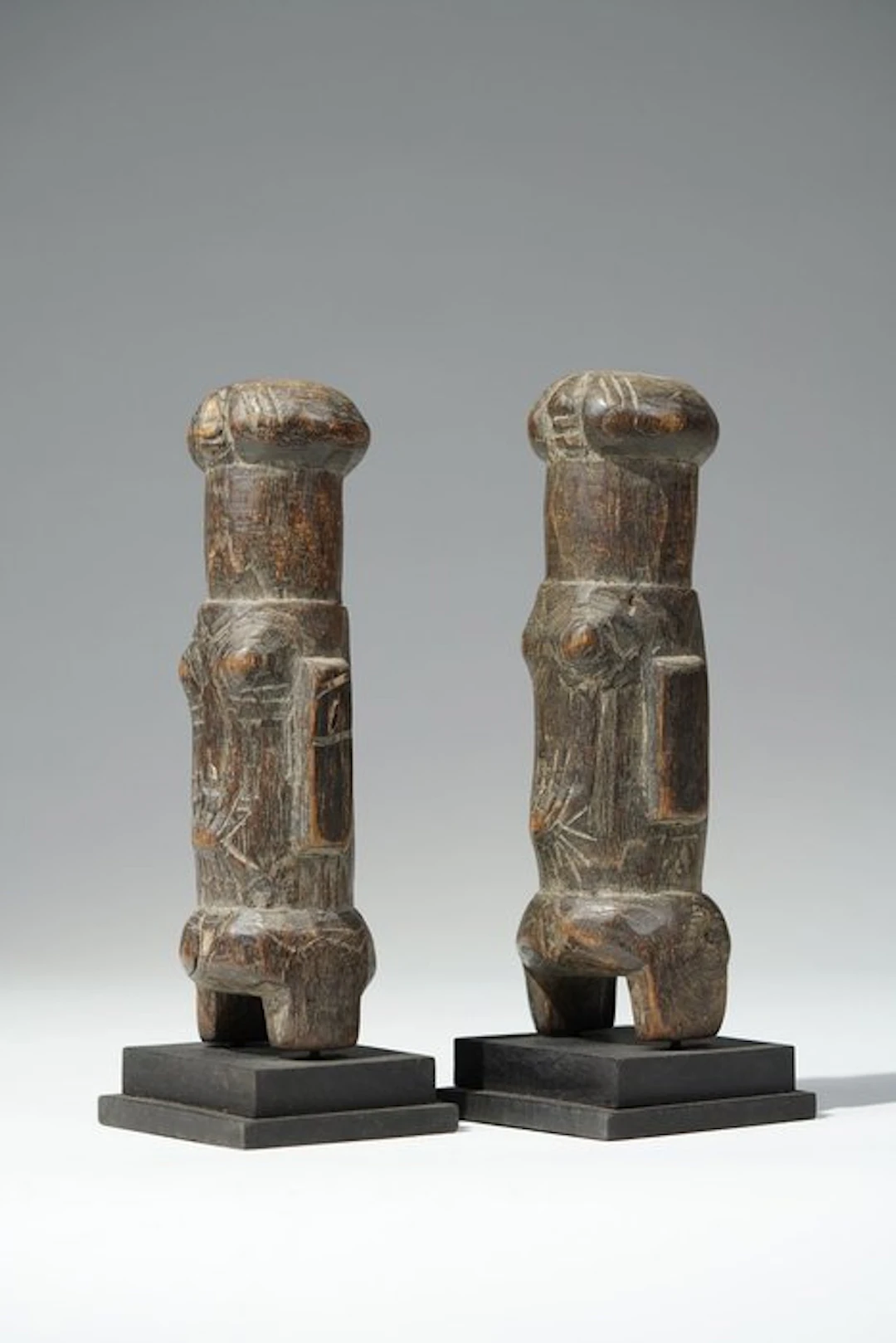
Pair of Losso Wooden Sculptures – Stylized Anthropomorphic Figures Losso (Nawdba), attributed Siou Village, Niamtougou Region, Northern Togo Material: Carved wood with dark brown patina, surface wear and incised decoration Dating: Undetermined, possibly 20th century Cultural Attribution: Losso, according to the informant Function: Undetermined; possibly associated with ancestral or protective practices Description This remarkable pair of wooden sculptures represents two highly stylized anthropomorphic figures characterized by elongated cylindrical bodies, compact rounded heads, and a distinctive reduction of human anatomy to elementary geometric forms. Their closely related proportions and decorative details suggest a shared sculptural conception, possibly originating from the same workshop or individual carver. Both figures possess horizontally expanded, rounded heads resembling flattened domes. The upper surfaces are decorated with short incised lines, while small projecting elements and shallow grooves suggest highly abbreviated facial features. The heads rest upon long, cylindrical sections that may represent elongated necks or an intentional extension of the upper body. This unusual arrangement creates a strong vertical emphasis and gives the sculptures an almost architectural appearance. The central portions of the figures are comparatively broad and display a series of incised geometric patterns. Small rounded projections emerge from the frontal surfaces, possibly indicating breasts, anatomical details, or symbolic attributes. Their exact significance cannot be determined with certainty. Prominent rectangular projections extend from one side of each body, suggesting highly abstracted arms or other structural elements. These projections are particularly distinctive because they interrupt the otherwise cylindrical silhouettes. The lower sections terminate in two short, substantial supports separated by a central opening. These elements may represent legs, although their block-like construction makes anatomical interpretation secondary to the overall sculptural design. The figures are mounted on modern black display bases, which are not original components. The surfaces exhibit dark brown coloration with lighter areas of abrasion, particularly along projecting edges and incised details. Numerous scratches, shallow grooves, and irregular patches of discoloration contribute to the sculptures' textured appearance. Their surfaces suggest handling and environmental exposure, although neither age nor ritual use can be established from these characteristics alone. Despite minor differences in proportions and decoration, the two sculptures form a visually coherent ensemble. Their repeated structural elements create a deliberate rhythm, while subtle variations preserve the individuality of each figure. Art-Historical Context The sculptures are attributed to the Losso, also known as the Nawdba, an ethnolinguistic community inhabiting parts of northern Togo, particularly the area surrounding Niamtougou. The Losso cultural region belongs to a broader landscape of closely interacting communities, including the Lamba, Kabyè, and other populations of the northern Togolese highlands. Wooden sculpture in this region is characterized by considerable formal diversity, ranging from comparatively naturalistic anthropomorphic representations to highly abstract, columnar figures. The artistic traditions of the Losso and neighboring communities have historically been associated with family shrines, ancestral relationships, and practices involving protective or spiritual forces. The present sculptures display several characteristics consistent with the broader vocabulary of northern Togolese figurative carving. Their cylindrical bodies, simplified anatomical features, and pronounced geometric organization emphasize the essential structure of the human figure rather than naturalistic representation. Particularly striking is the unusual relationship between the rounded heads and elongated neck-like sections. Such extreme vertical abstraction distinguishes these objects from more conventional anthropomorphic sculptures and suggests a local artistic interpretation within the wider regional tradition. The attribution to Siou village is especially relevant. Siou lies within the Niamtougou area and is associated with the Nawdm-speaking cultural environment. Nevertheless, individual workshops and sculptural styles within this region have not always been systematically documented. The supplied village attribution should therefore be preserved without assuming that the figures represent a securely established Siou sculptural subtype. Symbolism and Possible Ritual Function The sculptures' highly abstracted human forms invite consideration of their possible relationship to ancestral representation and protective ritual practices. In several northern Togolese communities, carved wooden figures have served as material supports for relationships between living families, deceased relatives, and spiritual forces. Such figures do not necessarily function as portraits in the Western sense. Their significance may derive instead from ritual consecration, inherited associations, or their placement within particular domestic and communal settings. The present sculptures' strongly vertical organization could suggest permanence and stability, while the compact heads and abbreviated limbs emphasize an intentional reduction of the human body. However, these formal characteristics cannot independently establish a particular religious meaning. The small rounded projections on the torsos may represent anatomical features, but their symbolic significance remains uncertain. Similarly, the rectangular lateral elements could indicate arms or attributes associated with the represented figures. The apparent pairing is another potentially meaningful characteristic. In certain African sculptural traditions, paired figures express complementary relationships, family continuity, or the association of distinct spiritual presences. Nevertheless, no documented ritual context confirms that the present sculptures were originally conceived as a complementary pair. Their close stylistic correspondence makes such an association plausible, but the possibility that they were brought together at a later stage cannot be excluded. Without information concerning their original location, ownership, or ritual treatment, a more precise functional interpretation would be speculative. Regional Characteristics: Siou and the Niamtougou Area The Niamtougou region of northern Togo occupies an important position within the cultural geography of the Kara area. Its landscape of hills, cultivated valleys, and dispersed settlements has historically supported communities whose social and religious practices are closely connected with lineage organization, agricultural life, and ancestral relationships. Siou is particularly associated with the Losso or Nawdba cultural sphere. The wider region is characterized by longstanding interactions between neighboring populations, making rigid stylistic boundaries difficult to establish. Traditional wooden sculpture in northern Togo frequently reflects the importance of local ritual practices rather than the requirements of centralized political institutions. Objects may be produced for individual families, lineage shrines, or particular spiritual purposes, and their forms can vary considerably between neighboring settlements. In this context, the present figures' simplified bodies and carefully organized geometric decoration are especially interesting. Their elongated cylindrical sections create a strong formal continuity between head and torso, while the incised markings introduce a restrained decorative vocabulary. The short, block-like lower supports distinguish these sculptures from standing figures with fully articulated legs. Their compact construction may have facilitated placement on a shrine or another supporting surface, although this remains hypothetical. The reported origin in Siou offers a valuable geographical point of reference. It also encourages comparison with the sculptural traditions of neighboring Lamba and Kabyè communities, whose artistic production forms part of the same interconnected northern Togolese environment. Nevertheless, regional proximity should not be mistaken for cultural identity. The sculptures' specific classification must remain dependent upon documented provenance and comparative examples. Art-Historical Appreciation The artistic distinction of this pair lies in the radical simplification of the human figure and the disciplined repetition of geometric forms. The sculptor has transformed the body into a sequence of cylindrical and rectangular volumes, producing a composition of remarkable clarity. The horizontally expanded heads provide a visual counterweight to the elongated vertical bodies. Their rounded contours contrast with the angular lateral projections and block-like lower supports, creating a carefully balanced relationship between curved and straight forms. The incised decoration contributes significantly to the sculptures' expressive character. Rather than covering the surfaces with elaborate ornament, the carver has employed restrained geometric markings that emphasize particular anatomical or structural areas. The dark, worn surfaces enhance the visual effect of these details, allowing the lighter incisions and abraded edges to emerge against the deeper brown wood. Viewed together, the figures establish a compelling sculptural dialogue. Their similarities suggest a common artistic vocabulary, while differences in their proportions and surface treatment introduce a sense of individuality. The pair represents an intriguing example of the abstract figurative traditions associated with northern Togo. Its unusual proportions, distinctive cylindrical construction, and reported origin in Siou make it particularly relevant for comparative study of Losso sculpture. Although its precise function and historical date remain uncertain, the ensemble demonstrates the expressive possibilities of highly reduced anthropomorphic representation within the artistic environment of the Niamtougou region. Selected Literature Amrouche, Pierre. Corps & décors: Statuaire Lamba et Losso du Togo. 2008. A particularly relevant comparative reference for the sculptural traditions of the Lamba and Losso of northern Togo, including their distinctive treatment of the human figure. Froelich, Jean-Claude, Pierre Alexandre, and Robert Cornevin. Les populations du Nord-Togo. Paris: Presses Universitaires de France, 1963. An important ethnographic study of the communities of northern Togo, providing historical and cultural context for the Losso and neighboring populations. Spieth, Jakob. Die Ewe-Stämme: Material zur Kunde des Ewe-Volkes in Deutsch-Togo. Berlin: Dietrich Reimer, 1906. A historical ethnographic work concerning southern Togo; geographically less relevant to the present sculptures and not a direct reference for Losso statuary. The study by Pierre Amrouche is the most directly relevant art-historical comparison for the present objects. The ethnographic publication by Froelich, Alexandre, and Cornevin provides important regional context. Neither establishes the precise function or dating of this particular pair. Informant: Ouro Copyright and Scientific Documentation Some of the information and photographs have been generated with the assistance of artificial intelligence and are based on published sources in ethnography, archaeology, and art history. Original texts and photographs may be protected by copyright. All rights held by the respective copyright holders are reserved. Inv. No. MAZ32524 Height: 20 cm / 20 cm Weight: 320 g / 370 g (incl. stand)
估價:$308.06
前往拍賣頁查看所有物品來自Catawiki或Ethnographic
估價:
$308.06
類似物品


類似物品的拍賣結果
讓您的拍賣觸及全球收藏家!
立刻發佈上架