
全部拍賣 / Ethnographic / A wooden sculpture - Prampram - Ghana (No reserve price)

A wooden sculpture - Prampram - Ghana (No reserve price)
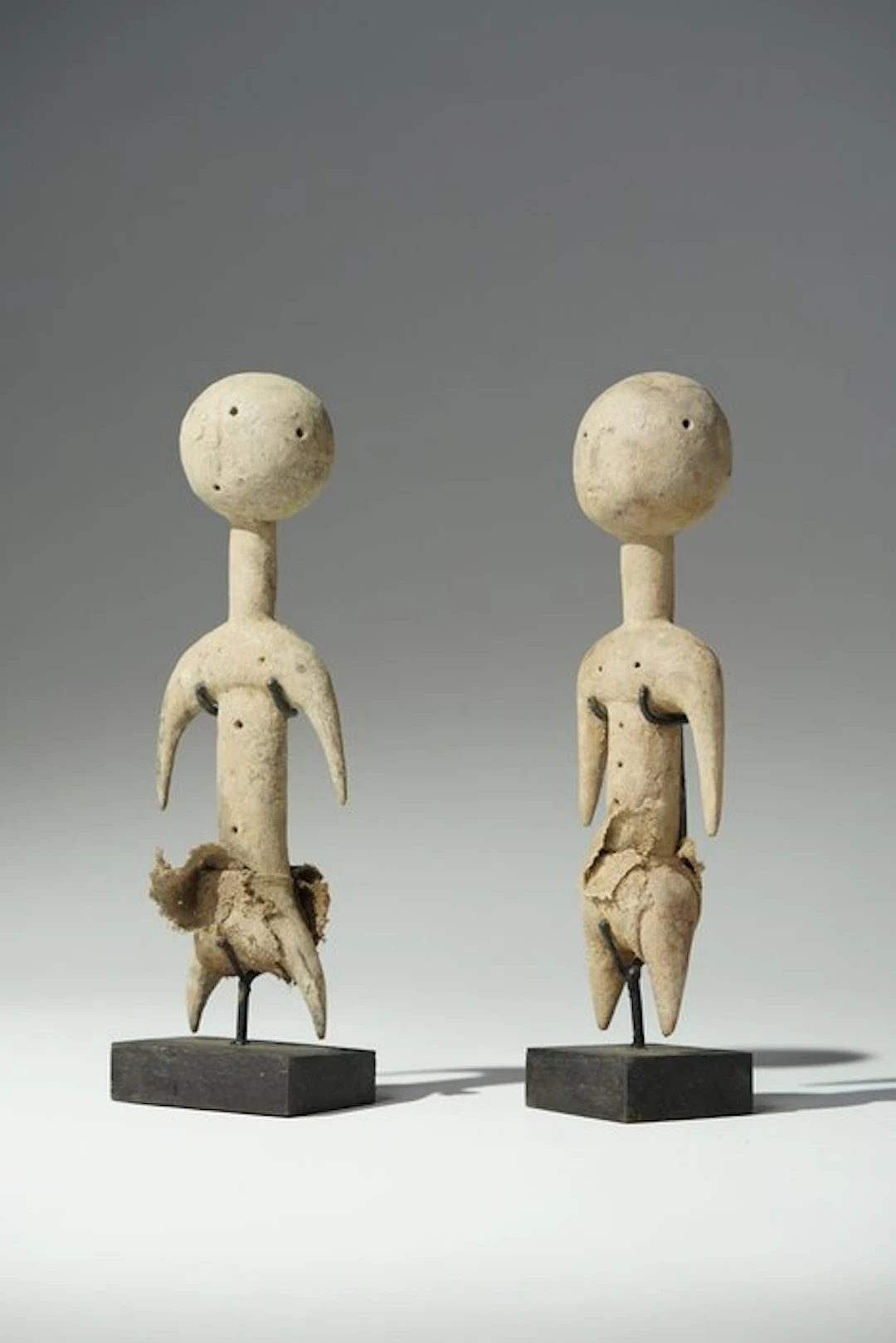
Pair of Prampram Anthropomorphic Figures Origin: Southern region, Ghana Possible ritual or shrine function; precise dating and identification not established. Material: Wood covered with a whitish-beige, matte, and grainy layer, with some gray or reddish traces. Description The two sculptures are modeled with nearly identical proportions, but they differ slightly in height, facial modeling, and the condition of their accessories. Each features a large, spherical head set atop a relatively long, cylindrical neck. The face is reduced to a few basic features: two circular perforations indicate the eyes, a faint vertical ridge suggests the nose, and a small incision or cavity marks the mouth. This economy of form gives the faces a silent, fixed, and impersonal expression. The shoulders form a continuous arc from which two short, curved, and tapered arms extend downward, ending without hands. The torso is narrow, cylindrical, and elongated. Several small holes are arranged on the chest, abdomen, and sometimes the head. Two of these, placed symmetrically on the upper torso, may represent nipples, while those along the abdominal axis could indicate the navel, body markings, or attachment points that are now empty. However, not all perforations can be interpreted with certainty: some may be the result of wood-boring insects or wood decay. The pelvis extends directly into two short, tapered legs without feet. No clearly carved sexual characteristics are visible; it is therefore not possible to determine whether the figures represent a man and a woman. Around the hips, fragments of fibrous material—textile or plant-based—remain, partially covered by an earthy substance. These elements may correspond to ancient loincloths, ritual wrappings, remnants of fastenings, or more recent additions. The rods, metal hooks, and black bases are modern display fixtures. The entire surface is covered with a whitish-beige, matte, and grainy layer, with a few gray or reddish traces. This could be light-colored clay, kaolin, chalk, ash, or a ritual mixture, but photographic examination does not allow for a determination of its composition. Historical and Artistic Analysis The sculptural language is based on a radical reduction of the human body. The spherical head dominates the composition, while the neck, torso, arms, and legs are reduced to simple volumes. The sculptor does not appear to be seeking an individual portrait or anatomical realism, but rather a vertical, frontal, and immediately recognizable presence. The repetition of the two forms reinforces the idea of a whole conceived as a visual unit. The pair may evoke complementarity, kinship, filiation, or the duplication of a single spiritual presence. However, there is no evidence that it necessarily represents a married couple, nor even that the two sculptures have always been associated. Their technical and formal similarity nevertheless suggests the same workshop or a closely related production. This austerity finds a general parallel in certain Dangme religious arts. Nii Otokunor Quarcoopome demonstrates that Dangme religious monuments frequently favor sober, geometric, and minimally figurative forms, whose meaning depends less on ornamentation than on their location, their invisible contents, and their ritual activation. Sanctuaries and altars are understood as anchor points for deities, ancestors, and kinship groups. The stylistic designation "Prampram," however, remains tenuous. The corpus of sculptures marketed under this name has not yet been the subject of an academic monograph or a sufficiently in-depth comparative study. The connections sometimes suggested with Moba figures from northern Togo and Ghana are based primarily on formal analogies and provenance information derived from the market; they do not demonstrate a direct historical lineage. Scientifically Grounded Description A rigorous attribution would first require the identification of the wood species. Microscopic anatomy, possibly supplemented by chemical analysis such as DART-MS spectrometry, could compare a micro-sample to West African reference wood samples. The Smithsonian emphasizes that botanical identification can shed light on the material's technical characteristics, geographic provenance, and symbolic meanings. The whitish layer should be examined using X-ray fluorescence, Raman spectroscopy, or FTIR to identify mineral elements and any organic binders. X-ray imaging would help distinguish between carved perforations, insect galleries, internal cracks, and repairs. Fiber analysis of the basin would determine whether it consists of textile, bark, plant fibers, or a modern material. These examinations are commonly used by conservation laboratories to study pigments, wood, fibers, internal structures, and restorations. Ritual Function Among the Dangme, altars and shrines can embody the identity of a lineage, house consecrated objects, and serve as intermediaries between the living, the ancestors, and spiritual powers. The periodic whitewashing of certain altars accompanies ceremonies, libations, and sacrifices; purification rites also apply to shrines and various sacred objects. In this context, the two figures may have been kept in a family or community shrine, received coatings, wrappings, and offerings, or represented protective presences. The material around the hips and the light-colored layer are consistent with ceremonial handling, but they are not sufficient to prove a specific function. It would therefore be excessive to formally identify them as ancestors, fertility deities, funerary figures, or initiation objects. Selected Bibliography Biveridge, Fritz. "Archaeological Perspectives of the Danish-Dangbe Encounter along the Eastern Coastal Belt of Ghana and their Implications for Understanding Dangbe Culture." Ghana Social Science Journal, vol. 13, no. 1, 2016, pp. 119–156. Cole, Herbert M., and Doran H. Ross. The Arts of Ghana. Los Angeles: Museum of Cultural History, University of California, 1977. Huber, Hugo. "Adangme Purification and Pacification Rituals (West Africa)." Anthropos, vol. 53, 1958, pp. 161–191. Quarcoopome, Nii Otokunor. Rituals and Regalia of Power: Art and Politics Among the Dangme and Ewe, 1800 to Present. Ph.D. dissertation, University of California, Los Angeles, 1993. Quarcoopome, Nii Otokunor. "Thresholds and Thrones: Morphology and Symbolism of Dangme Public Altars." Journal of Religion in Africa, vol. 24, no. 4, 1994, pp. 339–357. The publications mentioned serve for comparative art historical classification. They do not establish the specific cultural attribution, dating, or original use of the sculpture in question. Copyright and Scientific Documentation Some of the information and photographs have been generated with the assistance of artificial intelligence and are based on published sources in ethnography, archaeology, and art history. Original texts and photographs may be protected by copyright. All rights held by the respective copyright holders are reserved. Inv. No. MAZ33092 Informant: Ouro Height: 20 cm / 19 cm Weight: 110 g / 100 g (incl. stand)
估價:$308.06
前往拍賣頁查看所有物品來自Catawiki或Ethnographic
估價:
$308.06
類似物品


類似物品的拍賣結果
讓您的拍賣觸及全球收藏家!
立刻發佈上架