
全部拍賣 / Ethnographic / A wooden sculpture - Lobi - Burkina Faso (No reserve price)

A wooden sculpture - Lobi - Burkina Faso (No reserve price)
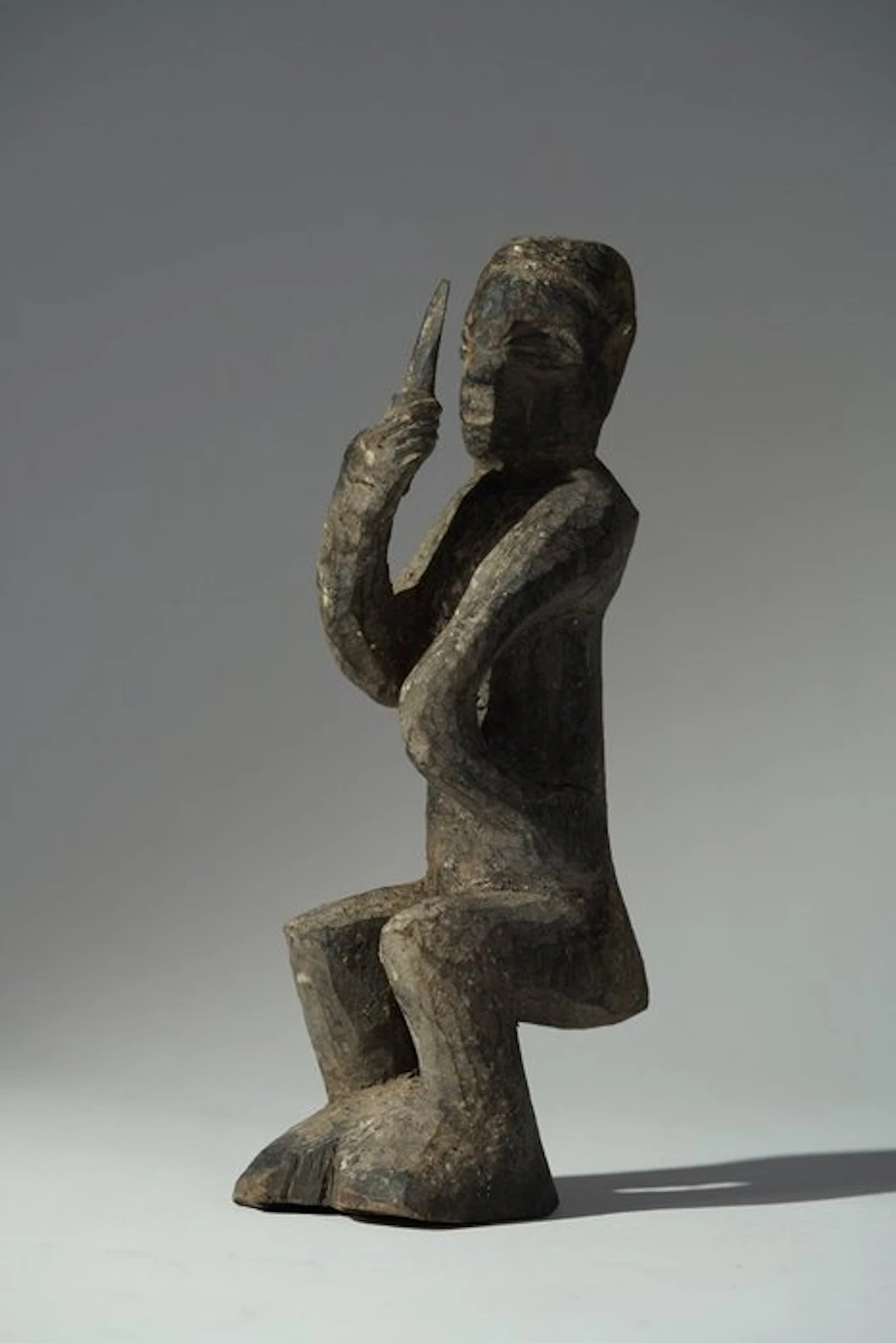
Lobi Seated Figure, Gaoua Region, Burkina Faso Lobi, Gaoua region, southwestern Burkina Faso Wood with dark, partly encrusted surface This highly expressive seated figure from the Gaoua region belongs to the sculptural traditions generally associated with Lobi bateba figures. Unlike the more familiar upright examples, the figure is represented in a strongly articulated seated position, with bent legs projecting forward and two dramatically differentiated arm gestures. The unusual posture gives the sculpture a remarkable psychological and physical intensity. The figure is constructed around a compact vertical torso rising above the bent legs. The thighs project forward from the body before the lower legs descend almost vertically toward the broad feet. Rather than being represented on a separate stool, the seated position appears to be created by the geometry of the body itself. Seen in profile, this produces a powerful succession of angular forms: torso, thighs, knees, lower legs and feet. The upper body is dominated by the arms. One arm bends upward beside the head, terminating in an elongated hand or pointed form held close to the face. The opposite arm describes a broad curve downward across the front of the body, with the hand apparently resting near the abdomen or upper thigh. This asymmetry transforms the figure from a static image into one defined by gesture. The head is comparatively large and rounded, with a high forehead and restrained facial features. The eyes are indicated beneath gently modeled brows, while the nose and mouth project only slightly from the facial plane. There is little attempt at individualized portraiture. Instead, the simplified face contributes to the concentrated, inward character of the sculpture. The surface is dark and irregular, with greyish and lighter deposits distributed over the head, shoulders, arms and legs. Areas of abrasion reveal the underlying wood, while recessed passages retain thicker accumulations. Such surfaces are compatible with the prolonged ritual lives of Lobi shrine figures, which could receive offerings and other substances. From the photograph alone, however, the precise origin of these deposits cannot be determined. Regional characteristics Gaoua lies at the heart of the Lobi cultural area of southwestern Burkina Faso, close to the borders with Côte d’Ivoire and Ghana. This wider region is inhabited by Lobi and culturally related communities whose religious practices historically centered upon relationships between human beings and invisible spiritual powers known as thila, singular thil. Anthropomorphic wooden sculptures commonly known as bateba formed an important part of this religious environment. They could be installed in domestic or other shrines and understood as active intermediaries associated with thila. Their significance therefore extended far beyond representation: within their original context, such sculptures participated in systems concerned with protection, misfortune, illness, social relationships and the maintenance of spiritual equilibrium. An especially important characteristic of Lobi sculpture is the extraordinary variety of bodily postures. While many bateba stand frontally with their arms close to the body, others raise their arms, turn their heads, sit, embrace, display unusual anatomical features or assume gestures associated in the literature with particular conditions or protective capacities. The posture of the present sculpture is consequently highly significant. Its seated position and raised hand place it outside the most neutral standing type. Published classifications of Lobi sculpture distinguish several categories according to bodily attitude, including seated figures and figures expressing particular emotional or protective states. The terminology applied to individual examples, however, is not always consistent, and an exact ritual category should not be assigned solely on visual evidence. The raised arm deserves particular caution. In discussions of Lobi sculpture, elevated arms are sometimes associated with figures intended to counter threatening forces, while other unusual gestures have been interpreted in relation to suffering, mourning or the transfer of undesirable conditions away from human beings. Yet the present figure combines a raised arm with a seated posture in a particularly individual manner. It would therefore be too restrictive to identify it automatically with one named bateba subtype. This individuality is characteristic of Lobi sculpture more generally. There was no single centralized Lobi court or workshop imposing a uniform sculptural canon. Carvers developed highly personal solutions within a shared religious and formal vocabulary. Consequently, figures from the Gaoua region can vary dramatically in proportions, facial treatment, gesture and degree of abstraction. The present sculpture is an especially compelling example of this freedom. Its power does not depend upon anatomical naturalism. The oversized feet anchor the figure physically, the sharply bent knees establish the seated position, and the sweeping arms concentrate attention around the torso and head. The upward-pointing hand creates the strongest accent of the entire composition. Seen from the side, the sculpture is almost calligraphic. The body is constructed through a succession of curves and counter-curves, culminating in the narrow vertical gesture beside the face. This gives the work a sense of arrested movement—as though an action or gesture had been permanently fixed in wood. Without documentation concerning the original shrine and circumstances of collection, the figure is best described as a Lobi seated bateba-type figure rather than assigned to a narrowly defined ritual category. Its unusual posture, strongly differentiated gestures and worn, accumulated surface nevertheless place it convincingly within the rich sculptural traditions centered on Gaoua and the wider Lobi region. Selected Literature Meyer, Piet. Kunst und Religion der Lobi. Zürich: Museum Rietberg, 1981. Bognolo, Daniela. Lobi. Milan: 5 Continents Editions, 2007. Himmelheber, Hans. “Figuren und Schnitztechnik bei den Lobi, Elfenbeinküste.” Tribus 15, 1966. Massa, Gabriel, and Jean-Claude Lauret. Sculptures des trois Volta. Saint-Maur: Sépia, 2001. Some of the information and photos are generated by artificial intelligence and is based on published sources from the fields of ethnography, archaeology, and art history documents. All information and photos are protected by copyright. Inv. No. MAZ31114
估價:$252.09
前往拍賣頁查看所有物品來自Catawiki或Ethnographic
估價:
$252.09
類似物品

類似物品的拍賣結果

讓您的拍賣觸及全球收藏家!
立刻發佈上架