
全部拍賣 / Ethnographic / A wooden sculpture - Legba - Ewe - Togo (No reserve price)

A wooden sculpture - Legba - Ewe - Togo (No reserve price)
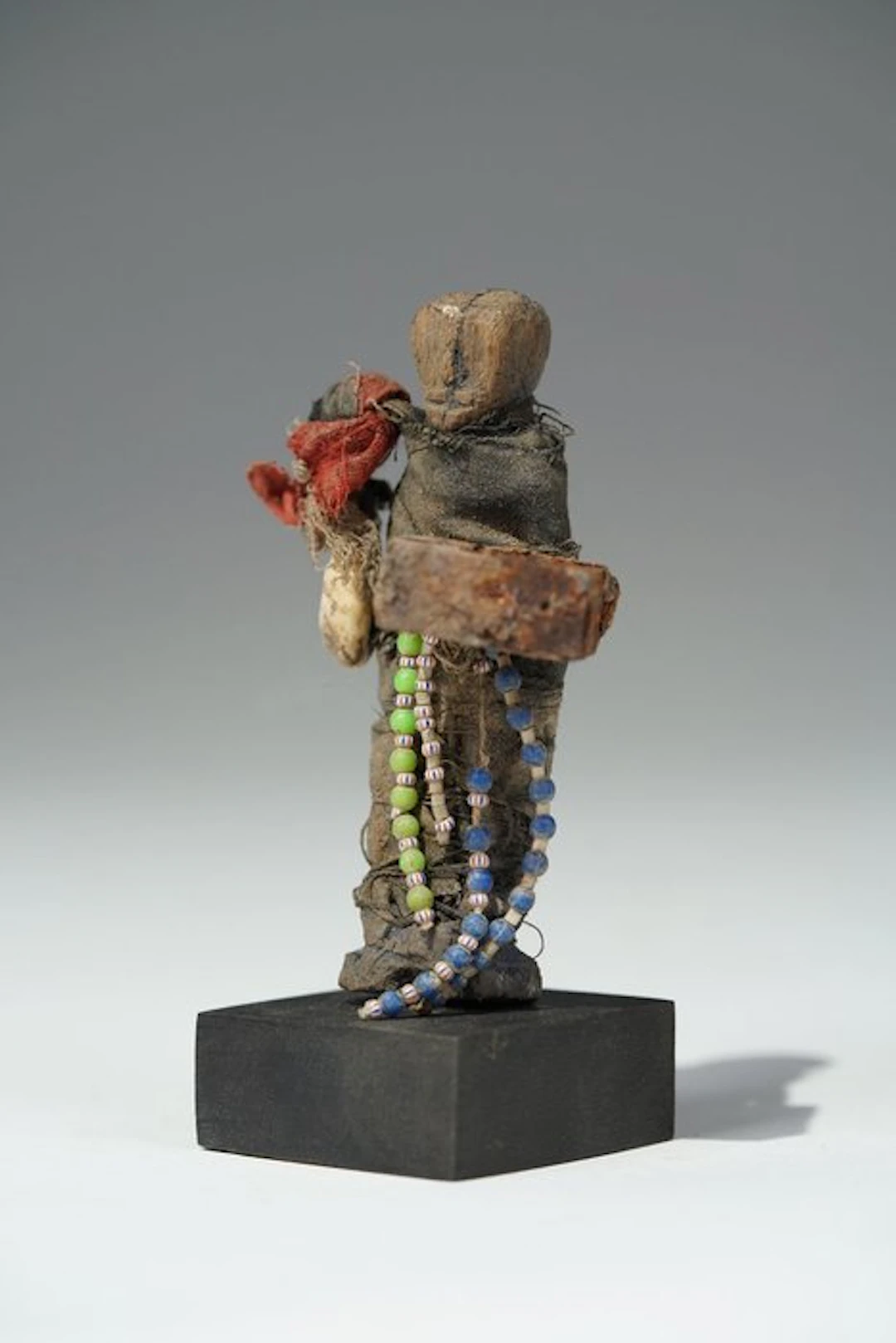
Ewe Legba Fetish Figure – Village Protection and Ritual Power Ewe Cultural Sphere, Tsévié Region, Southern Togo Material: Carved wood, textile wrappings, iron attachment, glass beads, cords and organic materials, incl stand Dating: Undetermined, possibly 20th century or later Cultural Attribution: Ewe, according to the informant Object Type: Composite anthropomorphic ritual figure Function: Legba associated with the protection of a village, according to the informant Description This remarkable ritual sculpture represents a highly abstracted anthropomorphic figure whose original wooden form has been transformed through the addition of textiles, iron, beads, cords, and other materials. Its appearance is characterized by the accumulation of diverse substances and objects, creating a complex assemblage in which the carved figure functions as the structural core of a spiritually significant composition. The head consists of a roughly cylindrical wooden element with a rounded upper section and a slightly tapering lower portion. Its surface displays pronounced vertical cracks, abrasion, and irregular discoloration. Facial features are not clearly recognizable, suggesting either an intentionally simplified representation or a form whose original details have been obscured by wear and subsequent ritual modifications. The neck and upper torso are enveloped in dark, coarse textile material, secured with cords and bindings. This covering conceals much of the underlying wooden structure and gives the figure a compact, columnar silhouette. The body continues downward as an elongated, approximately rectangular mass, wrapped in additional layers of dark material and fibers. A particularly conspicuous feature is the substantial iron element projecting horizontally across the upper body. Its surface is heavily oxidized, displaying reddish-brown corrosion and an irregular texture. The object resembles a short section of cylindrical iron or a thick metal fitting. Its precise original form and function cannot be established from the photograph. On one side of the upper body, an assemblage of red textile fragments, pale fibrous material, and a suspended light-colored object creates a second focal point. The pale element may be a shell, tooth, bone, or another organic component, but its identification requires direct examination. Several strands of brightly colored beads descend across the front of the sculpture. These include vivid green and blue spherical beads interspersed with smaller striped beads and pale cylindrical elements. Their colors contrast sharply with the dark wrappings and oxidized metal. The lower portion of the figure is irregularly shaped and appears to incorporate additional binding materials and compacted surface deposits. It rests on a modern black display base, which is not part of the original ritual assemblage. The overall composition is asymmetrical, with the projecting iron element and attached textile bundle interrupting the figure's otherwise vertical structure. This asymmetry contributes to its distinctive expressive character and emphasizes the importance of accumulated materials in its construction. Art-Historical Context The sculpture is attributed to the Ewe cultural sphere of southern Togo and is identified by the informant as a Legba associated with the protection of a village. This designation situates the object within the religious traditions of the region, where Legba occupies an important position among spiritual intermediaries and protective forces. In Ewe and neighboring Aja-Fon religious traditions, Legba is frequently associated with thresholds, communication, passage, and the mediation of relationships between human beings and supernatural powers. His manifestations vary considerably between communities, and his responsibilities may include the protection of households, compounds, settlements, and particular ritual spaces. Legba is not represented through a single standardized artistic form. Depending upon local practice, he may appear as an earthen construction, an anthropomorphic sculpture, or a composite assemblage incorporating materials believed to possess particular spiritual properties. The present figure belongs to this broader category of materially complex ritual objects. Its wooden core has been transformed through wrappings and attachments that appear to constitute an integral part of its present identity. Such objects are often difficult to classify through stylistic analysis alone. Their significance may depend less upon the original carving than upon the materials added during preparation, consecration, and subsequent ritual use. The attribution to Legba and the protective function supplied by Batoure are therefore especially important elements of the available documentation. Nevertheless, the sculpture's original ritual setting, the identity of its custodians, and the ceremonies associated with it remain unknown. Symbolism and Ritual Function According to the informant, the sculpture represents a Legba responsible for protecting a village. Within the religious traditions of southern Togo, the protection of a settlement may involve relationships with spiritual forces associated with territorial boundaries, entrances, crossroads, and communal well-being. Legba's association with thresholds makes him particularly relevant to such protective functions. A shrine dedicated to this spiritual power may serve as a point of mediation between the inhabited community and forces understood to operate beyond its immediate control. The present sculpture's protective identity is expressed through an accumulation of materials rather than through elaborate anatomical representation. The iron attachment is particularly noteworthy. Iron occupies an important position in numerous West African religious traditions because of its association with transformation, craftsmanship, strength, and the activities of blacksmiths. In certain ritual contexts, metal objects may contribute to the perceived effectiveness of protective assemblages. However, the specific meaning of the iron component in this sculpture cannot be established without information about its original preparation and use. Its substantial dimensions and prominent placement suggest that it was deliberately incorporated into the composition. The textile wrappings may have served to contain, protect, or conceal substances associated with the figure's ritual identity. In some West African traditions, wrapped objects function as repositories for materials whose significance depends upon specialized knowledge. The brightly colored beads introduce another dimension. Beads may serve as ornaments, offerings, identifying attributes, or components of spiritually significant assemblages. Their particular colors and arrangement could have carried local meanings, but these cannot be reliably reconstructed from the photograph. The red textile bundle attached near the upper body may likewise have contained materials associated with the object's preparation or maintenance. Its significance remains uncertain. Taken together, these components suggest an object whose spiritual identity was established through the interaction of carving, wrapping, binding, and the addition of selected materials. The sculpture's reported function as a village protector is consistent with the broader role of Legba in southern Togolese religious practice, although the precise rituals associated with this particular figure remain undocumented. Regional Characteristics: Tsévié and Southern Togo Tsévié is situated north of Lomé in the Maritime Region of Togo, within an area historically associated with Ewe-speaking communities and extensive cultural interaction with neighboring populations. The region forms part of a religious landscape in which Vodun traditions have developed through relationships among Ewe, Aja, Fon, and other communities of southern Togo and Benin. Legba occupies a significant position within this interconnected environment, although his attributes, representations, and ritual responsibilities vary between local traditions. In some communities, Legba shrines are positioned at entrances to compounds, along paths, or near crossroads. These locations reflect the importance of movement, boundaries, and communication in the divinity's religious identity. Village-protective manifestations of Legba may be associated with the maintenance of communal security and the regulation of relationships between inhabitants and potentially harmful spiritual influences. The present sculpture's composite construction is particularly relevant to this regional context. In southern Togo, ritual objects may incorporate wood, textiles, iron, shells, beads, fibers, and other materials selected according to local religious requirements. Such assemblages should not necessarily be understood as finished works created at a single moment. Their appearance may develop through successive additions, replacements, and applications of substances. The visible beads, textile fragments, and metal component may therefore represent different stages in the sculpture's history. However, without documented evidence, their sequence of application cannot be determined. The reported origin in the Tsévié region provides an important geographical reference, but it does not establish the specific village where the figure was manufactured or used. The designation “village protector” should consequently be retained as information supplied by the informant rather than presented as an independently verified ritual classification. Art-Historical Appreciation The artistic significance of this sculpture lies in its transformation of a simple anthropomorphic wooden core into a complex ritual assemblage. Unlike sculptures whose visual impact depends primarily upon anatomical modeling, this figure derives much of its expressive force from the accumulation and juxtaposition of contrasting materials. The roughly carved wooden head establishes a minimal human presence, while the dark textile wrappings create a compact and almost architectural body. The horizontal iron attachment introduces a powerful counterpoint to the vertical structure. Its corroded surface contrasts with the softer textures of the fabrics and cords, emphasizing the material diversity of the composition. The colored beads provide a particularly striking visual element. Their bright green and blue tones stand out against the subdued browns, greys, and blacks of the surrounding materials, creating a rhythmic sequence that draws attention down the front of the figure. The red textile bundle introduces another strong color accent and contributes to the sculpture's asymmetrical organization. The object is especially interesting because its present appearance cannot be attributed solely to the work of a woodcarver. It reflects the interaction of carving, material selection, binding, and possible ritual modification. Its significance therefore resides not only in the underlying anthropomorphic form but also in the relationships between the various components. As a Legba figure attributed to the Tsévié region, the sculpture offers an intriguing example of the material complexity associated with protective religious practices in southern Togo. Its reported role as a village protector provides a meaningful interpretive framework, while its precise history, dating, and original ritual context remain subjects for further investigation. Selected Literature Rosenthal, Judy. Possession, Ecstasy, and Law in Ewe Voodoo. Charlottesville: University Press of Virginia, 1998. A particularly relevant ethnographic study of Ewe Vodun practices, religious institutions, and relationships with spiritual powers in the Ghana-Togo border region. Spieth, Jakob. Die Ewe-Stämme: Material zur Kunde des Ewe-Volkes in Deutsch-Togo. Berlin: Dietrich Reimer, 1906. A foundational historical source concerning Ewe religious beliefs, ritual practices, and material culture in southern Togo. Blier, Suzanne Preston. African Vodun: Art, Psychology, and Power. Chicago: University of Chicago Press, 1995. An important comparative study of Vodun objects, ritual assemblages, and the relationship between material substances and spiritual power in neighboring southern Benin. Meyer, Birgit. Translating the Devil: Religion and Modernity Among the Ewe in Ghana. Edinburgh: Edinburgh University Press, 1999. Provides additional context for Ewe religious concepts and the transformation of indigenous spiritual practices. These publications provide relevant ethnographic and comparative material for understanding Legba and the wider Vodun traditions of southern Togo and Benin. They do not document the present sculpture or independently establish its particular role in village protection. Informant: Batoure Copyright and Scientific Documentation Some of the information and photographs have been generated with the assistance of artificial intelligence and are based on published sources in ethnography, archaeology, and art history. Original texts and photographs may be protected by copyright. All rights held by the respective copyright holders are reserved. Inv. No. MAZ32928
估價:$235.24
前往拍賣頁查看所有物品來自Catawiki或Ethnographic
估價:
$235.24
類似物品

類似物品的拍賣結果
讓您的拍賣觸及全球收藏家!
立刻發佈上架