
全部拍賣 / Ethnographic / A wooden mask - Karanga - Mossi - Burkina Faso (No reserve price)

A wooden mask - Karanga - Mossi - Burkina Faso (No reserve price)
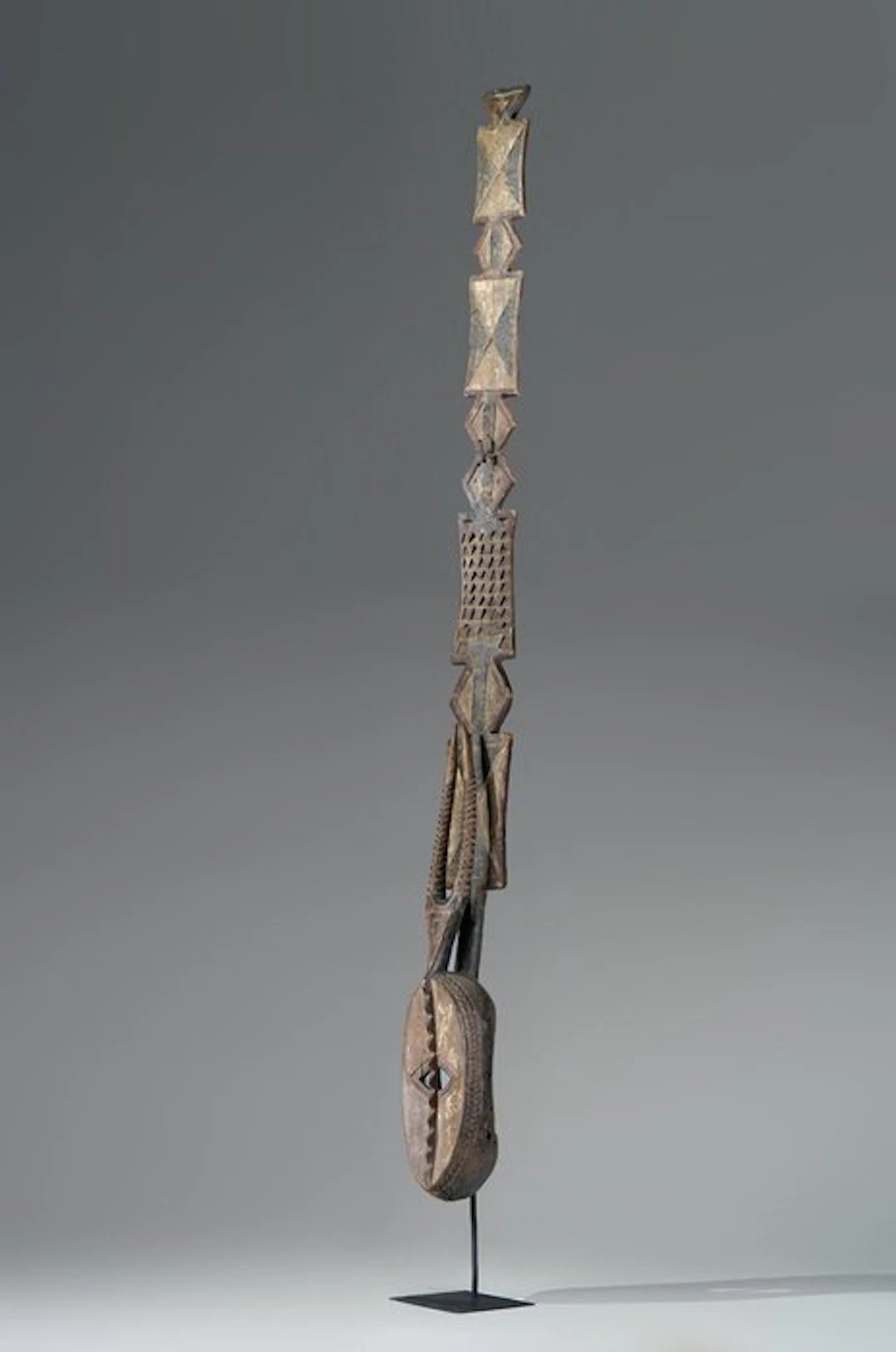
Karanga mask depicting a large antelope, Mossi—Nyonyosé tradition Origin: Yatenga region, Burkina Faso Material: wood and traces of pigments; likely used for funerary and lineage rituals, incl stand. Description This object is a vertical Mossi wooden mask belonging to the category generally known as karanga. It is immediately distinguished by its spectacular proportions: an oval, hollow facial section is extended upward by a very long, narrow superstructure, composed of a succession of rectangular, diamond-shaped, and openwork forms. The section intended to cover the face consists of an elongated shell, slightly convex on the outside and hollowed out on the reverse. At the center of this face is a prominent, serrated vertical ridge, interrupted by two symmetrical triangular openings corresponding to the eyes. The side edges feature geometric herringbone patterns incised into the wood. Several perforations are visible on the sides and were likely used to attach costume elements, fibers, or a fastening system. Above the face mask rise two long, tapered, parallel forms reminiscent of antelope horns, whose surfaces are punctuated by transverse notches. These elements join a tall structure composed of flat, decorated panels. One can observe rectangles divided into opposing triangles, diamonds, openwork latticework, and geometric patterns created by incision or the removal of material. Residual traces of dark, light, and reddish pigments appear to remain in certain areas; however, their chemical composition and age cannot be determined without material analysis. The reverse side clearly shows the hollowing out of the mask and the significant reduction in the thickness of the wood, a process essential for making such a long object wearable. Wear, cracks, loss of material, and some repairs indicate a complex material history. Art-Historical Analysis From an art-historical perspective, comparison with documented examples strongly confirms that this sculpture belongs to the Karanga tradition of the Yatenga region. The Metropolitan Museum of Art describes this type as a mask with an oval face surmounted by an imposing vertical superstructure, combining geometric patterns, openwork, and antelope horns. More specifically, the museum identifies the karanga as a representation of the greater koba antelope (Hippotragus koba), native to this region of Mossi country. The New Orleans Museum of Art also holds a mask from Yatenga, whose description mentions a concave face, a serrated central ridge, eye openings, horns, and a tall panel carved with polychrome geometric motifs. The construction of the object presented here is particularly interesting because it combines an animal representation with a largely abstract vocabulary. The horns identify the zoological referent, while the rectangles, triangles, diamonds, and chevrons gradually transform the silhouette into a graphic composition. This combination of figurative and geometric elements is characteristic of the arts of several populations in Burkina Faso, but the extremely vertical design is particularly associated with the Mossi of the northwest. Christopher D. Roy has shown that Mossi mask traditions differ significantly across historical regions and that the Yatenga style constitutes a distinct artistic tradition. Nevertheless, it is important to be precise regarding social attribution. In the ethnographic literature on the Mossi, it is notably the Nyonyosé communities—descendants of populations predating the establishment of Nakomsé political power—who are associated with the production and use of masks. The Palmer Museum emphasizes that masks in the Yatenga style are linked to these groups and their lineage traditions. This distinction is important: the mask does not simply represent "Mossi royal art," but is part of a set of village and lineage practices with their own history. Ritual Function The function of the karanga is primarily ritual, funerary, ancestral, and protective. According to documentation from the Metropolitan Museum, the male head of a clan may possess a mask depicting an animal or a being linked to his family's origin story. This totemic animal symbolically shares the clan's life force. The mask thus becomes a means of connecting with the lineage's founders and ancestors. Libations may be offered to it before the rainy season to pray for agricultural fertility, rain, and collective prosperity. The karanga also plays a role in funerals and commemorative ceremonies. The masks may accompany the deceased, ensure the proper conduct of the rites, and take part in the dances celebrating the deceased's passage to the ancestral world. The National Museum of African Art confirms that masks from northern Mossi appear during burials, memorial ceremonies, and certain protective rituals. A field photograph taken by Christopher Roy in 1977 indeed documents a Karanga mask from Yatenga in a funerary context. Selected Bibliography Roy, Christopher D. *Art of the Upper Volta Rivers*. Meudon: Alain and Françoise Chaffin, 1987. 384 pp. Wheelock, Thomas G. B. and Christopher D. Roy. Land of the Flying Masks: Art and Culture in Burkina Faso; The Thomas G. B. Wheelock Collection. Munich/New York: Prestel, 2007. Metropolitan Museum of Art. Mask (Karanga), Mossi peoples, Yatenga region, Burkina Faso. Michael C. Rockefeller Wing Collection. New Orleans Museum of Art. Face Mask (Karanga), Mossi, Yatenga Area, Burkina Faso. National Museum of African Art, Smithsonian Institution. Mossi Face Mask, Burkina Faso. Documentation on the funerary, commemorative, and protective uses of masks from northern Mossi. The publications mentioned serve for comparative art historical classification. They do not establish the specific cultural attribution, dating, or original use of the sculpture in question. Copyright and Scientific Documentation Some of the information and photographs have been generated with the assistance of artificial intelligence and are based on published sources in ethnography, archaeology, and art history. Original texts and photographs may be protected by copyright. All rights held by the respective copyright holders are reserved. Inv. No. MAZ33276
估價:$504.1
前往拍賣頁查看所有物品來自Catawiki或Ethnographic
估價:
$504.1
類似物品

類似物品的拍賣結果
讓您的拍賣觸及全球收藏家!
立刻發佈上架