
全部拍賣 / Ethnographic / A iron sculpture - Vere - Nigeria (No reserve price)

A iron sculpture - Vere - Nigeria (No reserve price)
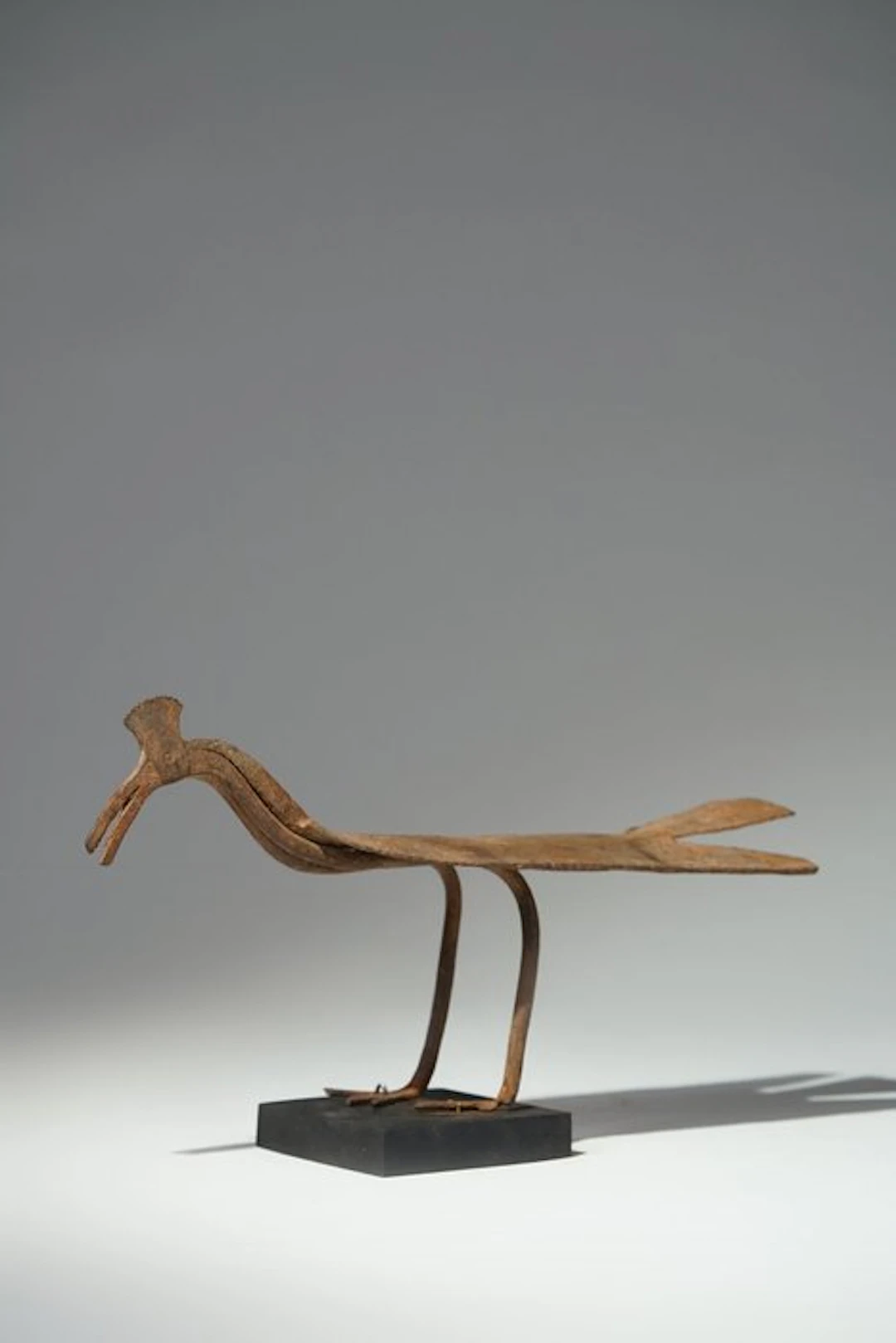
Vere Bird Sculpture – Abstract Iron Sculpture with an Elongated Body Origin: Jimeta Region, Adamawa State, Northeast Nigeria Cultural Attribution: Vere (Verre), attributed Material: Wrought iron, reddish-brown oxidation patina, incl stand Dating: Not certain Provenance: Jimeta Region, Nigeria, according to the original provenance information Description This exceptionally slender bird sculpture, made of wrought iron, is characterized by a consistently linear design that reduces the animal's body to a few essential elements. The horizontally oriented figure has an elongated, narrow torso that extends forward into an elegantly curved neck. This transitions into a small, highly stylized head, the upper end of which is formed by an upright, fan-shaped crest. Two narrow, downward-pointing iron projections can be interpreted as a forked beak or as abstracted components of the head. The body consists of several parallel, partially interconnected strands of iron, whose slight irregularities reveal the handcrafted nature of the work. The horizontal movement continues backward in two flat, forged, tapered extensions that form a forked tail. Particularly noteworthy are the two long, curved legs, which extend downward from the body at almost right angles and end in short, flattened feet. This gives the figure the appearance of a long-legged wading bird, whose anatomical features have been greatly simplified in favor of a balanced, symbolic silhouette. The entire surface has a differentiated reddish-brown to dark brown oxidation layer, which in places exhibits a rough, granular texture. The omission of naturalistic details such as eyes, plumage, or differentiated wings underscores the focus on the fundamental lines of the bird's body. The sculpture is mounted on a modern black display base. Art Historical Perspective The Vere, also known as Verre, are an ethnic group of the eastern Adamawa region, whose historical cultural landscapes extend across present-day northeastern Nigeria and adjacent regions of Cameroon. Their settlements are primarily located in the vicinity of the Atlantika Mountains and the southern Adamawa region. The geographical origin designation Jimeta refers to a significant location in present-day Adamawa State, but does not allow for a definitive determination of the original place of manufacture. The artistic traditions of the Vere are part of the broader context of the material cultures of the upper Benue region, which is characterized by a remarkable diversity of figurative wood sculpture, ceramics, and forged metal objects. Iron held particular significance in numerous societies of this region, as its production required specialized technical knowledge, artisanal expertise, and mastery of complex forming processes. Blacksmithing enabled the production of tools and weapons, but also of objects whose significance extended beyond their immediate practical use. The present bird sculpture can be formally categorized within this broader context. Its design is based on a pronounced reduction of the animal's form to a system of curved and straight iron shapes. Unlike a sculpture developed from a solid block of material, the physicality here arises from the connection of individual forged elements. The spaces between the neck, body, and legs become essential components of the composition. A precise typological classification within the documented Vere art is not possible based on the photograph. In particular, the question of whether it is an independent figurative object type or a component of an originally larger construction remains open. Symbolism and Iconography The depiction of a bird opens up various symbolic interpretations within African pictorial traditions. Due to their ability to move between earth and sky, birds can be associated with notions of transition, mobility, and the connection between different spatial or spiritual realms. However, such meanings vary across cultures and should not be applied to a single object without corresponding ethnographic evidence. The sculpture in question possesses several characteristic features that suggest a long-legged bird with a striking head ornamentation. The erect crest, the curved neck, and the long legs could be reminiscent of certain species of savannah or water birds. A definitive zoological identification is not possible due to the highly abstract design. The tension between the forward-pointing, downward-pointing head and the tail reaching far back is particularly striking. This opposing movement creates the impression of an animal attentively observing its surroundings or in a calm, striding posture. The two narrow projections on the head could represent a forked beak, wattles, or other stylized anatomical features. The fan-like crest on the head also allows for various interpretations. It is conceivable that the sculpture was not intended to depict a specific bird species naturalistically, but rather to highlight essential characteristics of a symbolically significant animal. However, without documented cultural context, such an interpretation remains hypothetical. Ritual Function and Cultural Context Forged iron objects could fulfill practical, social, and religious functions in various societies of the Adamawa and Benue regions. Their meaning derived not only from the material itself, but also from their specific use, their history of manufacture, and the respective local beliefs. A ceremonial or symbolic use is conceivable for the present bird sculpture, but has not been proven. The unusually elongated body shape and the carefully crafted silhouette suggest that the object was primarily conceived as a figurative representation. Whether it was originally freestanding, attached to another object, or used as part of a larger ensemble cannot be determined with certainty. The flattened ends of the legs could indicate earlier attachment, but it is equally possible that they served only for stabilization. In various West and Central African traditions, animal representations can appear as emblems of social affiliation, as symbols of certain characteristics, or as components of religious artifacts. However, such a function cannot be definitively proven for the Vere sculpture. The pronounced oxidation patina also does not allow for reliable conclusions regarding ritual treatment or the object's age. It initially only documents changes to the metal surface that could have resulted from humidity, storage conditions, and long-term material processes. A more precise determination of its function would require reliable ethnographic comparison objects and additional information on its provenance. Art Historical Assessment The exceptional aesthetic quality of this bird sculpture lies in the extraordinary economy of its sculptural means. With just a few forged iron strands, the artist succeeds in creating a distinctive animal form whose effect arises almost entirely from the lines. The elongated body forms a calm horizontal axis, rhythmically articulated by the curved neck and the two vertically downward-pointing legs. The tapered tail extensions lengthen the silhouette and lend it a remarkable lightness. The design of the head is particularly striking, its erect crest creating a bold accent and drawing attention to the front of the composition. The sculpture thus appears both static and dynamic: while the clear horizontal orientation establishes a calm basic structure, the curved lines of the neck and legs convey a subtle dynamism. The irregularly oxidized surface underscores the handcrafted nature of the material and gives the figure an independent material presence. The combination of figurative recognizability and far-reaching abstraction is particularly noteworthy from an art historical perspective. The bird's form is not created by reproducing anatomical details, but rather by the precise organization of a few characteristic lines and proportions. Subject to cultural attribution, the work can be considered an impressive example of the creative possibilities of wrought iron in the wider Adamawa cultural sphere. Its particular significance lies in the consistent transformation of a natural animal form into a spatially open, almost calligraphic iron sculpture. Literature Marla C. Berns, Richard Fardon, and Sidney Littlefield Kasfir (eds.): Central Nigeria Unmasked: Arts of the Benue River Valley. Los Angeles: Fowler Museum at UCLA, 2011. For a more precise cultural and functional classification, supplementary ethnographic studies on metalworking and figurative art of the Vere people in the Nigerian-Cameroonian border region are needed. A reliable literature reference directly related to this specific type of bird sculpture is currently unavailable. Copyright and Scientific Documentation Some of the information and photographs have been generated with the assistance of artificial intelligence and are based on published sources in ethnography, archaeology, and art history. Original texts and photographs may be protected by copyright. All rights held by the respective rights holders are reserved. Inv. No. MAZ31941 Informant: Amadou Dogo
估價:$235.24
前往拍賣頁查看所有物品來自Catawiki或Ethnographic
估價:
$235.24
類似物品

類似物品的拍賣結果
讓您的拍賣觸及全球收藏家!
立刻發佈上架