
全部拍賣 / Ethnographic / A bronze bracelet - Benin - Nigeria

A bronze bracelet - Benin - Nigeria
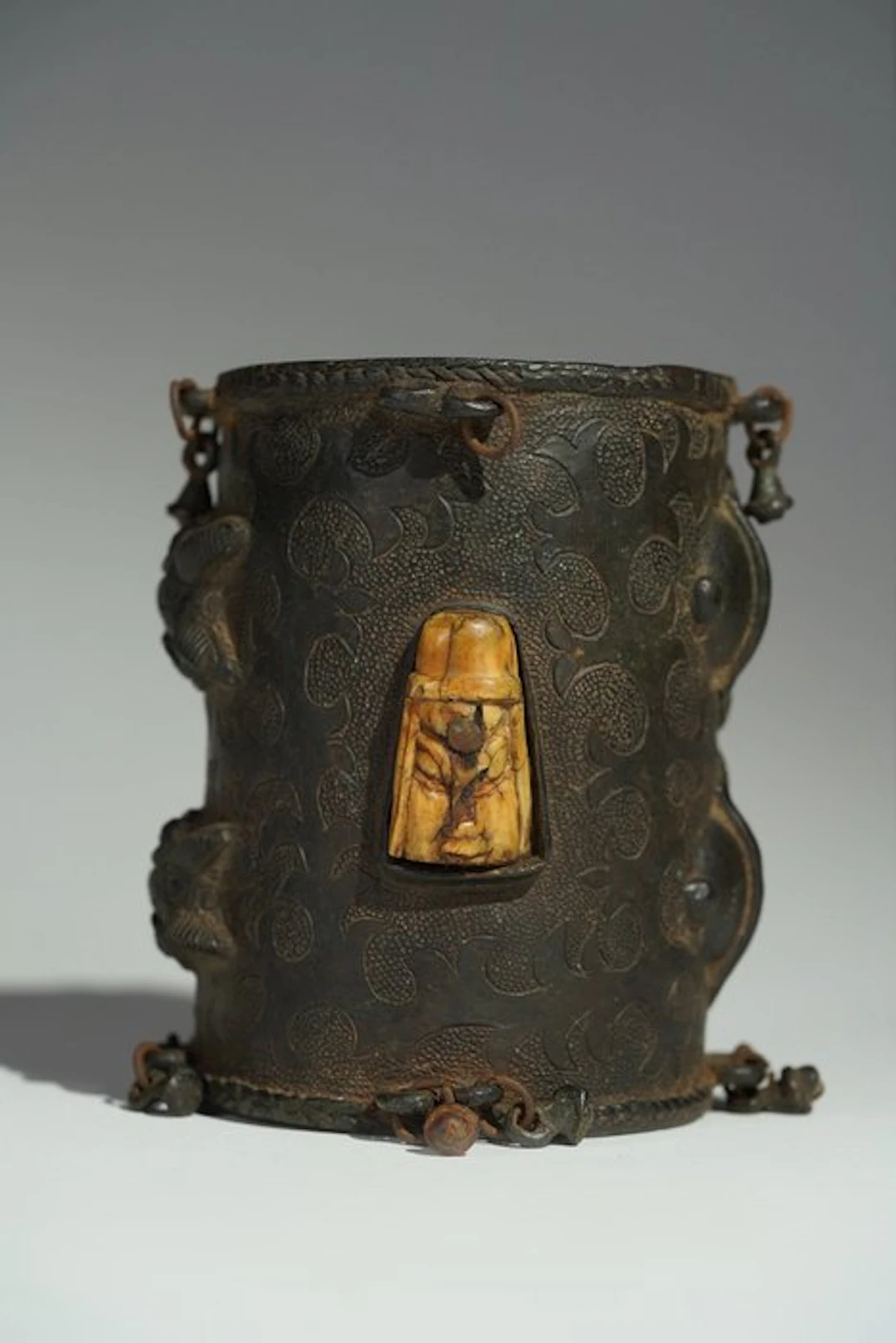
Bronze Bracelet from Benin – Monumental cylindrical bangle with relief faces, geometric ornamentation, and an inset mask element Origin: Benin City region, Edo State, Southern Nigeria Cultural Attribution: Kingdom of Benin, Edo culture Material: Copper alloy, traditionally described as bronze, with a dark brown patina, greenish oxidation marks, and a light-colored face inset, possibly made of ivory or bone Dating: Not certain Provenance: Benin City region, Nigeria, according to the provenance information Description This monumental, cylindrical bangle impresses with its unusual size, rich ornamentation, and the combination of diverse sculptural and material design elements. The wide metal body has nearly parallel sides and is framed at its top and bottom by strong, slightly projecting bands. These bands display a regularly structured, diagonal relief pattern reminiscent of braided or twisted cords. The outer surface is entirely covered with a complex system of spirally curled, crescent-shaped, and circular ornaments. Between the larger motifs are densely spaced, dot-like indentations that lend the metal a fine-grained, almost textile-like surface texture. The individual ornaments are separated by smooth contour lines and form a rhythmic pattern that continues across the entire visible surface of the cylinder. A rectangular to trapezoidal inset on the front is particularly striking. Within this opening is a small, light brown to honey-colored face, its material distinctly different from the dark metal body. The face has a high forehead, narrow, slightly downward-sloping eyes, a prominent nose, and sculpted lips. On the forehead is a round, dark element, possibly serving as a fastener or ornamental accent. The surface of the light inset exhibits fine cracks, darker discolorations, and irregular lines. Several sculpted, mask- or head-like reliefs are prominently displayed on the sides of the bracelet, their details only partially discernible due to the side view. Numerous metal loops and movable, ring-shaped pendants, some bearing small bell-shaped elements, adorn the upper and lower edges. The entire metal surface possesses a dark brown to blackish patina with greenish oxidation zones and, in places, reddish-brown discolorations. Art Historical Analysis The metalwork of the historical Kingdom of Benin is among the most significant courtly art traditions of the African continent. The kingdom developed in the area of present-day southern Nigeria and reached a remarkable political and cultural zenith, particularly from the 15th century onward. Benin City formed the center of a highly developed courtly society, where specialized artisans worked under the authority of the Oba, the King of Benin. Metal casters held a prominent position, their workshops producing complex objects from copper alloys. The lost-wax casting process enabled the production of highly detailed reliefs, three-dimensional figures, and elaborately ornamented objects. Besides the well-known commemorative heads, relief plaques, and figurative representations, Beninese metalwork also encompasses jewelry, ceremonial implements, and various forms of status and prestige objects. Bracelets and other metal ornaments could serve as symbols of wealth, social standing, and institutional affiliation within courtly society. The present work incorporates several design elements that can be associated with historical Beninese art. These include the dense ornamental articulation, the use of relief faces, and the meticulous finishing of the metal surface. The combination of a large-format cylindrical metal body with an inserted face, possibly made of organic material, is particularly unusual. Such a combination of different materials may indicate a specific representational intent. However, the photograph does not allow us to determine whether the object actually originates from a historical court workshop or represents a later work in the Beninese casting tradition. Even its original function as a wearable bracelet is not definitively established, given its exceptional width and numerous charms. Iconography and Symbolism The bracelet's iconographic design is characterized by the interplay of geometric ornaments, three-dimensional facial representations, and movable charms. The metal pendant is clearly identifiable. The spirally curled and crescent-shaped motifs create a complex ornamental structure, the rhythmic repetition of which emphasizes the object's cylindrical form. In Beninese art, geometric patterns, stylized natural forms, and figurative representations can be linked to notions of social order, royal dignity, and cultural identity. However, a concrete symbolic interpretation of the ornaments visible here is not possible without corresponding comparative objects. Particularly noteworthy is the small, frontally oriented face at the center of the composition. Its calm, concentrated physiognomy differs markedly from the dynamic ornamentation of the surrounding metal surface. If the light-colored material is indeed ivory, a connection to the special appreciation of this material within Beninese courtly culture would be conceivable. Ivory held paramount importance there and was used, among other things, for royal altar furnishings, jewelry, and representative objects. However, the material identification remains open. The mask-like reliefs projecting from the sides could also point to a deliberate repetition of anthropomorphic motifs. The small, bell-shaped pendants add a possible acoustic dimension to the visual design. Movement of the object could have produced sounds, making the piece of jewelry not only visible but also audible. Whether this feature had a ceremonial significance cannot be proven. Function and Courtly Context In the historical Kingdom of Benin, jewelry and metal prestige objects were important for displaying social standing and political authority. Certain types of bracelets, neck rings, and other ornaments could be worn within courtly settings or used as symbols of special relationships and obligations. Due to its monumental design and elaborate decoration, the present piece could have originated in such a prestigious context. However, its exceptional width leaves open the question of whether it was actually worn as an ordinary bracelet. Its use as a ceremonial upper arm ornament, as part of a special set of accessories, or as an independent prestige object is conceivable. The numerous loops and movable pendants may originally have served a decorative and possibly acoustic function. The central facial element was also likely of particular importance to the object's visual impact. Its setting within a specially designed opening suggests that the connection between the metal body and the inserted material was intended to be deliberately emphasized. Whether the face represents a specific historical figure, an ancestor, or a symbolic form is unknown. Therefore, a direct interpretation as a royal or religious emblem would not be justified without additional evidence. The visible traces of oxidation and the surface changes of the light-colored insert do not allow for a reliable determination of its age. Likewise, it remains unclear whether all the pendants and the central insert originally belonged to the same production phase. Art Historical Assessment The exceptional aesthetic quality of this monumental bangle lies in the extraordinary combination of architectural unity, ornamental diversity, and sculptural detail. The cylindrical metal body forms a powerful, clearly defined basic shape, the surface of which is enlivened by a dense system of curved lines, spiral motifs, and dotted structures. The regular end bands give the object a distinct formal boundary and reinforce its compact appearance. The contrast between the dark, almost solid metal surface and the light-colored face insert at the center is particularly striking. This material contrast immediately draws the eye to the small anthropomorphic figure, lending it a distinctive visual presence. The relief heads projecting from the sides extend the three-dimensional effect beyond the cylindrical base form. The movable metal pendants create a further contrast to the closed body structure, giving the object a subtle dynamism. The dark brown patina, with its greenish and reddish oxidation zones, emphasizes the depth of the reliefs and allows the ornamental details to stand out clearly. Within the broader art historical context of Beninese metalwork, and subject to its dating and cultural attribution, the work can be considered a remarkable example of a richly ornamented piece of jewelry or prestige object. Its particular in the complex interplay of diverse design techniques and materials. The work illustrates the close relationship between artistic refinement, figurative representation, and representational effect that is characteristic of Benin art. Literature Barbara Plankensteiner (ed.): Benin: Kings and Rituals. Court Arts from Nigeria. Ghent: Snoeck, 2007. Paula Ben-Amos: The Art of Benin. London: Thames & Hudson, 1980. Kathleen Bickford Berzock (ed.): Benin: Royal Arts of a West African Kingdom. Chicago: The Art Institute of Chicago, 2008. The publications mentioned above serve as a general art historical reference for the courtly metalwork of Benin. A reliable literature reference directly related to this specific type of bracelet with an inset facial element is currently unavailable. In particular, the precise material identification of the light-colored inset, its original function, and its chronological classification require further scholarly investigation. Copyright and Scientific Documentation Some of the information and photographs have been generated with the assistance of artificial intelligence and are based on published sources in ethnography, archaeology, and art history. Original texts and photographs may be protected by copyright. All rights held by the respective rights holders are reserved. Inv. No. MAZ32377 Sold without TL test. Catawiki's experts perform a virtual review based on the information, photographs, provenance and supporting documentation provided during the submission process. Acceptance of a traditional or ancient African art object for auction does not constitute independent authentication or certification by Catawiki, nor does it mean that Catawiki's expert has physically or scientifically authenticated, patina-analyzed, or dated the object. Under our Terms and Traditional African Art Submission Guidelines, the seller remains responsible for the accuracy, legality, provenance and authenticity of the object and the information provided.
估價:$392.08
前往拍賣頁查看所有物品來自Catawiki或Ethnographic
估價:
$392.08
類似物品


類似物品的拍賣結果
讓您的拍賣觸及全球收藏家!
立刻發佈上架