
全部拍賣 / Coins & Banknotes / 1895 Morgan Silver Dollar. JD-3. Rarity-4. Proof-67 Deep Cameo (PCGS).

1895 Morgan Silver Dollar. JD-3. Rarity-4. Proof-67 Deep Cameo (PCGS).
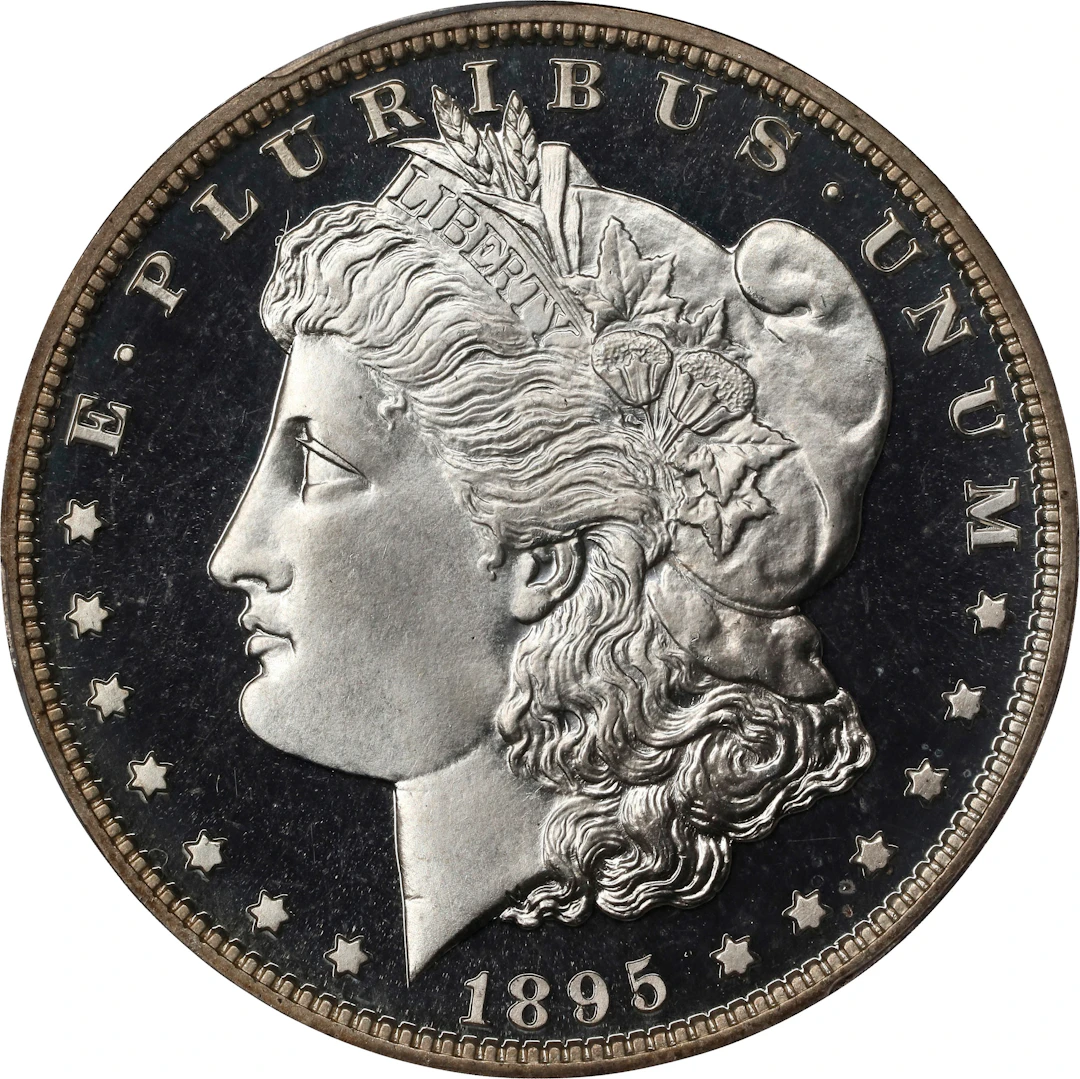
Exquisite Superb Deep Cameo Proof 1895 Silver Dollar The "King of the Morgan Dollars" 1895 Morgan Silver Dollar. JD-3. Rarity-4. Proof-67 Deep Cameo (PCGS). This extremely beautiful 1895 Morgan dollar should be seen to be fully appreciated. The obverse is untoned and presents sharp contrast between satiny devices and deeply mirrored fields. Deep Cameo contrast is also noted for the reverse, where there is also delicate pale silver and gold iridescent toning toward the left border. The detail is razor sharp throughout, smooth and the virtually pristine surfaces will please even the most discerning Morgan dollar enthusiast. The alleged sole Proof-only issue in the popular Morgan silver dollar series, the Philadelphia Mint 1895 has long enjoyed legendary status. Early generations of collectors were puzzled by an entry in Mint records that showed a circulation strike delivery of 12,000 coins for this year, and many theories arose to explain why the only 1895-dated examples found were believed to be survivors of the year's 880-piece Proof issue. Some said the circulation strikes were never made at all and the 12,000-piece figure represented a bookkeeping error. Others suggest that the 12,000-coin mintage reported for 1895 represents an adjustment to the Mint's ledgers to account for a final delivery of 1894-dated silver dollars. Modern numismatic scholarship has not only challenged these traditional theories, but overturned them, in the process going a long way toward finally solving the mystery of the 1895 Philadelphia Mint Morgan dollar issue. In an article titled "King of Morgan Dollars Revisited" (2006, 2018), Roger W. Burdette provides conclusive evidence from available government documents that, indeed, the Philadelphia Mint did produce 12,000 circulation strike Morgan dollars from 1895-dated dies. This conclusion is picked up and expanded upon by John W. Dannreuther in the 2025 volume in his United States Proof Coins reference series: The explanation lies in the retirement of Chief Coiner William S. Steele on May 31 and his planchets-on-hand problem. All 1894 proof and working dies were destroyed per the 1873 coinage act (and subsequent "Section 3550 Revised Statutes") at the beginning of 1895 (on January 2, 1895 per the Mint die use and destruction document). When the order was issued that no circulation strikes were to be struck in Philadelphia, the coiner had a problem. Coiner Steele still had 13,000 unstruck dollar planchets on hand. To balance his books before he left his position, proof dies were prepared and the coins were struck with proof dies - there were no working dies... - thus, proof-only dies struck the on-hand planchets. One can assume he did not disobey the order not to strike circulation strike dollars, as these were technically "Proofs." Only 12,000 coins were of deliverable quality of the 13,000 presumedly struck and they went through the normal channels prescribed by the 1873 coinage act. Indeed, six of the circulation strikes were provided to the Assay Commission (along with four of the Proof 1895 dollars). Since there are upward of 300 circulated 1895 Philadelphia Mint Morgan dollars extant, and neither the Mint nor contemporary collectors would have deliberately disposed of that many Proofs by placing them into circulation, it is likely that somewhere between half a bag and two full 1,000-coin bags of circulation strike 1895 Philadelphia Mint dollars were released into commerce through normal channels. The balance of the 12,000-piece circulation strike mintage is presumed to have been destroyed as part of the 270,232,722 silver dollars melted under provision of the Pittman Silver Purchase Act of 1918. Dannreuther also takes up the challenge as to what to call these circulation strike 1895 Morgan dollars struck from Proof dies - a situation that he believes is unique in American numismatics. Since the 25 trade dollars struck in 1874 from polished working dies (JD-2, No Period) have been classified as "Semi-Proofs" by Dannreuther, and certified as Specimens by PCGS, the author whimsically proposes the term "semi-circulation strikes" for the circulation strike 1895 silver dollars struck from Proof dies. Of the four die marriages confirmed for the 1895 Morgan dollar, JD-1 and JD-2 account for the vast majority of survivors. They are believed to have struck the 790 Proofs delivered for distribution in the year's Proof sets, as well as most of the "semi-circulation strikes" that were released into commercial channels and account for the majority of circulated survivors. JD-3 (as here) and JD-4 are significantly scarcer and, according to Dannreuther, "may constitute the 90 coins delivered in September with the 790 Proofs for sets mostly comprised of the first two varieties [JD-1 and JD-2]." Provenance: Property from an Alabama Family. Earlier from our sale of the Blue Moon Collection, Part I, March 2017 Baltimore Auction, lot 2617. PCGS Population: 6; 3 finer in this category (Proof-68 Deep Cameo finest). PCGS# 97330. NGC ID: 27ZR. Click here for certification details from PCGS. Image with the PCGS TrueView logo is obtained from and is subject to a license agreement with Collectors Universe, Inc. and its divisions PCGS and PSA.
估價:$1
前往拍賣頁查看所有物品來自Stack's Bowers或Coins & Banknotes
估價:
$1
類似物品




類似物品的拍賣結果
讓您的拍賣觸及全球收藏家!
立刻發佈上架