
全部拍賣 / Coins & Banknotes / 1861-S Liberty Head Double Eagle. A.C. Paquet Reverse. AU-53 (PCGS).

1861-S Liberty Head Double Eagle. A.C. Paquet Reverse. AU-53 (PCGS).
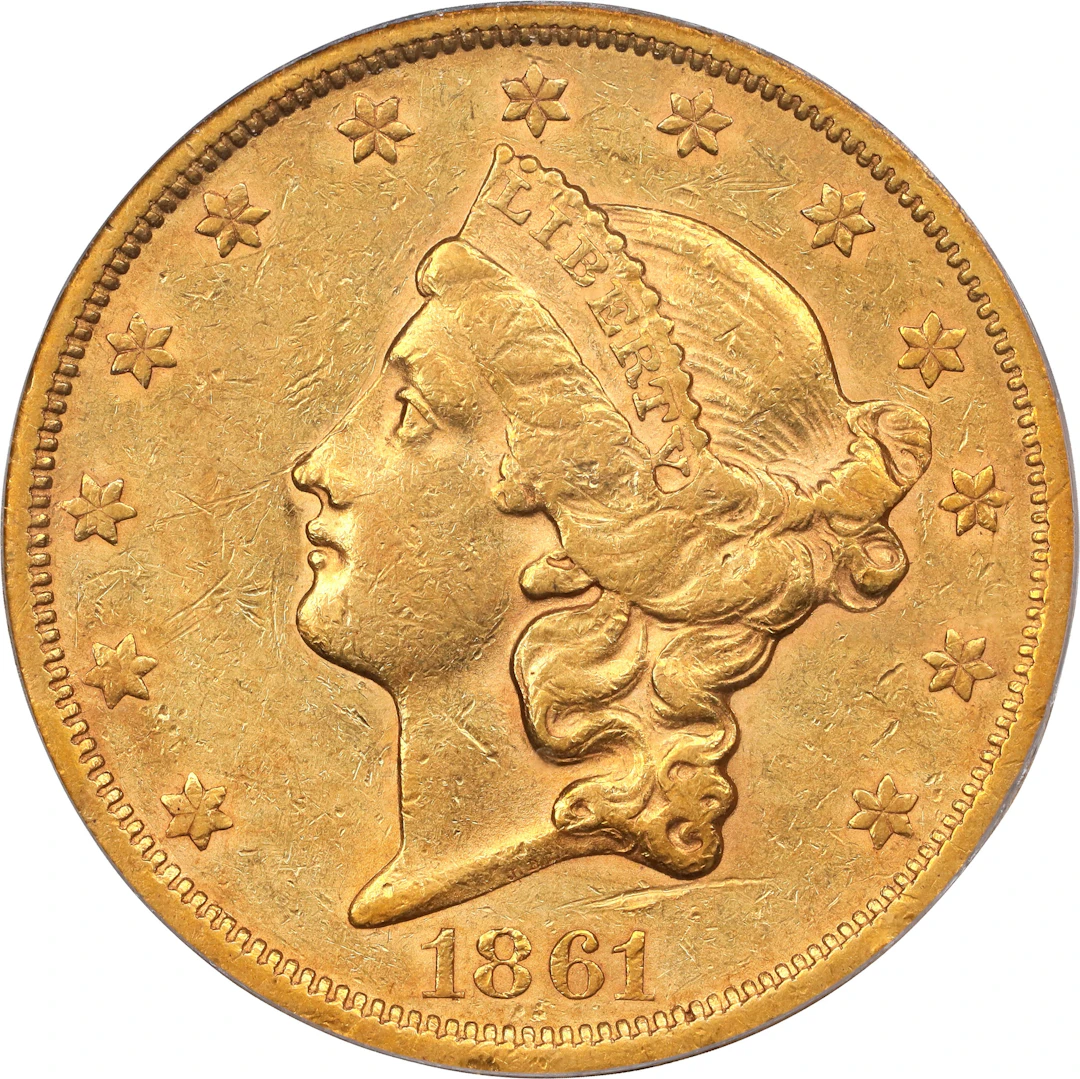
Legendary 1861-S Paquet Reverse Double Eagle Rarity 1861-S Liberty Head Double Eagle. A.C. Paquet Reverse. AU-53 (PCGS). A noteworthy offering for this fabled rarity, this 1861-S Paquet Reverse double eagle stands tall among the gold highlights in our current sale. Awash in rich honey-color, the surfaces also sport an extensive intermingling of deep olive patina. Remnants of a frosty mint finish flash into view as the coin rotates under a light. There is some glossiness to the texture, as well as faint hairlines and scattered marks, but a thin gaze in the obverse field off Liberty's nose is the only singularly mentionable blemish. Boldly defined through the centers. Believed to be the son of bronze-worker Toussaint Francois Paquet, Anthony C. Paquet was born in Hamburg, Germany on December 5, 1814, and arrived in Philadelphia in 1848. At some point in the mid-1850s, Paquet opened an engraving business in New York, during which time he is believed to have struck several medals, apparently all unsigned, except for THE ROCKY MOUNTAINS ECHO BACK FREMONT campaign medal. In early 1857, Paquet took up contract work for the Philadelphia Mint before finally being hired on as an assistant engraver. Among his projects at the Mint were mostly pattern coins, once again unsigned, including a fascinating copper double eagle pattern, Judd-257. By far his most well known work is that of the United States military's highest decoration for valor, the Medal of Honor instituted by President Abraham Lincoln on July 12, 1861, the pattern for which bears Paquet's script signature on the obverse. He is also thought to have prepared a set of letter punches that were used on several patterns, but also are believed to have been planned for use on regular circulation dimes, quarters, and half dollars, though this never came to fruition. To this day, the reverse dies he prepared for the 1861 double eagles remain the only coin designs that have been positively attributed to Paquet, who left the Mint in 1864 and returned to private business, though he continued to take on government work periodically. Anthony Paquet died in Philadelphia in 1882. One of the defining features of Paquet's double eagle reverse is the tall and thin logotype style he preferred as compared to the rather squat font employed by Chief Engraver James Barton Longacre. The most readily apparent diagnostic between the Paquet reverse and the regular Longacre reverse may be found with the letter O in OF. The Paquet logotype has an extremely thin space between the uprights on the letter, while Longacre's is significantly wider and much more of a circle. Another defining indicator is how the central halo of stars above the eagle interacts with the rays; they are separate on the Paquet reverse but are nestled in with the rays on the Longacre reverse dies. Paquet prepared four sets of dies using his distinctive lettering for use at the Philadelphia Mint, as well as the branch mints at New Orleans and San Francisco. In early December the dies were shipped to San Francisco, and to New Orleans a few days later, along with a note instructing the coiner that they "will require the modification of the milling to suit the border." On January 5, 1861, production with the new reverse dies began at the Philadelphia Mint and was almost immediately halted after concerns were raised that the narrow rim of the reverse design would lead to poor wearing characteristics. Mint Director James Ross Snowden sent directives to New Orleans and San Francisco to cease use of the new dies and return to using the original Longacre dies. New Orleans received this message with ample time for the branch mint's officials to withdraw the new dies from service and no 1861-O double eagles were struck with the Paquet reverse. The story was different with the directive sent to San Francisco. Messages sent to the West Coast required using telegraph and overland express and took a very long time to reach their intended destination. Snowden's directive did not reach the San Francisco Mint until early February, and only after 19,250 double eagles with Paquet's reverse were struck and subsequently issued before the cease order could be implemented. Only two confirmed examples of the Philadelphia Mint Paquet Reverse double eagle are known, making it one of the greatest American numismatic rarities. The 1861-S Paquet Reverse exists in somewhat larger numbers, although with estimates ranging from as few as 100 coins to nearly 275 surviving examples it is still one of the rarest and most coveted issues in the Liberty Head double eagle series. As with much of the early products of the San Francisco Mint, most examples of this issue that were released into commerce stayed there and saw heavy use. The typical survivor is well worn, if not also impaired, and to this day, only a few problem free Mint States example have been confirmed by PCGS and NGC. As an attractive PCGS-certified AU, the coin offered here would serve as a highlight in any advanced double eagle set. PCGS# 8936. NGC ID: 269L. Click here for certification details from PCGS.
估價:$1
前往拍賣頁查看所有物品來自Stack's Bowers或Coins & Banknotes
估價:
$1
類似物品




類似物品的拍賣結果

讓您的拍賣觸及全球收藏家!
立刻發佈上架